News
Research: IBM Joins Cloud Giants as Leaders in AI AppDev Platforms
IBM once again joins Amazon Web Services (AWS), Google and Microsoft in the Leaders quadrant of Gartner's Magic Quadrant for AI Application Development Platforms, reinforcing the continued dominance of these vendors in enterprise cloud-based AI development.
The report evaluates platforms that provide software engineering teams with the tools and workflows needed to design, build, test, deploy and govern AI-embedded applications, including AI assistants, AI agents and multimodal applications. Gartner positions these platforms as a response to mounting pressure on IT and development teams to integrate AI into products without requiring deep machine learning expertise.
Leaders: Big 3 Plus IBM
In the Leaders quadrant, Gartner placed AWS, Google, IBM and Microsoft. The three hyperscalers have long defined this space, with IBM maintaining a consistent leadership position alongside them, though usually ranking lower on the two axes of the report, "Ability to Execute" and "Completeness of Vision."
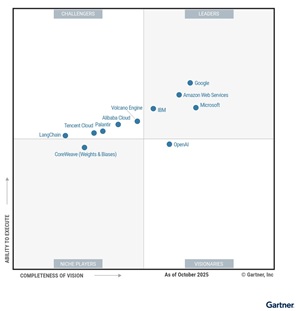 [Click on image for larger view.] 2025 Magic Quadrant for AI Application Development Platforms (source: Gartner).
As in most MQ reports, things haven't changed much since last year's report.
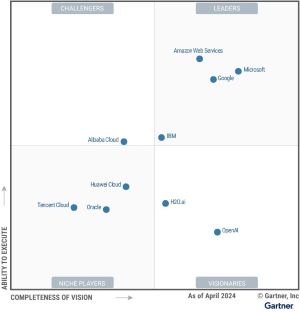 [Click on image for larger view.] 2024 Magic Quadrant for Cloud AI Developer Services (source: Gartner).
AWS was recognized as a Leader with its Amazon Bedrock platform, which provides managed access to foundation models and tooling for building and deploying AI applications and agents. Gartner highlighted AWS' global customer base and ongoing investment in features such as guardrails and automated reasoning checks designed to help reduce hallucinations and improve output reliability.
Google earned a Leader position with Vertex AI, its unified AI development platform that spans model development, agent building and governance. Gartner pointed to Google's work on agent interoperability, including the Agent2Agent protocol, and its support for hybrid, on-premises and edge deployments as differentiators for enterprises with data sovereignty and regulatory requirements.
Microsoft was again named a Leader with Azure AI Foundry, its platform-as-a-service offering for enterprise AI application development. Gartner cited Microsoft's focus on agent orchestration, multimodal development and developer experience, including expanded model catalogs and tooling integrations aimed at large-scale cloud deployments.
IBM's repeat inclusion among the Leaders reflects Gartner's assessment of its watsonx portfolio, which combines model development, data management, governance and agent orchestration. The report highlighted IBM's emphasis on openness, including open-weight models and support for open-source agent frameworks, as well as its traction in regulated industries such as financial services and the public sector.
Market Overview and Key Trends
Gartner characterized the AI application development platform market as one of the fastest-growing segments in enterprise software, estimating the market exceeded $5.2 billion in 2025 with annual growth above 30 percent. The firm tied that growth to rising demand from software engineering and IT teams tasked with embedding AI capabilities directly into production applications.
Key highlights include:
- The introduction of Model Context Protocol and Agent2Agent Protocol standards
- Increased focus on managing the AI agent life cycle
- New regulations such as the EU AI Act and California's SB 53
- The rise of agent experience (AX)
- Enhanced fine-tuning and grounding techniques beyond retrieval-augmented generation
- The rise of open-weights and open-source offerings
- The heightened need for application security
Here's a summary of the research firm's analysis of the trends and general market direction:
Enterprises are moving away from fragmented, single-purpose AI tools toward consolidated platforms that support the full life cycle of AI-embedded applications, from design and development through deployment, governance and ongoing operations. These platforms are increasingly expected to reduce tooling complexity while enabling consistent governance, security and compliance across teams.
The report highlighted several market shifts that accelerated over the past year. One is the growing focus on AI agents, including platforms that support agent planning, orchestration, evaluation and lifecycle management. Gartner noted that vendors are expanding beyond basic retrieval-augmented generation to provide deeper grounding techniques, improved short- and long-term memory for agents, and richer observability into agent reasoning and behavior.
Standardization efforts are also reshaping the market. Gartner pointed to the emergence of protocols such as Model Context Protocol and Agent2Agent Protocol, which are designed to enable interoperability between agents, platforms and external tools. These efforts aim to reduce vendor lock-in and support more complex, distributed agent workflows across enterprise environments.
Regulatory pressure is another key driver. Gartner cited new regulations, including the EU AI Act and state-level initiatives in the United States, as factors pushing enterprises to prioritize platforms with strong data residency options, governance controls and responsible AI guardrails. As a result, vendors are investing more heavily in auditing, monitoring and compliance features built directly into their platforms.
Gartner also noted a shift in how organizations customize and ground models. While retrieval-augmented generation remains common, the firm reported that fine-tuning has become the most widely used grounding approach, selected by 80 percent of respondents in the 2025 Gartner AI in Software Engineering Survey, compared to 45 percent for RAG. This trend is influencing platform roadmaps, particularly around model management, evaluation and cost control.
Looking ahead, Gartner expects continued investment in features that reduce operational complexity and improve security, along with growing support for edge deployments and device-level AI. The firm also anticipates that agent-centric interaction models will increasingly influence application design, reshaping how front-end and user experience technologies evolve in cloud-based enterprise environments.
About the Author
David Ramel is an editor and writer at Converge 360.