News
AI Firms Push Cloud Giants from 'Leaders' Quadrant in Gartner AI Coding Report
As is every other tech-oriented company in existence, Gartner is adjusting to the agentic AI era.
The firm's first Magic Quadrant for Enterprise AI Coding Agents shows AI-focused vendors leading a newly defined market for agentic software engineering, while major cloud providers that ranked as Leaders in earlier, adjacent AI code assistant reports are now positioned as Challengers.
The 2026 Magic Quadrant for Enterprise AI Coding Agents, published May 20, names Anthropic, Cursor, GitHub and OpenAI as Leaders. AWS, Google, Alibaba Cloud and Cognition are listed as Challengers. Tabnine is the only Visionary. Atlassian, BytePlus and JetBrains are listed as Niche Players.
Gartner's prior reports were titled Magic Quadrant for AI Code Assistants, while the 2026 report introduces the Enterprise AI Coding Agents category. At least one consistent "Leader," though, is positioning this as the third in a series. Even with a slightly different name and focus, the comparison is notable for cloud-focused buyers: AWS, GitHub, GitLab and Google Cloud were identified as Leaders in public materials around Gartner's 2024 AI code assistant report, and AWS, Cognition/Windsurf, GitHub and GitLab were among vendors publicly identifying Leader status in the 2025 AI code assistant report.
In the new Gartner agentic coding category, however, the Leaders quadrant is led largely by AI-first companies. GitHub remains in the Leaders group, while AWS and Google move into the Challengers quadrant. Microsoft, the third widely recognized cloud giant with its Azure offering, owns consistent leader GitHub.
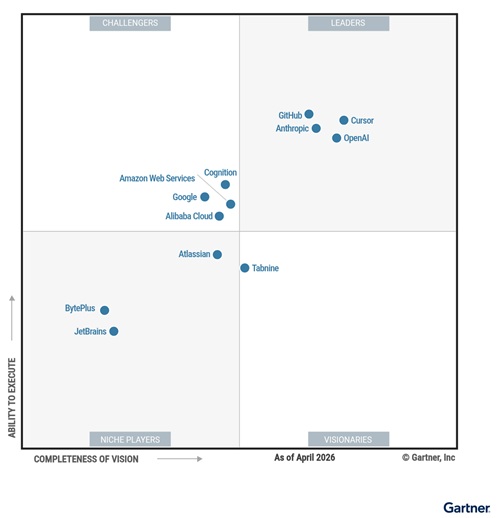 [Click on image for larger view.] 2026 Magic Quadrant for Enterprise AI Coding Agents (source: Gartner).
Here's how the leaders stacked up in previous years:
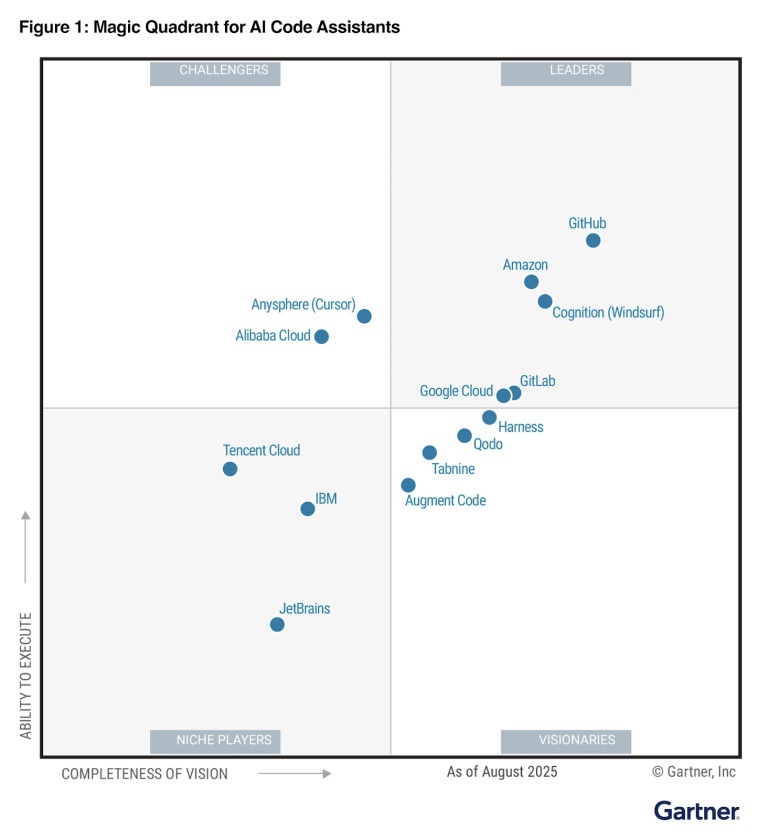 [Click on image for larger view.] 2025 Magic Quadrant for AI Code Assistants (source: Gartner).
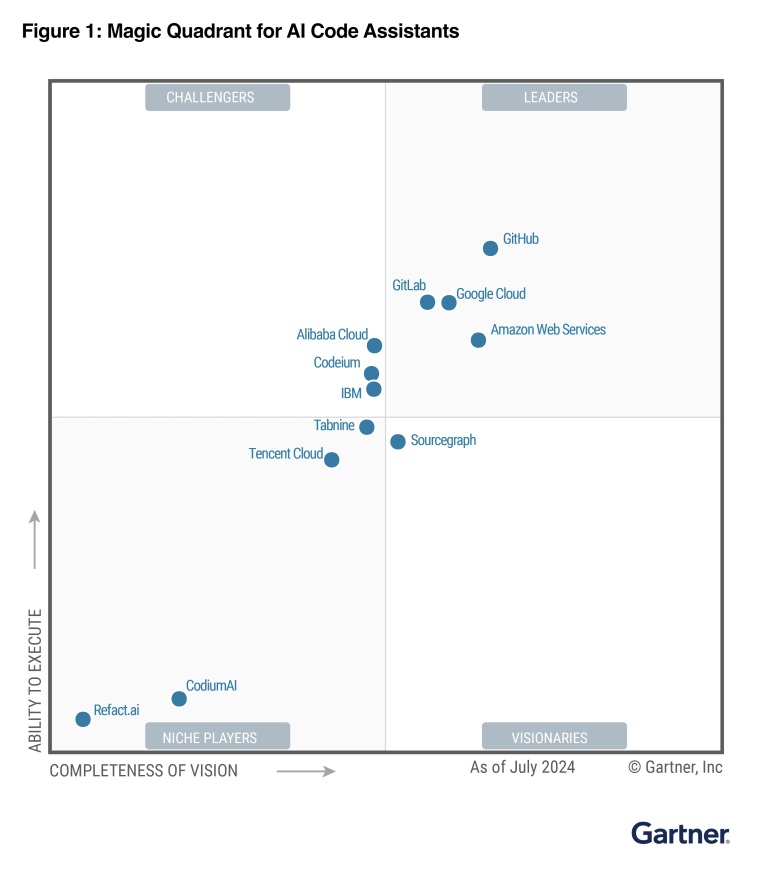 [Click on image for larger view.] 2024 Magic Quadrant for AI Code Assistants (source: Gartner).
A New Category, Not Just a New Chart
Gartner's changed Leaders lineup comes with a changed market definition. The firm defines enterprise AI coding agents as "autonomous or semiautonomous software engineering solutions that perceive context, translate human intent into multistep plans, and execute and verify those steps across code, tests and related engineering artifacts."
That is a higher bar than AI code assistance. Gartner says AI code assistants primarily suggest code, complete snippets and answer questions in chat interfaces. Enterprise AI coding agents, by contrast, allow teams to "delegate and offload a greater portion of development work through dynamic task planning and tool use."
The report describes the new category around "agentic coding," which Gartner defines as an approach that moves "beyond interactive suggestions toward multistep planning, execution and verification." That shift helps explain why cloud infrastructure scale and broad developer platform reach are no longer enough to define leadership in the new category. Gartner's evaluation emphasizes autonomous task execution, context awareness, verification, tool integration and governed operation across enterprise software engineering workflows.
Why AI Specialists Moved Up
Gartner directly addresses one market dynamic behind the rise of AI-first vendors: "Model providers move up the stack."
The report says frontier model providers that previously supplied underlying AI infrastructure to coding assistants and agent platforms are now launching full-featured coding agents that compete directly with application-layer products built on their application programming interfaces.
Gartner describes this as a "structural fork" in the market. Vertically integrated vendors argue that co-optimizing the model and agent harness can provide tighter feedback loops, faster performance gains and deeper task automation. Model-agnostic platforms argue that long-term differentiation will come from workflow design, enterprise integration, context management and flexible model choice.
The report says that distinction is already blurring as some application-layer vendors invest in proprietary models to improve cost, speed and strategic control. Gartner frames the unresolved question this way: if frontier model performance continues to advance faster than orchestration techniques, vertically integrated offerings may compound their advantage; if coding-specialized or distilled models become "good enough" at lower cost, value may shift higher into workflow orchestration, tooling integration and developer experience.
From Assistance to Orchestration
Gartner says enterprise AI coding agents are no longer defined mainly by their ability to respond to single prompts or generate inline code suggestions. The market is shifting toward systems that can plan tasks, delegate work and execute multiple activities concurrently.
The report says leading products now emphasize orchestration features that let developers break work into parallel streams, supervise background execution and choose different agents or models based on task requirements. Gartner says the user experience challenge has shifted from prompt formulation to "managing concurrency, visibility and control."
That change also reduces the centrality of the integrated development environment (IDE). Gartner predicts that by 2027, more than 65 percent of engineering teams using agentic coding will treat IDEs as optional, shifting control, governance and validation to automated platforms.
Gartner also says many platforms now support transitions between local development sessions and background or cloud-based agents, allowing work to continue asynchronously and scale beyond the limits of a single developer machine. The report describes this as a move "from assistance toward orchestration."
The Plan-Act-Verify Loop
The report centers the category on a plan-act-verify loop. Enterprise AI coding agents can take high-level instructions, generate plans, modify code, run builds or tests, debug failures, refactor output and iterate until defined success criteria are met.
Gartner says these agents can help automate greenfield coding, multifile changes, refactoring, modernization, test generation and remediation, dependency updates, and issue resolution. Their primary output is version-controlled source code and related engineering artifacts, such as tests, configuration and documentation, rather than deployed or running applications.
The report says enterprise AI coding agents connect with repositories, continuous integration/continuous delivery (CI/CD) systems, agile planning tools, artifact stores, command-line consoles, IDEs, cloud platforms and third-party tools, including security and quality systems. That wider integration expands context awareness beyond the editor and lets agents maintain task continuity across an organization's development environment.
MCP Becomes a Required Capability
Gartner's mandatory feature list shows how enterprise expectations for coding agents have expanded. Required capabilities include autonomous task execution, iterative verification and self-correction, extensible tool and environment integration, advanced context awareness, human oversight, traceability, auditability, usage analytics, and enterprise controls and data protection.
The report also lists native Model Context Protocol (MCP) support as a mandatory feature. Gartner says MCP provides "a standardized way for the agent to access tools, perform actions and retrieve project context in a consistent and governed manner."
Other required controls reflect the enterprise risk profile of autonomous coding. Gartner says these systems need built-in mechanisms for human review and approval of agent-produced changes, detailed logs and traceability of agent actions, and controls for user access, organizational configuration, codebase indexing and data protection. The report also requires a guarantee that base models will not be trained on customer code or documentation except for explicitly approved fine-tuning or customization.
What Comes Next: Multiagent Workflows, Subagents and Event Triggers
Gartner's optional feature list points to the next stage of the market. It includes multiagent orchestration, event-triggered workflows, custom subagents, reusable workflow instructions, unified context orchestration, extensible plugin ecosystems, plan-first markdown workflows, documentation generation, modernization agents, AI-assisted code review, cost management and deployment flexibility.
Event-triggered workflows are one example. Gartner describes agents activated by build failures, test regressions, repository changes, ticket updates or production telemetry, with policy controls for scope and frequency.
Custom subagents are another emerging area. Gartner describes them as specialized agents that operate with their own context, instructions and tool permissions, allowing a primary agent to delegate focused tasks for improved reliability and workflow organization.
Reusable workflow instructions also appear in the report as an optional capability. Gartner describes these as specialized, modular instruction sets, such as skills-based markdown files, that define repeatable workflows so agents can follow domain-specific practices without repeated manual prompting.
Productivity Forecasts Come with a Cost Warning
Gartner's adoption and productivity forecasts are aggressive. By 2028, the firm predicts that more than 70 percent of enterprise software engineers will rely on AI coding agents for both synchronous and asynchronous development tasks.
Gartner also predicts that by 2028, asynchronous AI coding agent workflows will improve software engineering team productivity by 30 percent to 50 percent. That compares with 0 percent to 20 percent gains from AI code assistants in 2025.
The cost outlook is more complicated. Gartner predicts that by 2028, AI coding costs will overtake the average developer's salary because of rising large language model (LLM) token consumption and increased consumption-based licensing costs.
The report says adoption at scale shifts cost drivers from interactive suggestions to longer-horizon execution with more retrieval, validation and model calls. It also says pricing is shifting from per-seat subscriptions toward consumption or hybrid models tied to measurable agent activity, such as task executions, premium requests, metered compute and token usage.
For enterprise buyers, Gartner frames return on investment (ROI) less as a question of whether AI coding agents deliver value and more as a question of what that value costs. The report says organizations need cost governance, workload throttling and usage controls aligned with enterprise engineering practices.
A Market Approaching $11 Billion
Gartner estimates the global enterprise AI coding agent market at roughly $9.8 billion to $11.0 billion annualized as of April 2026. The estimate includes AI coding assistants, AI-native IDEs, terminal-based coding agents and related agentic coding products sold into enterprise software engineering workflows.
The report says growth has accelerated since mid-2025 as enterprise adoption broadened, vendors expanded from seat-based subscriptions toward hybrid seat-plus-consumption pricing and agentic workflows increased realized spend per paying developer.
Gartner identifies four key trends shaping the 2026 market: model providers moving up the stack, agentic workflows redefining how development work is executed, AI coding agents expanding across the software development life cycle (SDLC), and rising productivity gains colliding with evolving pricing models.
Agents Expand Across the SDLC
Gartner says core code generation has matured enough that vendors are now targeting adjacent development bottlenecks across the SDLC. Code review is one early focus area, with AI-driven review agents positioned to identify defects, enforce standards and propose improvements before or alongside human review.
The report says vendors are also extending agent capabilities into testing, validation, automated environment setup, and user interface or visual testing. Gartner says few offerings claim complete end-to-end SDLC coverage today, but AI coding agents are evolving into broader software delivery platforms that seek to unify fragmented workflows and reduce handoffs between tools.
That expansion has implications for cloud and DevOps platforms. Gartner says vendors that extend beyond code generation can increase switching costs, deepen enterprise relationships and capture a larger share of development spend. At the same time, that puts agent vendors into more direct competition with established SDLC tools, accelerating consolidation pressures and blurring traditional category boundaries.
Governance, Not Code Volume, Becomes the Test
Gartner cautions that selecting an enterprise AI coding agent should be treated as an operating model decision, not a simple developer tooling purchase.
The report says AI code assistants and AI coding agents represent different operating models. Code assistants augment developers within existing SDLC practices and governance structures. Coding agents execute multistep workflows with reduced human oversight, which Gartner says can amplify both strengths and weaknesses in architecture, testing and governance.
Gartner says organizations should evaluate enterprise AI coding agents only where they can consistently supply high-quality context, enforce zero-trust controls at generation, commit and CI/CD stages, and automatically validate outputs at scale. Without those prerequisites, the report says agentic tools can increase rework, security risk and architectural drift rather than improve productivity.
The report also warns against relying on narrow productivity metrics such as lines of code produced, acceptance rates or task-level measures alone. Gartner says organizations should measure productivity with a clear link to team-level outcomes such as delivery flow, software quality, developer experience and business value.
Roles and Teams Will Have to Change
Gartner says adoption of enterprise AI coding agents is breaking traditional software engineering role boundaries and delivery assumptions.
The report says agents automate routine tasks, but those speed gains can be offset by legacy roles, approval paths and human-only coordination models. Gartner says organizations need to redesign roles and team structures so accountability shifts from task execution to outcome ownership.
It also says engineers will increasingly need blended engineering and product capabilities to manage agent-driven work. Without that alignment, Gartner says people, processes and governance become the main bottlenecks constraining the value of AI coding agents.
For cloud-focused enterprises, the report points to a changed center of gravity. Cloud vendors still bring infrastructure scale, operations, support models and platform ecosystems to the enterprise market. But Gartner's first Enterprise AI Coding Agents Magic Quadrant suggests the leading edge has shifted toward AI-native workflow design, frontier-model integration, asynchronous execution, context orchestration and governed autonomy.
The result is not that cloud providers are out of the enterprise AI coding market. It is that cloud infrastructure and developer platform reach are no longer enough to define leadership in this segment. Gartner's 2026 report frames the next phase around who can turn AI coding from assistance into reliable, governed and cost-controlled software engineering execution.
While Gartner typically charges for access to its research reports, the Magic Quadrant reports are often available in licensed-for-distribution formats from vendors mentioned. A simple web search will find them.
About the Author
David Ramel is an editor and writer at Converge 360.