News
Enterprise Content Emerges as Agentic AI Bottleneck, Report Says
AI agents may have entered the enterprise mainstream, but the content infrastructure supporting them apparently has not kept pace, indicates a new survey-based report from Box, a cloud-based content management company.
While 83% of organizations surveyed by Box said they are running AI agents, only 36% of those using or experimenting with agents have connected them to trusted internal content across many use cases. Nearly half have experienced an AI-related data exposure incident, while just 34% have formal standards governing how agents access company data.
The findings point to an emerging shift in the enterprise AI challenge. Access to increasingly capable models is no longer the primary constraint. Instead, organizations must organize their institutional knowledge and build the integration, identity, permissions and governance infrastructure that lets agents securely use it.
That is the central theme of the 2026 State of AI in the Enterprise report commissioned The Harris Poll to survey 1,640 IT decision-makers in the United States, United Kingdom, France and Japan from April 30 through May 8.
Models Give Way to Context
In the report's chapter on enterprise context, 96% of organizations said it was important or very important for agents to access company-specific content and knowledge. The gap between recognizing that requirement and meeting it was especially pronounced among less-mature organizations.
TL;DR: Agents are only as good as the content they can reach. 96% of organizations know it; 36% have wired it up. The 2026 bottleneck isn't model capability. Instead, it's making enterprise knowledge accessible, usable, and trustworthy for the agents that depend on it.
Some 42% of organizations describing themselves as being on the leading edge had connected agents to trusted internal content across many use cases, compared with 17% of early-stage organizations.
"If the first phase of enterprise AI was defined by access to models, the next is defined by access to context," the report said.
Box characterized documents, contracts, reports and other unstructured content as evolving from passive repositories into working environments where agents can read information, write results, preserve context and collaborate with people or other agents.
That transition requires more than making documents searchable. Enterprise agents need to operate under the permissions, governance and auditing controls that already protect the organization's information, the report said.
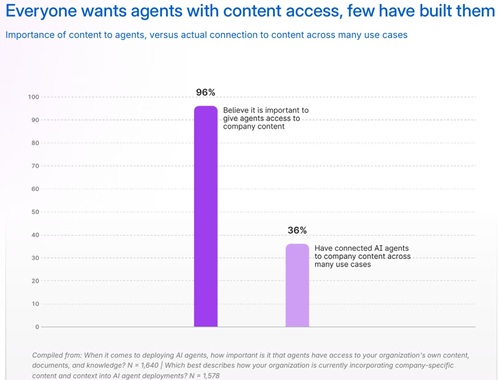 [Click on image for larger view.] Everyone Wants Agents with Content Access, Few Have Built Them (source: Box).
The Problem Is in the Plumbing
Security and privacy concerns were the most commonly cited barrier to connecting agents with organizational content, selected by 38% of respondents. Regulatory and compliance concerns followed at 29%.
Below those headline risks, however, were numerous infrastructure and data-management problems. Respondents cited data fragmented across systems at 25%, difficulty integrating AI into existing systems at 24%, missing permissions or access controls at 21%, poorly organized or classified content at 18%, and poor or outdated content quality at 16%.
Legacy technology further complicates that work. More than two-thirds of respondents said legacy or on-premises systems remain a moderate or major barrier to effective agent deployment, according to Box.
Those results give cloud modernization another role in enterprise AI initiatives. Moving information from isolated systems is not sufficient by itself, but cloud-based storage, content services, application programming interfaces (APIs), identity systems and centralized policy enforcement can make corporate knowledge easier for agents to reach and govern.
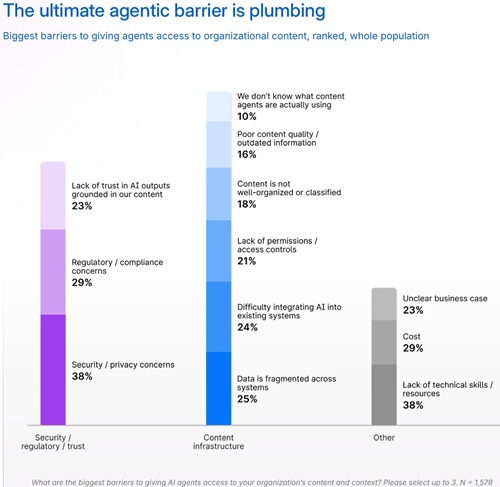 [Click on image for larger view.] The Ultimate Agentic Barrier Is Plumbing (source: Box).
Governance Trails Deployment
Connecting agents to more content also increases the potential impact of weak permissions and limited visibility. Box reported that 49% of organizations had experienced an incident in which an AI tool surfaced content that a user should not have been able to access. Some 16% described their incident as significant.
TL;DR: Agent Governance is not the brake on distributed AI. Done right, it is what makes scaling it survivable. Almost everyone believes better governance would help them move faster over time. Far fewer have built governance models fit for agents.
The most mature organizations actually reported more exposure incidents, with a rate of 60%, compared with 46% among early-stage respondents. Box attributed the counterintuitive result to leaders operating more agents across a larger attack surface while also having better visibility into incidents that less-mature organizations might not detect.
Only 39% of all respondents reported comprehensive visibility across sanctioned and unsanctioned AI use. At the early stage, that figure fell to 17%, while 28% said they either were unaware of any incident or had never audited for one.
The governance chapter also found that 76% believe current governance requirements are slowing their ability to deploy agentic AI. Yet 93% agreed that better governance would help them move faster over time.
Box framed that apparent contradiction as the difference between controls inherited from human workflows and governance designed specifically for autonomous software. Agent-oriented controls include granular permissions, visibility into actions, audit trails and restrictions requiring agents to use trusted sources.
Headless, Multi-Model Architectures
The report also found enterprises preparing for an AI market in which models and tools continue to change. Respondents reported officially using an average of 3.3 AI tools, while 68% were somewhat or very concerned about becoming locked into one model or provider.
Some 44% said a multi-model approach was the best way to scale AI, compared with 23% that favored standardizing on one provider. Another 32% said the choice depends on the use case.
Meanwhile, 80% called it important or critical for agents to operate "headlessly," connecting directly to systems, APIs and data sources without depending on a human-facing chat interface. Among leading-edge organizations, that figure reached 94%, according to the report's architecture chapter.
TL;DR: The tools will keep changing, so the leading edge refuses to bet on which one wins. It builds headless, runs multiple models, and keeps every part swappable.
Taken together, the findings suggest that the next stage of agentic AI will depend less on simply acquiring advanced models and more on building an operational layer around them. That layer must supply trusted enterprise context, enforce access controls, connect agents with existing systems and allow organizations to replace individual models and tools as the market changes.
The study's maturity levels were self-selected, and Box cautioned that comparisons with its 2025 report are only directional because the survey methodology and geographic coverage changed. The raw 2026 data was not weighted and represents only the individuals who completed the survey.
About the Author
David Ramel is an editor and writer at Converge 360.