News
Veeam Adds AI Agents for Privacy and Governance
Veeam Software is adding new agentic AI capabilities to its DataAI Command Platform, targeting privacy operations, consent management, compliance and AI governance.
The company announced three new PrivacyOps AI agents during VeeamON London: Consent Agent, Data Subject Request Agent and Assessment Agent. Veeam said the agents are designed to automate operational work that privacy and governance teams often handle through manual assessments, spreadsheets and disconnected workflows.
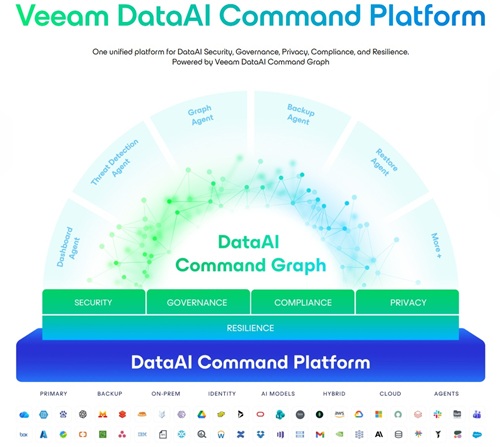 [Click on image for larger view.] Veeam DataAI Command Platform (source: Veeam).
The announcement came the same day Veeam published its Data & AI Trust Gap report. As covered by Virtualization & Cloud Review
, that report found that 88% of organizations are already using or piloting AI agents, while only 7% qualify as AI-ready and 95% of CEOs report that data challenges have slowed AI progress in the past year.
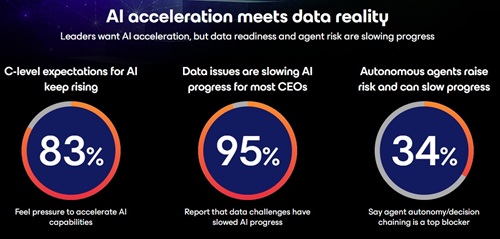 [Click on image for larger view.] Key Findings of Data & AI Trust Gap Report (source: Veeam).
Veeam is positioning the new agents as part of the operational layer needed to close that kind of gap. The company said traditional privacy programs are not built for AI systems and autonomous agents that act on enterprise data at machine speed.
"For 10 years, privacy professionals have been quietly admitting they cannot fully prove compliance with their own policies," said Cassandra Maldini, head of product strategy for Privacy and AI Governance at Veeam. "Now they're being asked to do the same for AI, at a pace no manual program can keep up with. Compliance is no longer a point-in-time exercise. It has to be continuous, evidence-based, and built directly into how organizations operate."
Consent Management Moves Beyond the Banner
The most immediate product addition is Consent Agent, which Veeam said is generally available now as part of the DataAI Command Platform.
The agent manages the consent lifecycle from banner creation and automated testing to continuous monitoring and auto-remediation. Veeam said it captures user consent signals including cookie preferences, marketing opt-outs, revoked permissions for AI personalization and downstream processing restrictions.
The agent then helps propagate and enforce those preferences across systems that need to honor them, including analytics platforms, AI pipelines, advertising technologies, Software-as-a-Service applications and third-party ecosystems. The agent is powered by its regulatory database and provides jurisdiction-aware risk scoring, centralized dashboards and audit-ready evidence.
A related Veeam blog post described the issue as a shift in where consent must be enforced. "In modern environments, consent is no longer a banner problem -- it's a data infrastructure problem," the company said.
DSR and Assessment Agents Planned for Q3
The Data Subject Request Agent is designed to generate and maintain data subject request intake forms configured to an organization's operational and regulatory footprint. Veeam said the agent can help teams stand up compliant forms in minutes and keep them current as regulations change, reducing time to launch a Data Subject Rights (DSR) form by roughly 50%.
The Assessment Agent is designed to analyze supporting evidence and generate tailored assessment responses. It covers Data Protection Impact Assessments (DPIAs), EU AI Act conformity assessments and vendor risk questionnaires.
Both the Data Subject Request Agent and Assessment Agent are planned for Q3 2026. The company said the three agents are intended to reduce operational overhead and allow privacy teams to focus on work requiring human judgment.
Platform Ties Privacy, AI Governance and Resilience
The new capabilities run on the Veeam DataAI Command Platform, which the company describes as a unified data and AI trust infrastructure for the agentic era. Veeam said the platform spans DataAI Security, DataAI Governance, DataAI Compliance, DataAI Privacy and DataAI Resilience.
The platform is powered by the DataAI Command Graph, which Veeam described as its intelligence layer with hundreds of connectors across cloud, SaaS and on-premises environments. Veeam said DataAI Privacy is also powered by the People Data Graph, which is intended to unify structured and unstructured personal data across hybrid multi-cloud environments.
For IT teams, the announcement places privacy and AI governance in the same operational domain as data resilience. Veeam said the agents operate on "live, continuously updated context, not assumptions or point-in-time snapshots," so governance can keep pace with agentic AI systems.
Regulatory Pressure Cited
Veeam cited the General Data Protection Regulation (GDPR), EU AI Act, ePrivacy, Digital Operational Resilience Act (DORA) and emerging national and state AI regulations as part of the compliance environment driving the need for operational privacy and AI governance. The company said fines under those frameworks can reach up to 7% of global annual revenue.
Michael Dolan, vice president and chief privacy officer at Best Buy, said in the Veeam announcement that privacy and AI governance practices need to change as AI systems become more active in decision-making.
"The way we think about privacy and AI governance has to be fundamentally different now," Dolan said. "Static policies and quarterly reviews were built for a world where data moved slowly, and AI didn't make decisions. That world is gone."
Veeam said the broader goal is to help organizations continuously prove, with evidence, that policies are working across complex data and AI ecosystems.
About the Author
David Ramel is an editor and writer at Converge 360.