In-Depth
Cloud Resilience Expert: AI Can Be a Single Point of Failure for Lean SMB Teams
AI can help understaffed IT departments monitor systems, triage incidents and troubleshoot problems. But when organizations reduce staff because those tools are available, the AI itself can become a new single point of failure.
That was one of the warnings delivered by cloud and data infrastructure analyst Greg Schulz during "Cloud Resilience Essentials: SMB Edition," the opening session of today's "Protecting Cloud Data: Strategies for Lean IT Teams Summit," being made available for on-demand replay thanks to the sponsor, Veeam Software.
 "If you're that dependent on AI that you're able to address and reduce headcount, that AI is a single point of failure. It needs to be resilient. It needs to be protected. It needs to have the different security and guardrails."
Greg Schulz, founder of independent IT analyst firm Server StorageIO
Schulz, founder and senior adviser at Server StorageIO, discussed the issue after being asked whether AI should be considered a single point of failure when organizations use it to support headcount reductions.
"Absolutely," Schulz said. "If you're that dependent on AI ... that AI is a single point of failure."
If the remaining IT staff depends on an AI assistant for troubleshooting, repairs, deployments or access to operational knowledge, he explained, the technology must be protected like any other critical component.
"It needs to be resilient," Schulz said. "It needs to be protected. It needs to have the different security and guardrails."
AI Extends the Team -- and the Dependency Chain
Schulz did not argue against using AI in IT operations. He identified several areas where assistants and agents can help resource-constrained teams, including first- and second-level triage, health checks, posture assessments, validation, anomaly detection and troubleshooting.
Those capabilities could help a small team process alerts, identify likely causes and direct human attention toward incidents requiring judgment or escalation. That is particularly attractive as organizations manage expanding combinations of public cloud, private cloud, on-premises infrastructure, edge environments and software-as-a-service applications.
The tradeoff is that adding AI also expands the operational dependency chain. An assistant may rely on an underlying large language model, a hosted service provider, cloud compute and networking, application programming interfaces, Model Context Protocol connections, identity services, credentials and internal knowledge sources.
A disruption or compromise affecting any of those components could impair the same IT team expected to diagnose and recover from the incident.
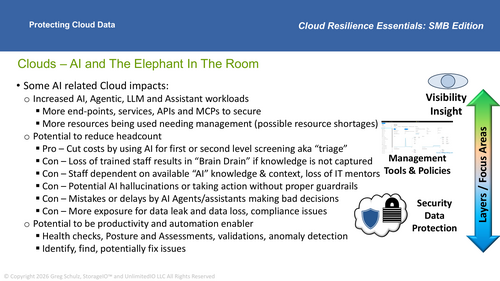 [Click on image for larger view.] Clouds -- AI and The Elephant In The Room (source: Greg Schulz).
Headcount Reduction Can Turn Into Brain Drain
The risk is not limited to an AI service becoming temporarily unavailable. Schulz also warned about losing the human knowledge that previously supported the environment.
Organizations may be tempted to reduce costs by shifting routine screening and troubleshooting to AI. But if experienced employees leave before their knowledge has been documented and transferred, the organization can suffer what Schulz described as "brain drain."
The remaining employees may then become dependent on the assistant's stored knowledge and context while losing access to experienced mentors who understood why systems were designed, configured and operated in particular ways.
That creates a different kind of single point of failure. The organization may still have servers, backups, monitoring and network connectivity, but lack personnel capable of independently evaluating an AI recommendation or operating through an outage without it.
An assistant that produces an incorrect diagnosis can also consume valuable recovery time. An AI hallucination, incomplete recommendation or poorly chosen remediation step may send a lean team in the wrong direction when rapid restoration is most important.
Protect the AI Like Production Infrastructure
For organizations placing AI in the operational path, resilience planning should account for the complete system rather than only the visible assistant.
That means identifying the models, providers, APIs, identity systems, knowledge repositories, credentials and cloud services required for the AI to function. Teams should determine what happens if one of those dependencies becomes unavailable, degraded or inaccessible during an incident.
They should also preserve the ability to perform essential work without the assistant. Runbooks, configuration information, contact lists, recovery instructions and architectural knowledge should not exist exclusively within an AI service or its context window.
Schulz's broader resilience guidance called for identifying single points of failure across infrastructure, management tools and staffing. That includes situations in which knowledge of a workload or environment resides with only one person. An indispensable AI assistant creates a similar concentration of operational risk.
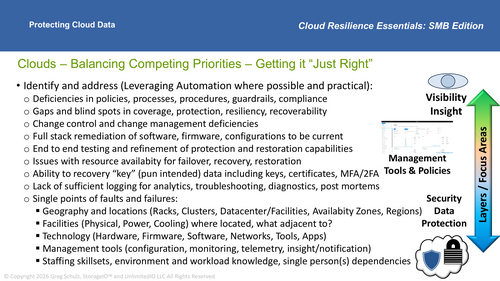 [Click on image for larger view.] Clouds - Balancing Competing Priorities - Getting it 'Just Right' (source: Greg Schulz).
Agents Need Limits as Well as Uptime
Keeping an AI system available is only one part of resilience. Organizations must also limit what it can do when it is operating.
Schulz raised the question of whether an AI agent should be permitted to delete an account, database or repository. Without appropriate guardrails, an automated system attempting to correct a problem could instead expand the incident or create a new one.
He recommended applying a zero-trust approach, role-based access controls and least-privilege access to AI agents. Organizations should define which resources an agent can reach, which actions it can perform autonomously and which changes require human approval.
Useful controls can include:
- Restricting agents to the minimum permissions needed for each assigned task.
- Requiring human approval before destructive or difficult-to-reverse actions.
- Protecting the credentials, certificates, keys and service accounts used by automation.
- Logging the recommendations, access attempts and changes made by agents.
- Maintaining rollback procedures for agent-driven configuration changes.
- Testing whether controls continue to work when the environment is degraded or under attack.
Those protections can help prevent an incorrect recommendation or autonomous action from turning a manageable incident into a broader outage.
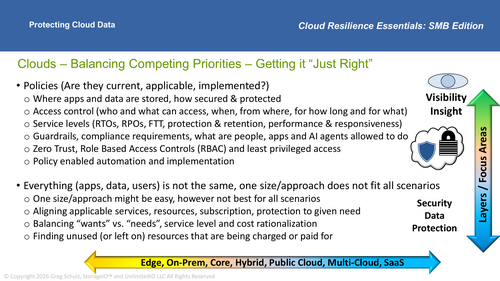 [Click on image for larger view.] Clouds - Balancing Competing Priorities - Getting it 'Just Right' II (source: Greg Schulz).
Add AI Failure to the DR Playbook
Schulz repeatedly emphasized that disaster recovery plans must be current, tested and flexible enough to address different failure scenarios. For AI-dependent IT teams, that should include testing the loss of the AI assistant itself.
A tabletop exercise or recovery drill could simulate an unavailable model provider, inaccessible knowledge store, expired credential, compromised agent identity or loss of network access to an external service. The objective would be to determine whether the remaining staff can still diagnose problems, access documentation and execute essential recovery procedures.
Organizations should also reconsider recovery time objectives and recovery point objectives from an end-to-end perspective. Restoring an individual virtual machine, container or database does not necessarily mean the complete application is available to its users. The same principle applies to AI-assisted operations: restoring the assistant interface will not help if its model, identity service, data source or required API remains unavailable.
The disaster recovery playbook should specify which functions can continue without AI, which require an alternate tool or provider and which must be handed back to human operators. Staff should practice those procedures before an actual disruption.
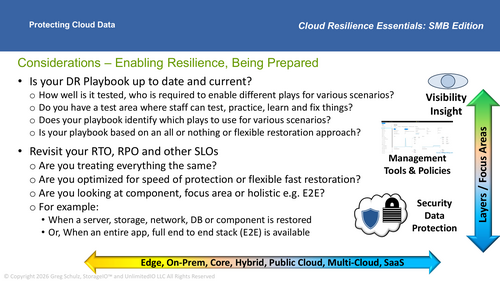 [Click on image for larger view.] Considerations - Enabling Resilience, Being Prepared (source: Greg Schulz).
Lean Should Not Mean Brittle
AI can give a small IT department additional capacity, helping it analyze alerts, conduct health checks and accelerate routine troubleshooting. But reducing people, documentation and fallback procedures around the technology can replace one staffing problem with a new resilience problem.
The practical question is not simply whether AI can perform an operational task. Organizations must also determine what the AI depends on, what it is allowed to change and how the work will continue when it is wrong, compromised or unavailable.
For lean cloud teams, the goal should be to use AI as an operational aid without allowing the assistant to become the only remaining source of knowledge or capability. Otherwise, technology intended to improve resilience may become the weak link in the recovery plan.
And More
Although replays are fine -- this event was just today, after all, so timeliness isn't an issue -- there are benefits to attending summits and webcasts from Virtualization & Cloud Review and its sister sites live. Paramount among these is the ability to ask questions of the presenters and see demos in context as they happen. And that's not to mention the chance to win a great prize, in this case $300 Target gift cards provided by the sponsor, Veaam Software, which also presented at the event along with well-known technologist, writer and presenter Brien Posey. Again, today's event is being made available for on-demand replay.
With all that in mind, here are some upcoming summits and webcasts from our parent company:
- Building Security Architecture for the New Reality -- July 30, 2026
- Benchmark Your Kubernetes Resilience: Insights from Aussie Broadband and GigaOm -- Aug. 6, 2026
- Detecting Threats Demo: Monitor, Detect and Remediate a Microsoft 365 Attack -- Aug. 11, 2026
- Best Practices for Modern DevSecOps Summit -- Aug. 14, 2026
- Rapid Identity Recovery: Lessons from Frontline Incident Response -- Aug. 18, 2026
- From Legacy to Agentic Systems Engineering -- How Enterprise Leaders Are Rewriting the Rules of Modernization -- Aug. 18, 2026
- The Great VDI Migration: Your Path to a Cloud-First Workplace -- Aug. 19, 2026
- The Security Symposium: Security for an AI-Driven World -- Aug. 25, 2026
- AI Trust & Governance Summit -- Sept. 15, 2026
- Next-Gen Zero Trust Summit: Architecting Security for the Modern Attack Landscape -- Nov. 6, 2026
About the Author
David Ramel is an editor and writer at Converge 360.