News
Veeam, Rubrik Lead Changing Backup/Data Protection Space
Veeam and Rubrik led the two axes in Gartner's 2026 Magic Quadrant for Backup and Data Protection Platforms, but the larger story in the report may be the changing definition of enterprise backup itself.
In the chart, Veeam was positioned highest on the Ability to Execute axis, while Rubrik was positioned furthest on the Completeness of Vision axis. Veeam also said in a June 30 announcement that it was named highest in Ability to Execute for the seventh consecutive time and was named a Leader for the 10th consecutive time.
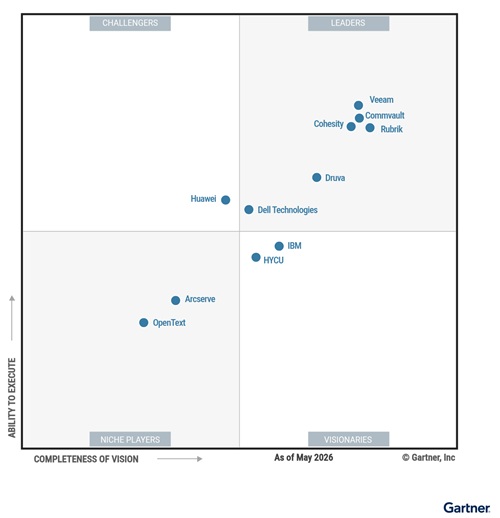 [Click on image for larger view.] Magic Quadrant for Backup and Data Protection Platforms (source: Gartner).
The Gartner report, dated June 29, signals that the backup and data protection platform market is being reshaped by generative AI, agentic automation, cyber recovery, identity recovery, SaaS protection, data discovery and cloud application recovery. One of the report's clearest strategic planning assumptions states: "By 2029, 90% of backup and data protection platforms products will integrate generative AI (GenAI) to improve management and support operations, compared with fewer than 25% in 2025."
That finding frames backup as part of a broader operational and security shift. Gartner defines backup and data protection platforms as systems that "capture point-in-time copies of enterprise data for multiple use cases." The report says they are primarily used for recovery from data loss scenarios, but also "enhance data protection initiatives to improve cyberreadiness and risk management."
Leaders and Axis Positions
For Veeam, Gartner identified Veeam Data Platform as the primary offering, available as software and virtual appliances. Gartner cited three strengths: Securiti AI integration, cyber extortion and incident response services, and the Linux Software Appliance. Gartner also listed cautions involving a fragmented management experience, limited SaaS application coverage and slow progress on identity recovery and resilience.
For Rubrik, Gartner identified Rubrik Security Cloud as the primary offering, available as a SaaS-based or customer-installable control plane for appliance- and cloud-based deployments. Gartner cited Rubrik strengths around market innovation, simplified unified platform administration and identity protection scope. Gartner's cautions for Rubrik involved lack of a native isolated recovery environment, a limited BaaS offering and limited cloud application recovery.
GenAI Moves Into Backup Operations
The GenAI forecast is one of the most notable market findings in the report because Gartner frames AI as a management and support function for backup operations, not only as a product label. In its market overview, Gartner says: "Leading vendors in this market have rapidly introduced GenAI-based capabilities."
The report says the primary focus of those GenAI features is to assist with backup administrative tasks and troubleshooting. Gartner lists implementations including chatbots, natural-language conversational chats and AI-based responses. It also says recent innovations include AI agent access through vendor-developed Model Context Protocol servers.
Gartner also identifies a separate agentic AI trend. The report says: "Vendors are accelerating the addition of agentic AI capabilities to automate more backup tasks." Gartner lists examples including recovery planning, identification of unprotected data, step-by-step recovery guidance, failure diagnosis and forensic investigations.
Those points align with product notes in several vendor sections. Gartner said Veeam added natural language querying of platform telemetry to its GenAI assistant and released Agent Commander, which combines AI agent governance and action rollback. Gartner said Rubrik introduced Rubrik Agent Cloud, with the Semantic AI Governance Engine, and Agent Rewind to roll back data or systems impacted by an AI agent.
Backup Expands Beyond Restore
Gartner's report repeatedly presents backup as a broader cyber resilience and data protection discipline. It says: "Protecting and recovering an organization's data, regardless of the underlying application, infrastructure type and its location, is more important than ever."
The report says backup and data protection platforms must protect enterprise data across hybrid, multicloud and SaaS environments. Mandatory features include backup across those environments, recovery from failure or data loss scenarios, integration with immutable backup storage targets, cyberattack detection capabilities and a centralized console for distributed platform infrastructure.
Gartner also lists optional features that show where the market is moving. Those include protection for Microsoft Active Directory, Microsoft Entra ID, Okta Platform and Ping Identity Platform; protection for SaaS applications such as GitHub, Microsoft Azure DevOps, ServiceNow and Slack; and "Generative and agentic AI automation features."
Identity Recovery Becomes a Priority
Another notable Gartner planning assumption involves identity systems. Gartner predicts: "By 2030, 70% of organizations will prioritize the recoverability of identity systems alongside preventive identity and access management (IAM) controls, up from less than 15% in 2026."
Cloud, SaaS and Operations Shift
Gartner also forecasts an operational shift around cloud backup ownership. The report states: "By 2029, 70% of enterprises will have shifted cloud backup responsibilities from cloud operations teams to IT operations teams, compared with 25% in 2025."
The report says heads of infrastructure and operations should assess and rearchitect backup strategy across technology, operations and consumption. Gartner recommends that they "Invest in backup solutions that address data protection requirements in the hybrid, multicloud and SaaS environments" and favor solutions with "a single pane of glass to manage these distributed environments."
Gartner also advises organizations to evaluate AI use and requirements for protecting critical AI datasets, including AI models, vector databases, training and fine-tuning datasets, and inference logs. In the market overview, Gartner says vendors are introducing protection for AI workload data such as vector databases, feature stores, streaming systems and caching layers.
While Gartner usually charges for access to its reports, the series of Magic Quadrant reports is often provided in licensed-for-distribution editions from covered vendors, easily discoverable with a quick web search.
About the Author
David Ramel is an editor and writer at Converge 360.