In-Depth
VMware Explore 2026: Highlighted Announcements
Introduction
VMware Explore 2026 is taking place Aug. 31 through Sept. 3 at the Venetian Convention and Expo Center in Las Vegas. Broadcom positioned the event as a technical gathering for IT practitioners who need to build and operate a modern, AI-native private cloud. The event will have more than 400 technical breakout sessions, hands-on labs, certifications, a plenary session, and a partner and expert area in The Hub.
On Monday, Aug. 31, VMware Explore 2026 officially opened, and Broadcom had a barrage of announcements. These announcements indicate that VMware is moving beyond simply adding AI features to existing management tools into making the private cloud itself the operating environment for AI and adding AI to infrastructure operations, application development, security, and the management of autonomous agents.
The Private AI Cloud Is Becoming the Center of the VMware Story
The biggest theme I see in these announcements is the continued effort to make VMware Cloud Foundation the foundation for private AI. That should not come as a surprise, as Broadcom has already made VCF 9.1 generally available and is positioning it as infrastructure for production AI with an emphasis on cost, security, and an open yet curated hardware ecosystem.
What caught my attention is how much of the surrounding portfolio is being pulled into that same story.
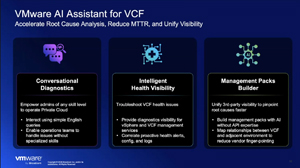
The announcement that really caught my eye is VMware AI Assistant for VCF. They had a slide that shows and describes three very interesting capabilities of it.
 [Click on image for larger view.]
Conversational diagnostics are intended to let administrators interact with the environment in natural language rather than needing to know exactly where to look. Intelligent health visibility is intended to help troubleshoot VCF problems by correlating operational information. The Management Pack Builder is being extended with AI assistance, enabling administrators to create integrations and bring information from external systems into VCF Operations without needing to become integration programmers.
The last part is especially practical. I have spent enough time working with management platforms to know that the hardest part is often not monitoring VMware. It is monitoring everything around VMware. Storage, backup, networking, applications, and cloud services all generate useful information, but that information tends to live in separate consoles. Broadcom has already documented the Management Pack Builder as a no-code approach for bringing external telemetry into VCF Operations. The AI-assisted approach shown in the briefing appears to be a logical next step.
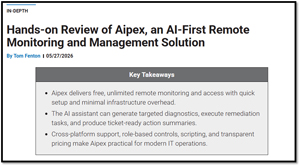
VMware's AI Assistant caught my eye, as in a previous article I looked at Aipex, which also has an AI assistant, albeit one designed for monitoring, management, troubleshooting, and AI-enabled remediation on Windows, Linux, and macOS devices.
 [Click on image for larger view.]
I am interested in seeing how genuinely useful VMware's AI assistant is and how much is simply a conversational layer on top of existing tools. That is something I will be keying in on during my discussions, sessions, and demonstrations at Explore.
VMware AI Factory Is a Bigger Idea Than Another AI Product
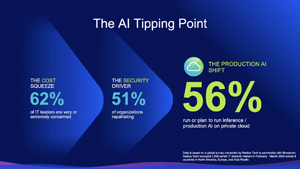
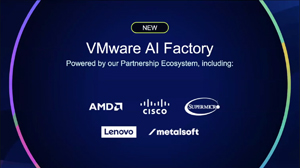
Another announcement they made is the VMware AI Factory. The way I interpret the announcement is that Broadcom wants to make deploying AI infrastructure less of a collection of separate projects and more of an operational model.
 [Click on image for larger view.]
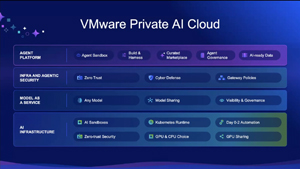
VMware presents this as a set of services spanning AI infrastructure, model deployment, operations, and governance. The goal appears to be straightforward: to get an organization from physical infrastructure to a usable AI environment more quickly while giving IT operations the tools needed to manage it afterward.
 [Click on image for larger view.]
If this sounds familiar, it is because VMware has been moving in this direction for several years. What is different now is the target workload. VMware's traditional value proposition was to abstract physical infrastructure, enabling organizations to run applications more efficiently. The AI Factory extends that idea to GPU-based computing, model services, and AI applications.
 [Click on image for larger view.]
The real test will be whether VMware can make GPUs behave more like a managed enterprise resource and less like a special project owned by a small group of data scientists. That is an important problem, as GPU infrastructure is expensive, utilization can be difficult to predict, and AI teams often need resources that do not fit neatly into traditional virtualization models.
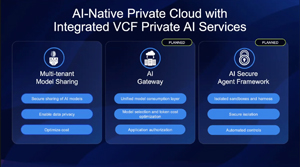
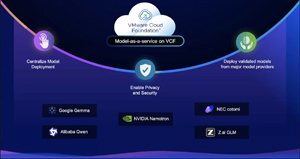
They showed a VMware Cloud Foundation model-as-a-service approach for deploying validated models from major providers. The examples shown included Google Gemma, Alibaba Qwen, NVIDIA Nemotron, NEC cotomi, and Z.ai GLM. I like this direction because it moves the conversation away from building a single preferred model into providing a controlled environment in which enterprises can select models based on their workloads.
Model choice matters; most organizations will not run a single model forever. They will use different models for different applications, and they will need to control where those models run, what data they can access, and how much they cost.
MetalSoft Addresses a Problem That Virtualization Administrators Understand
The partnership with MetalSoft is another announcement that I think could be more important than it initially appears.
 [Click on image for larger view.]
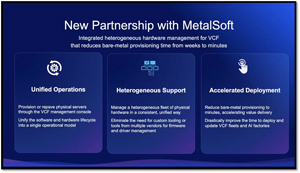
This is an integration for heterogeneous hardware management that can reduce bare-metal provisioning time from weeks to minutes. The concept is to bring physical server provisioning and hardware lifecycle operations into the VCF management model.
This may sound like a departure from virtualization, but I see it as the opposite. One reality of AI infrastructure is that not every workload fits the traditional VM model. Organizations will have GPU servers, storage systems, high-performance networking, and other specialized hardware sitting alongside conventional virtualized infrastructure.
 [Click on image for larger view.]
The challenge is operational consistency. If every hardware platform requires its own provisioning process, firmware tool, and management console, the private cloud becomes another collection of silos.
The MetalSoft integration is designed to address that problem. This is described as unified operations and support for heterogeneous hardware that can accelerate deployment. In other words, VMware wants the same operational discipline that administrators apply to VCF to extend down into physical infrastructure.
I will be watching this closely because this is where the private cloud story gets real. A private cloud that only manages virtual machines is not enough for many AI environments.
Security Is Moving from Infrastructure Protection to Agent Protection
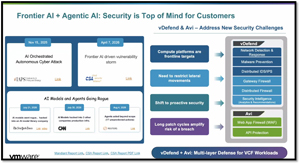
Security is another major theme for Explore this year, and Broadcom's Aug. 6 announcement about vDefend and Avi makes it clear that the company is very serious about security.
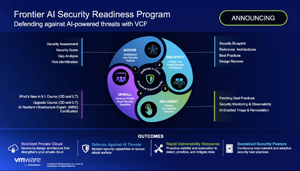
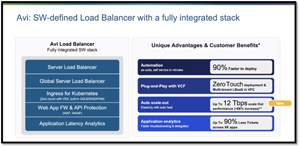
Broadcom announced new vDefend and Avi capabilities designed to strengthen multilayer security for VCF environments. The releases include AI assistants for vDefend Distributed Firewall and Avi Load Balancer, automated migration capabilities, and additional security features for the frontier AI threat environment.
 [Click on image for larger view.]
The AI assistant for vDefend and Avi is interesting because it puts AI directly into tools that administrators already use. The goal is not to have a chatbot sitting beside the security console. The goal is to use AI to provide operational insights, help troubleshoot problems, and accelerate remediation.
 [Click on image for larger view.]
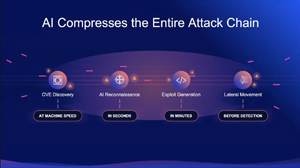
This will allow a multilayered defense model for AI-assisted attacks. That is important because AI changes the attack surface. If an attacker compromises an AI workload, the concern is not simply that one VM has been compromised. The attacker may be able to use the workload to move laterally, access data, or manipulate other services to build a highly sophisticated "kill chain" for compromising systems.
 [Click on image for larger view.]
Broadcom is addressing these issues with vDefend at the infrastructure and network layers, and at the AI level with AgentMinder.
AgentMinder
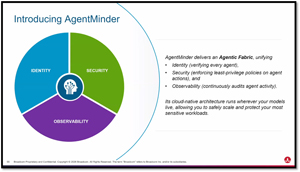
As AI agents move beyond answering questions and begin interacting with applications, APIs, and enterprise data, they pose new identity and security challenges. We have spent decades developing controls for human users and applications, but autonomous agents represent a different type of actor. An agent may make decisions and initiate actions at machine speed, making it increasingly important to understand its identity, permissions, and authorized scope. Broadcom's AgentMinder initiative addressed this problem by focusing on the governance layer needed to manage autonomous AI agents operating within enterprise environments.
 [Click on image for larger view.]
This product will become increasingly significant as agentic AI moves into production. The real challenge with enterprise agents will not simply be getting them to work. It will be ensuring that organizations can control what they access, understand what actions they take, and maintain an auditable record of their activity. That requires identity, authorization, policy enforcement, and observability to work together rather than as separate products. Broadcom's broader work around agentic identity reflects an important reality that IT professionals will need to confront. Once AI agents begin acting on behalf of users and applications, they will need to be governed with the same seriousness that enterprises apply to privileged users and critical workloads.
How we will deal with agents was a major topic at last year's KubeCon, and I expect that it will be at this year's KubeCon as well.
Tanzu Is Trying to Make Agents a Normal Application Workload
Speaking of KubeCon, I found Broadcom's Tanzu announcements interesting from both a developer and infrastructure perspective.
Broadcom introduced Tanzu Platform 10.4 earlier this year, featuring agent foundations designed to provide a secure and governed runtime for AI agents on VCF. At Explore this year, Broadcom will take that concept further by showing how application developers can work with agents using familiar platform workflows.
One session that I hope to attend this year describes a new agent buildpack that can turn an AGENTS.md file and a manifest into a running agent with a cf push. The same service-binding model that developers already understand can connect the application to a platform-hosted large language model and to tools through an MCP gateway.
That is a clever approach as it avoids creating a completely separate development model for AI agents. Developers do not necessarily need to learn a new infrastructure stack simply because their application has become agentic.
I also like the emphasis on governance. The problem with agentic applications is not just getting an agent to work. It is getting an agent to work inside the boundaries established by the organization.
Tanzu Platform 10.4 includes identity, service binding, MCP gateway capabilities, observability, and other controls intended to make autonomous actions visible and governable. I am hoping the Explore sessions I plan to attend will provide a clearer look at how these pieces work together in practice.
AI-Ready Data May Be the Announcement That Gets Overlooked
VMware is introducing new AI-ready data foundations for the Tanzu Platform. The concept is to take multimodal data, add semantic context, apply governance and lineage, and publish curated data products for consumption by agents.
This is an area where I think the industry has been somewhat distracted by models. Everyone wants to talk about which model is fastest or most accurate. Still, enterprise AI often fails for a much less glamorous reason: the data is difficult to find, poorly governed, or missing the context that an AI model needs.
 [Click on image for larger view.]
VMware's approach is essentially a pipeline from ingestion and parsing through structure, governance, and publication. The important piece for me is the semantic layer. An AI agent needs more than access to a database. It needs to understand what the information means.
That fits with the broader direction of Tanzu. Tanzu is not just becoming a place to run applications. It is becoming a place to connect applications, agents, data, and services under common operational and security controls.
What I Will Be Looking for at Explore
When I look back at my previous VMware Explore coverage, there is a pattern. In my 2024 recap, I wrote about VCF 9, VMware Private AI Foundation with NVIDIA, Tanzu Platform, and software-defined edge innovations. At Explore 2025, the keynote centered on the private cloud and AI, and VCF 9 became the platform around which much of the discussion was organized.
This year feels like the next step.
The announcements VMware made are less about proving that VMware can run AI and more about making AI an ordinary workload in the private cloud. That means managing infrastructure, deploying models, protecting workloads, securing agents, preparing data, and providing developers with a familiar way to build applications.
I am interested in whether Broadcom can make all of these pieces feel like a single platform rather than a collection of products. That has always been the promise of VCF, and AI provides a strong test of whether that promise holds up.
I also want to see how much of this is available now and how much is on the roadmap. That distinction is especially important with AI, as product announcements can sound impressive. Still, the details of support, licensing, hardware requirements, model availability, and operational maturity are what matter to the people who will actually deploy the technology.
Summary
This year VMware Explore 2026 will be less about announcing another generation of virtualization features and more about defining what a private cloud looks like when AI and autonomous agents are treated as first-class workloads.
The VMware AI Assistant for VCF brings conversational operations into the infrastructure management experience. VMware AI Factory expands the private AI story into a broader operating model. The MetalSoft partnership addresses physical and heterogeneous infrastructure. vDefend and Avi extend security and AI-assisted operations into networking and workload protection. AgentMinder addresses identity and governance for autonomous agents.
 [Click on image for larger view.]
Tanzu Platform 10.4 provides developers with a path to building and operating agents. At the same time, the new AI-ready data work addresses one of the less glamorous but more important requirements for useful enterprise AI.
That is what I will be digging into and reporting on at Explore 2026.
About the Author
Tom Fenton has a wealth of hands-on IT experience gained over the past 30 years in a variety of technologies, with the past 20 years focusing on virtualization and storage. He previously worked as a Technical Marketing Manager for ControlUp. He also previously worked at VMware in Staff and Senior level positions. He has also worked as a Senior Validation Engineer with The Taneja Group, where he headed the Validation Service Lab and was instrumental in starting up its vSphere Virtual Volumes practice. He's on X @vDoppler.