In-Depth
Omnissa Horizon Update
I recently had the opportunity to chat with Arindam Nag, vice president of Product Management at Omnissa, about what has happened with Horizon since it split off from VMware in 2024. We discussed not only the corporate changes but also Horizon's evolution under its new ownership.
 [Click on image for larger view.]
Background
Horizon entered a new era when VMware sold its End-User Computing (EUC) division to private equity firm KKR in 2023/2024. This led to the business being rebranded as Omnissa. VMware decided to divest its EUC product line, which included the Horizon and Workspace ONE segments, after Broadcom acquired VMware in 2023.
Company Changes
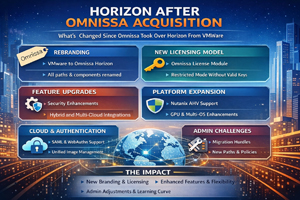
The most visible change since the acquisition has been around branding and licensing. The product, which was previously sold and supported
under the VMware name, is now called Omnissa Horizon. This
name change includes all associated components and installers that
adopt the Omnissa name rather than VMware. This change even includes the software purging VMware references from Horizon's file paths, ADAM database partitions, service names, log locations, registry keys, and Group Policy templates, and renaming them to align with Omnissa's branding. This rebranding firmly embedded their
products with their new corporate identity and helps clarify
ownership. Still, it has introduced migration work for administrators during upgrades, as well as for any scripts or automation tools that used the old file names and paths.
Beyond names,
licensing has shifted to a fully Omnissa-centric model.
Releases such as Horizon 8 2503 and 2506 transitioned away from
VMware/Broadcom license modules to the Omnissa License Module (OLM).
After upgrading, deployments without valid Omnissa keys enter a
restricted mode until compliant keys are applied, pushing
customers to adopt the new license ecosystem. This has implications,
particularly around renewals and signals Omnissa's intent to
unify licensing across its digital workspace portfolio.
Horizon
Under Omnissa's
stewardship, Horizon's technical direction continues to advance
and deliver feature enhancements to its users. Releases such as
Horizon 8 2312 delivered improvements in security (e.g., blocking
malicious SendKey scripts and modernizing the REST API), user
experience (telemetry with DEEM integration), and operational
capabilities, such as hybrid entitlement synchronization between
on-prem and cloud environments. Later versions, such as 2503 and
2506, added deeper infrastructure visibility, streamlined lifecycle
management through SMB support, and cloud-focused enhancements on
Amazon WorkSpaces Core and VCF 9.0 compatibility. These changes
reflect a product evolution that balances legacy Horizon capabilities
with growing multi-cloud and automation needs.
From an
administrative perspective, Omnissa has reinforced operational
controls and hybrid cloud readiness. Horizon 8 now supports
pod-level SAML configuration, enhanced authentication security
(including WebAuthn within UWP apps), and more robust cloud image
management services that span on-premises and public clouds. These
enhancements suggest that Omnissa seeks to reduce the day-to-day
administrative burden while enabling more flexible deployment and
access scenarios than those offered by the classic VMware Horizon
stacks.
Platform Flexibility
The most notable
change under Omnissa has been increased platform flexibility,
which was previously hampered by its status under VMware.
The most
anticipated change was in the Horizon 8 2512 release, which brought
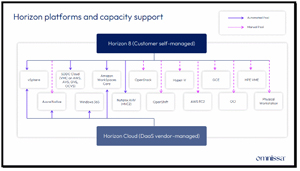
general availability of support for Nutanix AHV, making Horizon deployments viable on an alternative hypervisor and including features such as automated RDSH farms, ClonePrep for efficient provisioning.
 [Click on image for larger view.]
Alongside this,
client-side UX improvements, such as a unified, modern interface
across Windows, Mac, and Linux, and support for advanced GPUs (e.g.,
NVIDIA Blackwell RTX Pro 6000), indicate an accelerated focus on
performance and a cross-platform experience.
In a world of
constant cloud hype, the latest adoption trends in VDI show that
on-premises pragmatism is winning. While Horizon has been
synonymous with VMware's vSphere for years, the platform is expanding
to other infrastructures in response to real-world customer demand to
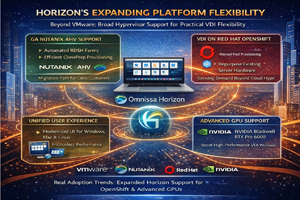
leverage their existing investments. The support for Nutanix AHV,
mentioned above, is a prime example, as it was the "most
oversubscribed beta" in the product's history. This integration
opens a direct migration path for the large contingent of Citrix
customers running on Nutanix who want to move to Horizon but were
unwilling to re-platform on vSphere to do so.
 [Click on image for larger view.]
Similarly,
there's demand for running VDI on OpenShift. This demand is
customer-driven, and Arindam mentioned that a large bank with
existing OpenShift capacity is considering provisioning Horizon on
it, seeing it as a way to repurpose existing server hardware without
the capital investment required by vSphere. I asked about the much-hyped Azure Local, which he said is "not getting a lot of traction." Due to its specialized hardware requirement, it is a significant barrier for many customers, proving that
practical hardware realities still dictate platform adoption.
Horizon Client
The Horizon
client is the most visible piece of the Horizon stack for Horizon's
end users. A significant highlight of the post-acquisition strategy
is the introduction of "Horizon Client Next," as
detailed in KB 6001222. It addresses a long-standing pain point by
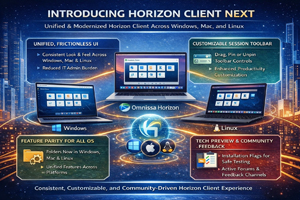
modernizing the user interface across Windows, Mac, and Linux.
Previously, each platform had a distinct UI, creating a fragmented
user experience and an administrative burden for IT teams. Horizon
Client Next unifies these designs, offering a consistent look and
feel that reduces training costs and simplifies support. This shift
reflects Omnissa's broader philosophy of "frictionless"
computing, where the platform fades into the background of the
user's workflow.
 [Click on image for larger view.]
In addition to
the visual overhaul, the new Horizon Next client includes
functional upgrades such as an enhanced, repositionable
in-session toolbar. This allows users to drag, pin, or unpin
essential controls, creating a customizable desktop experience tailored to individual needs. Furthermore, features like
"Folders" for resource organization, which used to be
exclusive to Windows, are now available in the Mac and Linux clients.
These changes demonstrate a commitment to feature parity across
all operating systems, ensuring that the platform's most
powerful tools are available to every user regardless of the hardware
on which they run.
Omnissa brings a
new approach to deployment and feedback. Omnissa has implemented
installation flags that allow IT administrators to test the new
"Client Next" interface alongside the existing client,
providing a "Tech Preview" environment without forcing an
immediate, total migration. This deployment model allows
organizations to validate the new experience at their own pace.
Additionally, Omnissa is actively leveraging its new Community Forums
and specialized support channels to gather direct user feedback, signaling a more community-driven development cycle than under its VMware ownership.
 [Click on image for larger view.]
AI Integration
Any IT discussion
now requires a discussion about AI, and Arindam was excited to share
his take with me on how Omnissa is facing the opportunities and
challenges as AI becomes more prevalent and can reduce
administrators' workload.
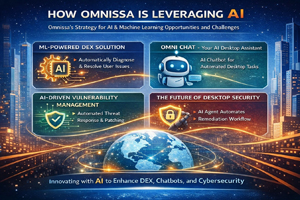
He shared that
Omnissa is currently using AI and machine learning (ML), and
we also discussed Omnissa's AI roadmap. I do need to emphasize that
some of the AI subjects that we discussed are on their roadmap and
not yet available.
He demonstrated
how Omnissa's Digital Employee Experience (DEX) solution uses ML to
move beyond simple monitoring, automatically analyzing user
experiences to identify common characteristics and pinpoint the
source of the problem.
He discussed
Omni, an AI-powered assistant that will be embedded across the Omnissa platform, enabling natural language interaction for data insights, search, and automation. It should reduce the manual effort needed and time
spent on data analysis, issue resolution, knowledge retrieval, and
scripting.
 [Click on image for larger view.]
Desktop
security is a top concern to users and administrators, and we
discussed how, in the future, an AI agent could automate the
entire vulnerability remediation workflow. Upon learning of a new
threat, this agent could identify all vulnerable machines, package
the required fix, deploy the patch across the fleet, and verify that
the remediation was successful. Of course, it would need safeguards,
such as the option to leave the final decision in the admin's hands.
Final Thoughts
Talking to people on the front lines, I have seen mostly positive reactions from the Horizon community under its Omnissa ownership. This reflects both
the excitement and growing pains of the new company. Long-time
Horizon administrators and partners appreciate the continued
innovation and responsive Omnissa support, especially compared to
recent Broadcom practices. Still, some have experienced practical
bumps, such as changes to client download flows or quirks in registry
or ADAM database paths resulting from rebranding. These human-centric
elements underscore that while the product roadmap is advancing,
operational realities such as documentation, tooling, and client
updates remain active areas of adjustment.
 [Click on image for larger view.]
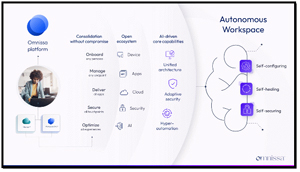
Of course, the
most significant change since Horizon was separated from
VMware/Broadcom is that Horizon now supports a variety of
deployment platforms tailored to different organizational needs.
For on-premises environments, it is, of course, compatible with and
supported on VMware vSphere, but its latest releases also support
Nutanix AHV and other platforms. Its public cloud options include
integration with Amazon WorkSpaces Core or EC2, Microsoft Azure, and
Google Cloud through VMware Cloud solutions. Additionally, Horizon
enables hybrid cloud deployments, allowing organizations to combine
on-premises infrastructure with public cloud resources for
greater flexibility and scalability. This is especially useful for
those who need to grow quickly or have bursty workloads.
The journey from
VMware Horizon to Omnissa Horizon has definitely been more than a
simple change of ownership. It represents a rebranded,
reinvigorated product with evolving cloud-centric capabilities, new
licensing models, expanded platform support, and a community learning
to adapt to both technical and procedural changes. As Omnissa
continues to build its identity and product vision, Horizon's
legacy -- now in a new corporate home -- appears poised to grow
into broader deployment scenarios while honoring its roots in
enterprise VDI and digital workspaces.
About the Author
Tom Fenton has a wealth of hands-on IT experience gained over the past 30 years in a variety of technologies, with the past 20 years focusing on virtualization and storage. He previously worked as a Technical Marketing Manager for ControlUp. He also previously worked at VMware in Staff and Senior level positions. He has also worked as a Senior Validation Engineer with The Taneja Group, where he headed the Validation Service Lab and was instrumental in starting up its vSphere Virtual Volumes practice. He's on X @vDoppler.