In-Depth
KubeCon 2026 EU Day 2 Recap -- Digital Sovereignty and Real-life Experiences with Kubernetes
In my previous coverage of KubeCon 2026 EU, which was put on by the Cloud Native Computing Foundation (CNCF) and attended by over 13,500 people, making it the largest open-source event ever, I discussed the keynote speeches and announcements from the event's first day. In this article, I will detail the second day keynotes and the discussions I had with one of the vendors at the event.
Day 2 Keynote
The second day of the conference shifted from the Kubernetes and Cloud Native enablement of artificial intelligence (AI) to other issues facing the CNCF members, including digital sovereignty.
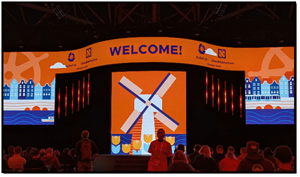 [Click on image for larger view.]
One of the great things about CNCF is that its members live in a geopolitical landscape, but this means they are increasingly defined by regional regulation. Jan Melén, Vice Chair of the CNCF Governing Board, addressed this and kicked off the keynotes by discussing the paradox that faces every modern enterprise: the desire for independence must not come at the cost of the global collaboration that fuels innovation.
He stated that the risk of fragmenting the open-source ecosystem is not just a technical concern but also an economic one, as it threatens to undermine the huge (by some estimates, trillions of dollars) value generated by the open-source software community. He emphasized that, to navigate this, we, as a community, must distinguish between sovereign code and sovereign deployment.
While the innovation layer must remain a unified global codebase, the operational layer must be localized to comply with regional laws and security policies. Doing this allows organizations to leverage the power of the global community while maintaining the "strategic autonomy" necessary for companies to govern their own digital destiny. He went on to explain that we are codifying these principles into law and that the European Union's Cyber Resilience Act (CRA) represents a landmark shift in software accountability.
Greg Kroah-Hartman, a Fellow at the Linux Foundation, built on this theme in his keynote, arguing that the CRA should not be framed as a regulatory hurdle but rather as a vital "list of ingredients" that ensures software transparency and safety. He likened it to food labeling, as the act mandates that software components be documented, kept up to date, and resilient against vulnerabilities.
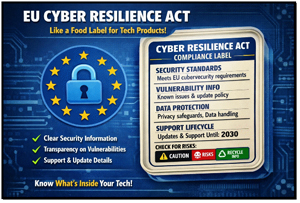 [Click on image for larger view.]
He stressed that the timeline for this transition is imminent: by June 2026, government reporting platforms and assessment bodies must be ready, and by September 2026, manufacturers must begin reporting known vulnerabilities.
Fortunately, the law exempts individual hobby projects, focusing instead on commercial entities and "stewards," foundations like the CNCF that provide governance and distribution. For organizations, meeting these requirements means adopting established best practices, such as using the OpenSSF security badges or the Free Software Foundation Europe's "reuse" tool to generate machine-readable Software Bills of Materials automatically.
One part of KubeCon I enjoy is when they bring up people to share their real-life experiences with containers and K8S.
K8S is used in the real world for critical tasks, and in the world of high-stakes infrastructure, sovereignty is realized through architectural abstraction rather than isolation. Oskar Kristiansen, an Enterprise Platform Engineer at Saxo Bank, illustrated this by identifying the wall where automated Kubernetes workloads meet external boundaries. To break this, his team implemented a "Service Blueprint" model that abstracts these dependencies, allowing developers to declare needs through a catalog. This allowed them to gain greater efficiency and automate infrastructure operations without manual intervention.
Continuing this theme of strategic autonomy, Thomas Comtet, Head of Container and Cloud Native platforms, and Yann Rotilio, Senior Staff Engineer - Kubernetes Specialist, both from France's national railway (SNCF), said that it is equally vital for SNCF.
They found that their initial managed cloud offerings fell far short of their resiliency targets, so they rebuilt their foundation from scratch using open-source layers. By maintaining 30% of applications in its own data centers and building a cloud-native environment comparable to public offerings, SNCF found that the second-largest railway network in the world remains safe and that its trains run on time, well, most of the time.
Companies and customers also had a chance to present during the day's two keynotes. They discussed the "Sovereign AI Factory," a Kubernetes-native blueprint designed to scale generative AI without surrendering data control.
Red Hat and Solo.io said a massive roadblock to current AI adoption is the inefficiency of traditional load balancing, which results in hardware waste and has caused many companies' cloud bills to skyrocket. They said that by implementing the Gateway API inference extension and LLMD, organizations can create an AI-aware routing fabric to address this issue.
During their speech, Solo.io announced that they are donating their Agent Registry project to the CNCF, which provides the necessary visibility and offers a central catalog for managing approved AI artifacts and tools.
One of the more engaging keynotes was by Planet Labs, which utilizes Kubernetes to process terabytes of daily satellite data. This data has far-reaching consequences and has enabled authorities to levy fines totaling 3 billion euros for illegal deforestation. Furthermore, the launch of hyperspectral satellites enables the precise detection of methane plumes from individual facilities. It was an interesting take on how technology is helping the planet.
During the keynotes, the CNCF recognized individuals and companies for their outstanding contributions to the cloud-native ecosystem and community, and brought up various individuals to accept awards, including the TAGGIES, which are recognition awards within the CNCF Community Awards given to individuals who have done the most to advance the CNCF TAGs.
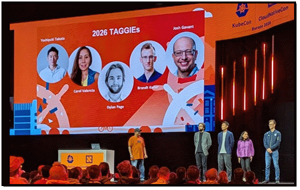 [Click on image for larger view.]
After the keynotes ended, I headed back to the solutions showcase to visit booths and talk to vendors and contributors.
Vendor Discussions
KubeCon is more than the CNCF; it is also about the ecosystem surrounding Kubernetes, containers, and other cloud-native technologies. One of the more interesting and enjoyable parts of KubeCon is talking with people and companies on the showcase floor. Below is a recap of discussions I had with a few of the vendors.
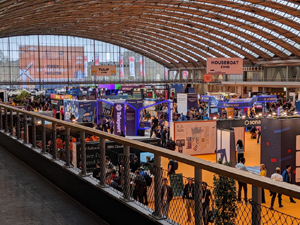 [Click on image for larger view.]
VMware
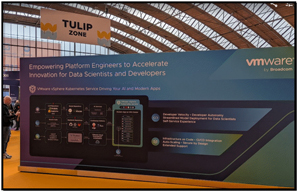
I spent some time talking with the folks at VMware about VMware vSphere Kubernetes Service (VKS), their fully certified, native Kubernetes platform that is integrated into and now bundled with VMware Cloud Foundation (VCF) and the less expensive VMware vSphere Foundation (VVF).
 [Click on image for larger view.]
The integration of K8S into VVF or VCF enables administrators to deploy and manage Kubernetes clusters directly in their data center using the VMware tools and workflows they have spent decades mastering, and simplifies K8S deployment and use. VKS provides tools such as automated lifecycle management and high-performance container orchestration, as well as seamless integration with vSphere storage and networking for Kubernetes.
At KubeCon, Broadcom announced VKS 3.6 and submitted Velero, their backup project, to the CNCF Sandbox. VKS 3.6 brings support for Kubernetes 1.35, RHEL 9 compatibility, declarative performance tuning, and improved upgrade safety for enterprise platform teams.
You can get more information about VKS here.
Final Thoughts
The second day of the conference shifted focus to the intersection of digital sovereignty and global innovation. I learned that the modern enterprise must balance the desire for independence with the collaborative spirit of open source, distinguishing between a unified global codebase and localized operational deployments. High-stakes infrastructure providers shared how they achieve autonomy through architectural abstraction rather than isolation, rebuilding foundations with open-source layers to ensure resiliency. This approach allows organizations to maintain control over their data and meet strict regional regulations while still leveraging the collective power of a worldwide community.
 [Click on image for larger view.]
The CNCF keynote speeches were recorded and will be available on the CNCF's YouTube channel within two weeks after the event.
About the Author
Tom Fenton has a wealth of hands-on IT experience gained over the past 30 years in a variety of technologies, with the past 20 years focusing on virtualization and storage. He previously worked as a Technical Marketing Manager for ControlUp. He also previously worked at VMware in Staff and Senior level positions. He has also worked as a Senior Validation Engineer with The Taneja Group, where he headed the Validation Service Lab and was instrumental in starting up its vSphere Virtual Volumes practice. He's on X @vDoppler.