News
Software Supply Chain Security Shifts Toward AI, SBOM Operations and Delivery Governance
Gartner's new Magic Quadrant for Software Supply Chain Security frames the category as an emerging stand-alone market for protecting software factories from third-party risk, including open source, third-party AI, containers and external providers.
The June 2026 report says the SSCS market "is emerging as a stand-alone capability set that protects organizations from third-party software risks, including open-source and third-party AI." Gartner says software engineering and security leaders should use the report "to help select vendors that can protect their software factories from upstream providers."
For enterprises, the report's main takeaway is that software supply chain security is no longer just software composition analysis. Gartner defines SSCS tools as solutions that "reduce business technology risk by protecting against compromise from third-party software," using threat intelligence, software composition analysis, software bills of materials and third-party governance to identify risk and ensure software integrity from acquisition through delivery.
The report says software supply chains extend beyond organizational boundaries and include both internal systems and external entities. Internal systems include software delivery pipelines, dependencies and development environments, while external entities include partners, open-source software, containers, AI models and vendors. Gartner adds: "Organizations have greater control over internal systems and little to no control over external entities."
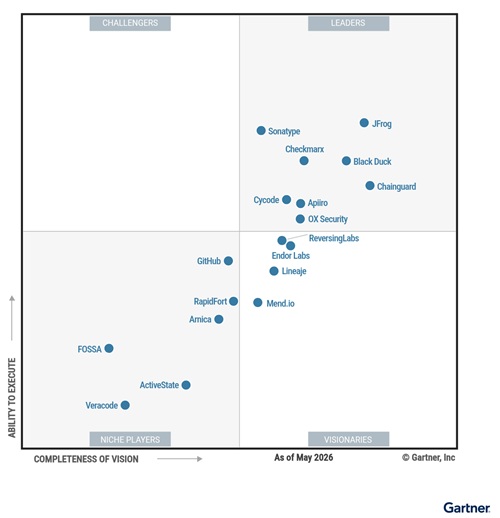 [Click on image for larger view.] Magic Quadrant for Software Supply Chain Security (source: Gartner).
Market Changes Enterprises Can Act On
The report's most actionable market signal is that Gartner groups several formerly separate concerns under SSCS: third-party software risk protection, SBOM management, threat intelligence, software delivery pipeline posture, developer workspace security, AI component protection and governance of software consumption.
Gartner lists tangible SSCS outcomes including identifying and mitigating risks from the widespread use of third-party software, including open source and commercial software, third-party AI large language models, Model Context Protocol servers and containerized workloads. It also lists reducing developer friction, guarding against compromised upstream dependencies, protecting intellectual property and satisfying governance and regulatory requirements.
That gives enterprises a practical buying lens: The product evaluation should not stop at vulnerability detection. Buyers should ask whether tools can enforce policy, create evidence, reduce alert noise, support engineering workflows and handle risk from suppliers and AI-assisted development that the enterprise does not directly control.
AI Is Now Part of the SSCS Checklist
Gartner includes "Protection from third-party AI components including large language models (LLMs) and Model Context Protocol (MCP) servers" among optional SSCS features. It also cites AI-augmented workflows that analyze security posture data and recommend alternatives to third-party software.
That matters because AI development introduces new software supply chain inventory and governance questions. Based on Gartner's criteria, enterprises should determine whether a tool can identify AI components, govern AI-generated code, monitor MCP server configurations, support AI bills of materials where applicable, and enforce controls inside developer workflows rather than only after code reaches a central security review.
SBOMs Are Becoming Operational Evidence
SBOMs are mandatory in Gartner's market definition. The report says SSCS tools must support the collection, storage and continuous analysis of SBOMs to identify third-party risk within components used to create software, along with generation of SBOMs for downstream users.
The report also lists SBOM life cycle management as an optional feature, including discovery, access and secure exchange of SBOMs between multiple suppliers and consumers through a common exchange point. That shifts the enterprise question from whether a tool can produce an SBOM to whether it can keep SBOM data useful over time.
Enterprises should evaluate SBOM support for ingestion, storage, continuous analysis, downstream sharing, VEX or CSAF support, vulnerability prioritization and integration with build, artifact and deployment systems. A static SBOM export alone does not address the operational model described in the report.
Reachability and Remediation Matter
Gartner lists reachability analysis as an optional feature that helps analyze and prioritize risk by identifying whether applications depend on vulnerable code fragments and affected dependencies. The report also describes workflows that replace artifacts that are tampered with or affected by vulnerabilities during or after build and deployment.
For buyers, this is one of the clearest ways to separate alert generation from useful remediation. Enterprises should test whether a tool can identify reachable or exploitable risk, create tickets or pull requests, recommend safer versions or alternatives, and provide upgrade impact analysis. Gartner's framing points toward remediation workflows that security and engineering teams can actually use, not just dashboards that add to vulnerability backlogs.
Governance Moves Into the Delivery Pipeline
The report says SSCS tools should help satisfy governance and regulatory requirements "by making the software delivery infrastructure auditable and automating the enforcement of application security policies." It also lists governance of third-party software consumption as a mandatory feature.
This makes software delivery infrastructure part of the control surface. Enterprises should evaluate integrations with source control, artifact management, build tools, CI/CD pipelines and developer environments. They should also check whether policies can be applied consistently across teams, suppliers, packages, containers and AI-related components.
The practical advice from Gartner's market definition is to treat SSCS as a software factory control layer. Buyers should map required controls to their own development model: regulated environments may prioritize auditability and compliance evidence; AI-heavy engineering teams may prioritize MCP and AI code governance; container-heavy environments may prioritize provenance, runtime analysis and curated artifact sources.
Gartner's overall message is that SSCS is becoming a broader enterprise discipline for managing the integrity of software from acquisition through delivery. The report says SSCS tools protect organizations from insider threats and compromised external entities and can automate enforcement of security and compliance policies. Enterprises can use that framing to build evaluations around business risk, engineering fit and operational evidence rather than quadrant placement alone.
While Gartner usually charges for its research reports, the Magic Quadrant series is typically available for free in licensed-for-distribution versions from vendors mentioned in the reports. A quick web search will find them.
About the Author
David Ramel is an editor and writer at Converge 360.