News
AI Agents Move to the Center of Gartner's 2026 Cloud-Native Magic Quadrant
Gartner's 2026 Magic Quadrant for Cloud-Native Application Platforms preserves the market's familiar group of Leaders, but the report's larger story is the changing role of the platforms themselves. Google, Microsoft, Amazon Web Services, Red Hat and Alibaba Cloud occupy the Leaders quadrant, while Gartner's research increasingly treats AI agents, governance, cost controls and secure operations as fundamental parts of cloud-native application delivery.
The Aug. 3 2026 Magic Quadrant report defines cloud-native application platforms as managed application runtime environments with integrated application life cycle capabilities. They support distributed deployments, elasticity, multitenancy and self-service without requiring development teams to provision infrastructure or manage containers.
The report says the market is moving beyond infrastructure abstraction and standardized application runtimes. Gartner evaluated vendors for support of AI-agent development, serverless computing, scalability, availability, monitoring, observability, cost management, platform engineering and governance. It also identified AI-assisted runtime environments, agentic and inference frameworks, and sovereign AI support among the market's optional capabilities.
Here's the quadrant for 2026:
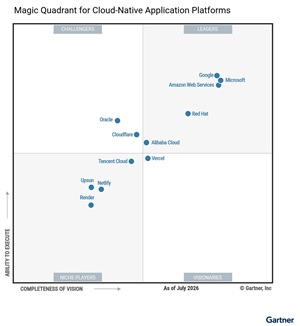 [Click on image for larger view.] 2026 Magic Quadrant for Cloud-Native Application Platforms (source: Gartner).
Here's the quadrant for 2025:
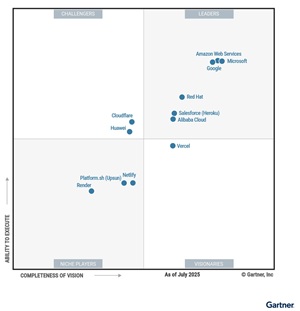 [Click on image for larger view.] 2025 Magic Quadrant for Cloud-Native Application Platforms (source: Gartner).
As detailed in our coverage of the 2025 report, the prior research put the three large cloud providers in a close group, with Red Hat following them. That overall pattern remains intact. The principal roster changes are the addition of Oracle as a Challenger and Tencent Cloud as a Niche Player, and the removal of Huawei and Salesforce Heroku. Platform.sh, meanwhile, rebranded as Upsun in September 2025.
Gartner cautions that an appearance or disappearance from a Magic Quadrant does not necessarily represent a changed opinion of a vendor. It can result from changes in the market, evaluation criteria or the vendor's own focus.
AI Agents Become a Platform Workload
AI is now embedded throughout Gartner's description of the cloud-native application platform market. The platforms are expected to run web applications, mobile back ends, microservices, analytics applications and AI or machine learning models. Gartner also lists AI agents and applications as a distinct use case, defining them as autonomous or semiautonomous software entities that perceive, make decisions, take actions and pursue goals.
This change appears in both the evaluation criteria and the vendor descriptions. Gartner's Product or Service assessment explicitly considers support for AI-agent development, while its list of optional platform features includes intelligent configuration and orchestration, AI inference and agentic frameworks, and the ability to run AI workloads in jurisdictionally compliant environments.
Several vendors outside the Leaders quadrant illustrate how agentic workloads are changing platform architecture and economics. Cloudflare expanded Workers with Containers and an Agents SDK for stateful AI agents. It also introduced CPU-time billing, under which customers pay for active CPU cycles rather than idle time spent waiting for large language model responses.
Render introduced durable Workflows for tasks such as agent runtimes, an MCP server for AI-agent infrastructure management, persistent compute and sandboxed execution. Gartner says the company also moved from per-seat pricing to flat platform fees to better model AI-agent workload costs.
Vercel, the report's sole Visionary, is expanding beyond front-end application delivery with AI Gateway, durable workflows, sandboxed compute and related agent infrastructure. Netlify has added Agent Runners, a managed AI Gateway and a serverless database, while Tencent Cloud now offers an AI gateway, an MCP server and AI Builder. Upsun has also introduced an MCP server and generative configuration tools.
Together, those examples show AI-agent support spreading across hyperscale clouds, edge platforms, front-end platforms and smaller developer-focused services. The report does not treat agents as a separate application category requiring an entirely separate platform market. Instead, agent execution, orchestration, observability and governance are being incorporated into cloud-native platforms.
Governance Joins Developer Speed
Gartner says cloud-native application platforms are evolving into opinionated, integrated systems that combine infrastructure abstraction with standardized runtimes, curated configurations, governance guardrails and built-in operational controls. The market is expanding beyond infrastructure specialists to serve front-end developers, product teams and AI-assisted development workflows.
The resulting objective is not simply to make deployment easier. Gartner identifies platform discipline, cost visibility, secure deployment and reduced operational variability as part of the value proposition. Preferred configurations, policy controls and high-volume observability can reduce fragmentation and unnecessary technology choices while making application modernization more repeatable.
Sovereign AI support is another newly prominent consideration. Gartner describes this capability as enabling organizations to operate models, data pipelines and inference workloads in environments that comply with jurisdictional, privacy and regulatory requirements. Oracle's newly included platform, for example, spans public, sovereign, government and dedicated cloud deployments, while Cloudflare identifies data localization as part of its response to changing customer requirements.
Multiplatform Does Not Necessarily Mean Multiprovider
The report draws an important distinction between using multiple types of application platforms and attempting to maintain maximum portability across multiple cloud providers. Gartner identifies a separation between front-end-focused services and comprehensive back-end platforms, and says a multiplatform strategy can help organizations use the strengths of each type.
At the same time, the research says multiprovider strategies remain difficult because platforms differ in abstractions, governance models and operational tooling. Enterprises are increasingly prioritizing consistency, control and end-to-end accountability over maximum portability, according to Gartner, often standardizing on fewer platforms with stronger built-in governance.
That tension appears throughout the vendor cautions. Gartner notes that integrated hyperscale platforms can create dependencies on provider-specific services, APIs, identities, observability systems and deployment tools. Smaller and more neutral providers can offer a simpler or more portable model, but may lack the operational depth, back-end control, integration ecosystems or Kubernetes capabilities required by complex enterprise environments.
While Gartner usually provides research to only paid clients, its Magic Quadrant reports are often made available for free by the vendors themselves in licensed-for-distribution complimentary editions, which can be found with a quick web search.
About the Author
David Ramel is an editor and writer at Converge 360.