News
Linux Creator Plants Foot on AI Open Source Contribution Issue
Linux creator and lead maintainer Linus Torvalds has drawn a firm line in the open source debate over artificial intelligence, declaring that the Linux kernel will not become an anti-AI project and telling developers who cannot accept that position that they are free to fork the project or leave.
The unusually direct intervention comes amid continuing resistance to AI-assisted development in open source communities. Critics have raised concerns about low-quality automated submissions, increased review burdens, uncertain code provenance and whether developers can legally certify contributions produced with tools trained on large collections of existing source code.
Red Hat has summarized that dispute, noting that some open source developers regard generative AI systems as "plagiarism machines" or "copyright laundering" mechanisms. Those concerns include the possibility that generated output could reproduce proprietary or license-incompatible code, along with a broader objection that AI companies have trained models on open source software without preserving the obligations normally attached to that software.
Red Hat also noted that concerns surrounding the Developer Certificate of Origin (DCO) have led some projects to prohibit AI-assisted contributions altogether. The DCO requires contributors to certify that they have the right to submit their work under the project's license.
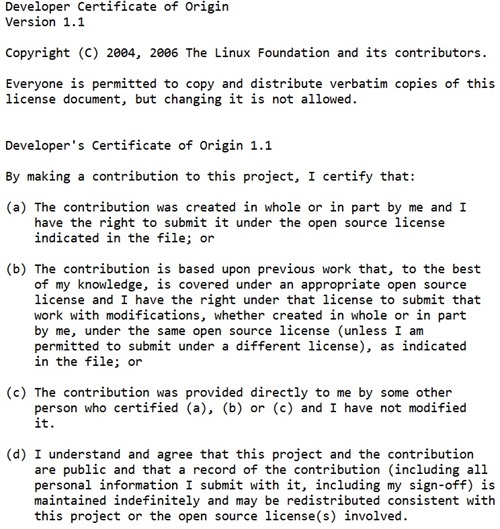 [Click on image for larger view.] Developer Certificate of Origin (source: Linux Foundation).
Torvalds, however, made clear that such general opposition will not determine policy for the Linux kernel.
Responding to a comment that a position being discussed on the kernel mailing list appeared broadly anti-large language model (LLM), Torvalds wrote: "Yes. And no, that's not the position of the Linux kernel."
"I realize that some people really dislike AI, but this is an area where I'm willing to absolutely put my foot down as the top-level maintainer," he continued in the mailing-list post.
"Linux is not one of those anti-AI projects, and if somebody has issues with that, they can do the open-source thing and fork it.
"Or just walk away."
'Clearly a Useful' Development Tool
Torvalds' position is not that kernel developers must use AI. Rather, he argued that developers who find the technology useful should not be prevented from using it.
"AI is a tool, just like other tools we use," he wrote. "And it's clearly a useful one."
That assessment represents a notably stronger endorsement than the cautious and frequently skeptical comments Torvalds has made about AI hype in the past.
"It may not have been that 'clearly' even just a year ago, but it's no longer in question today," he said. "There are other questions around AI (like what the economy of it will actually look like in the end), but 'is it useful' is no longer one of those questions. Anybody who doubts that clearly hasn't actually used it."
That usefulness does not mean AI has been painless for the kernel community. Automated tools have produced duplicate vulnerability reports, questionable patches and additional work for maintainers who must determine whether machine-generated findings are accurate, relevant or already addressed.
Torvalds acknowledged both the maintenance burden and AI's apparent success at exposing flaws.
"Yes, it can also be a somewhat painful tool, both for maintainer workloads and just from a 'it keeps finding embarrassing bugs' standpoint," he wrote.
But he rejected avoidance as a solution.
"The solution is not to put your head in the sand and sing 'La La La, I can't hear you' at the top of your voice like some people seem to do," Torvalds said. "The solution is to make sure those LLM tools help maintainers instead of just causing them pain."
"We're not forcing anybody to use it, but I will very loudly ignore people who try to argue against other people from using it."
Humans Still Own the Contribution
The Linux kernel's existing AI coding-assistant guidance reflects that pragmatic position. AI-assisted contributions are allowed, but they must follow the same development, coding, licensing and submission requirements as other kernel changes.
An AI agent cannot add the legally significant Signed-off-by tag used to certify compliance with the DCO. A human contributor must review the generated code, ensure that it complies with licensing requirements and take full responsibility for the submission.
The guidelines also call for substantial AI involvement to be disclosed with an Assisted-by tag identifying the agent, model version and any specialized analysis tools involved.
That approach attempts to separate responsible AI assistance from what critics commonly call "AI slop": contributors remain accountable for understanding, testing and defending their work rather than simply forwarding unverified model output to maintainers.
Torvalds also cautioned against evaluating machine intelligence against an idealized view of human development.
"AI isn't perfect," he wrote. "But Christ, anybody who points to the problems at AI had better be looking in the mirror and pointing at themselves at the same time.
"Because it's not like natural intelligence is always all that great either."
Technical Merit Over Ideology
Torvalds ultimately framed the dispute as a question about the purpose of Linux and the basis on which kernel-development decisions should be made.
"The kernel project has been and will continue to be about the technology," he wrote.
Although he acknowledged that collaboration and community are important motivations for open source contributors, he described those social benefits as secondary to producing better software.
"This is NOT some kind of 'social warrior' project, never has been, and never will be," Torvalds said.
"In the kernel community we do open source because it results in better technology, not because of religious reasons.
"And so we make decisions primarily based on technical merit. Not fear of new tools."
About the Author
David Ramel is an editor and writer at Converge 360.