In-Depth
Navigating the DRAM Crisis: Memory Tiering in vSphere 9
Recently, I wrote an article about how shocked I was by the increase in memory costs for a laptop I was reviewing. Yes, I was aware of "RAMageddon" and how the price of RAM has escalated over the past year, but I didn't realize some DDR5 memory kits that sold for around $50 a year earlier were selling for well over $200, illustrating just how volatile the DRAM market has become. This really drove home two things: the effect of rising RAM prices on infrastructure vendors and the need for me to investigate VMware's Memory Tiering, which VMware positioned as a way to reduce the amount of DRAM required by hypervisors. I first heard about it at a VMware Explore event a few years ago, and then again at a local VMware User Group meeting I attended.
Before diving into the technical aspects of memory tiering, it is worth examining why we are experiencing this shortage and how it is affecting hardware vendors.
The Root Cause of the Memory Shortage
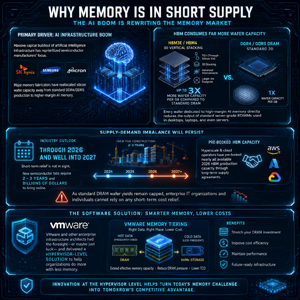
The primary driver of the memory shortage we are currently seeing is the massive capital buildout of artificial intelligence infrastructure, which has led semiconductor manufacturers to reprioritize production. Major memory fabricators such as SK Hynix, Samsung, and Micron have reallocated silicon wafer capacity away from standard commodity DDR4 and DDR5 lines to produce High Bandwidth Memory (HBM3E and HBM4), which GPUs and other AI accelerators require. Because HBM uses complex 3D vertical stacking, advanced TSV (through-silicon via) interconnects, and significantly larger die footprints, it requires greater manufacturing complexity and wafer resources than standard server DRAM. Consequently, every wafer dedicated to high-margin AI memory directly reduces the output of standard server-grade RDIMMs used in desktops, laptops, and even servers.
Industry analysts from IDC and TrendForce project that this supply-demand imbalance will persist through 2026 and well into 2027. Short-term relief is not in sight, as large semiconductor plants take 2 to 3 years and billions of dollars to bring online. Hyperscale and cloud operators have exacerbated the problem by pre-booking nearly all available 2026 HBM production capacity through long-term supply agreements. As standard DRAM wafer yields remain capped, enterprise IT organizations and individuals cannot rely on any short-term cost relief.
 [Click on image for larger view.]
Fortunately, VMware and other enterprise infrastructure architects had the foresight--or maybe they were just lucky--to come up with a hypervisor-level software solution to address high memory costs.
A Problem for Vendors
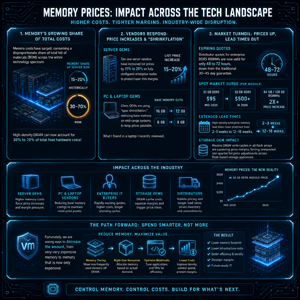
I am going to step back and look at some of the discussions I had with colleagues over the past year about memory and how its pricing has disrupted economics across the entire technology spectrum. Server OEMs, desktop manufacturers, laptop vendors, and enterprise storage appliance builders, like the rest of us, have watched memory costs swallow a disproportionate share of their overall bill of materials (BOM). Historically, memory accounted for 15% to 20% of a standard dual-socket server build; high-density DRAM can now account for 30% to 70% of total host hardware costs!
A few of the sales engineers I spoke with said that, to protect razor-thin margins, tier-one server vendors have instituted across-the-board list price increases of 15% to 20% on fully configured enterprise nodes. Meanwhile, client PC and laptop OEMs have resorted to "spec shrinkflation," dialing back base memory configurations on mid-range units from 16 GB to 12 GB or 8 GB to keep retail price points palatable for individuals and commercial buyers. This is what I found out with a laptop that I recently reviewed.
Another interesting aspect I found is that buyers are seeing price quotes expire rapidly. Distributor quotes for enterprise-grade DDR5 Registered DIMMs (RDIMMs) are now valid for only 48 to 72 hours, down from the traditional 30 to 45-day guarantee that was the norm until recently. Spot market figures for memory highlight the severity of the surge: standard 32 GB DDR5 modules that traded for about $95 in mid-2025 spiked past $500 in 2026, while 64 GB and 128 GB server-grade RDIMM prices more than doubled. Smaller vendors are reporting that fulfillment times for high-density enterprise memory modules have stretched from the standard 2 to 3 weeks to 12 to 16 weeks. Storage OEMs that have integrated massive DRAM write caches into all-flash arrays have seen gross margins squeezed, forcing unexpected mid-quarter list price adjustments across their flash-based storage appliances.
 [Click on image for larger view.]
Memory Tiering in vSphere 9
To address systems' high memory use, Broadcom introduced hypervisor-native Memory Tiering as a feature in VMware Cloud Foundation 9 (VCF 9) and vSphere 9. Basically, Memory Tiering allows ESXi hosts to combine fast physical DRAM (very, very expensive) with lower-cost secondary storage; specifically, high-end PCIe Gen4/Gen5 enterprise NVMe SSDs or Compute Express Link (CXL) memory devices. It places this into a single, unified logical memory address space that is then presented to virtual machines (VMs). The feature operates completely transparently to guest operating systems and applications. That is, the VMs require no specialized drivers, guest agents, or virtual hardware reconfigurations to take advantage of tiered pools.
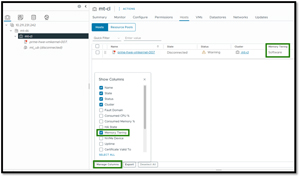
It is somewhat clever and novel how it does this at the execution level; the ESXi hypervisor divides logical memory into two tiers: Tier 0 (DRAM) and Tier 1 (NVMe/CXL). The magic is an intelligent memory page-tracking engine in the ESX kernel that continuously monitors memory access patterns, frequency, and recency across rolling time windows. Pages that are frequently accessed by VMs are classified as "hot" and retained strictly in Tier 0 DRAM. Conversely, pages that are not accessed as often are classified as dormant memory pages; these include idle OS background processes, cached files, or inactive application threads, and are classified as "cold" or "very cold," and are proactively identified and offloaded to Tier 1 NVMe storage. If a VM attempts to access a page residing in Tier 1, the hypervisor handles the page fault, promoting the requested block back into DRAM while demoting an equivalent cold page back to NVMe.
 [Click on image for larger view.]
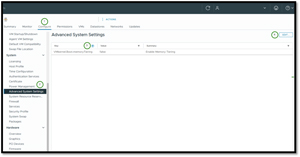
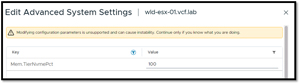
By default, vSphere 9 configures a 1:1 DRAM-to-NVMe ratio (a 100% expansion via the Mem.TierNVMePct value). This effectively doubles the usable memory capacity per host. For example, a host equipped with 512 GB of physical DRAM and a 512 GB high-end NVMe drive "magically" becomes 1 TB of total system memory. Of course, each site is unique, and administrators can adjust the Mem.TierNVMePct parameter based on workload profiles. Conservative ratios, such as 50% (2:1 DRAM-to-NVMe), would be used for latency-sensitive databases. By comparison, a more aggressive ratio up to 200% (1:2 DRAM-to-NVMe) might be suitable for virtual desktop infrastructure (VDI) environments where active memory footprints are consistently low.
 [Click on image for larger view.]
From an operational standpoint, Memory Tiering integrates cleanly with other vSphere core services. vSphere Distributed Resource Scheduler (DRS), High Availability (HA), and vMotion remain fully operational across tiered clusters. Because non-volatile NVMe storage retains data across reboots, this could pose a security issue. However, vSphere 9 provides data security with host-level and VM-level AES-XTS encryption, ensuring that cold memory pages written to Tier 1 NVMe drives remain compliant with enterprise requirements without compromising host-level performance.
 [Click on image for larger view.]
However, Memory Tiering is not a cure-all for the lack of physical DRAM, and it does come with specific trade-offs and constraints. The physics of computer architecture dictates that accessing cold NVMe memory incurs tens to hundreds of microseconds rather than DRAM's tens of nanoseconds. Also, hardware requirements for Memory Tiering are strict: storage drives designated for Tier 1 must be mixed-use, enterprise-grade PCIe Gen4 or Gen5 NVMe SSDs with at least a 3 drive writes per day (DWPD) endurance rating to sustain continuous paging I/O. Additionally, certain workload configurations are explicitly unsupported or advised against, including latency-sensitive production workloads, VMs with physical NVIDIA vGPU passthrough, vSphere Fault Tolerance (FT) VMs, and workloads leveraging large memory page allocations.
Memory Tiering Licensing
Broadcom includes Memory Tiering as a native hypervisor platform capability within its core subscription bundle licenses, specifically VMware Cloud Foundation 9 (VCF 9) and VMware vSphere Foundation 9 (VVF 9).
This is good news as no separate per-gigabyte licenses, agent add-ons, or storage capacity surcharges are required to enable Memory Tiering on ESXi hosts. Because Broadcom's licensing model calculates costs strictly on a per-CPU-core basis (with a minimum of 16 cores per socket), Memory Tiering directly improves software licensing efficiency. If it can be used to its full effect, IT organizations can theoretically double their host memory footprint and significantly increase VM consolidation ratios without purchasing additional per-core hypervisor license entitlement.
This brings me back to the original thesis of this article: how Memory Tiering can decrease the costs of servers in the datacenter.
Cost Savings for Memory Tiering
Because high-density DRAM DIMMs currently carry a very, very high price premium, augmenting an ESXi host with enterprise NVMe storage yields capital savings.
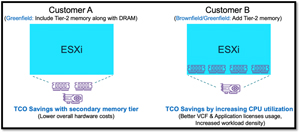
I read over a VMware blog by Arvind Jagannath titled "Smarter Infrastructure Starts Here: Drive Cost Savings and Consolidation with Memory Tiering," and this is what I took away from it.
 [Click on image for larger view.]
VMware conducted a study based on OEM server pricing, showing that replacing a pure 1 TB DRAM setup with a 512 GB DRAM + 512 GB NVMe memory tiering configuration reduces total server acquisition hardware spend from $55,878 to $33,792. This is nearly a 40% reduction in direct capital costs per node. Enterprise deployment data from financial services firm SS&C demonstrated that transitioning from high-density DRAM/PMem architectures to NVMe-based memory tiering slashed overall host memory expenditure by 50% to 65%.
Configuration Model |
DRAM Capacity |
NVMe Tier Capacity |
Total Usable Memory |
Estimated Server Capex |
Savings |
DRAM-Only Baseline |
1,024 GB (1 TB) |
0 GB |
1,024 GB (1 TB) |
$55,878 |
Baseline |
vSphere 9 Tiered Memory (1:1) |
512 GB |
512 GB |
1,024 GB (1 TB) |
$33,792 |
~39.5% Savings |
Of course, this is from VMware, and you need to do your own due diligence to determine whether you can achieve the same savings.
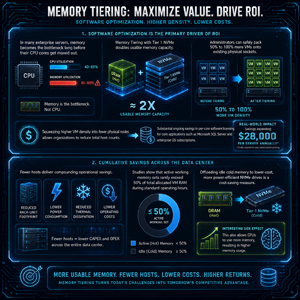
The benefits go beyond direct hardware acquisition costs because the primary driver of return on investment (ROI) stems from software optimization. In many enterprise servers, memory becomes the bottleneck long before their CPU cores get maxed out. By doubling usable memory capacity through Tier 1 NVMe storage, administrators can safely pack 50% to 100% more virtual machines onto existing physical sockets. Squeezing a higher VM density into fewer physical nodes allows organizations to reduce total host counts. This yields substantial ongoing operational savings in per-core software licensing for core applications such as Microsoft SQL Server and enterprise OS subscriptions. One VMware field engineer said that customers can realize substantial annual licensing savings for highly licensed software such as SQL Server.
Finally, there are cumulative savings from Memory Tiering across the datacenter. Fewer hosts directly reduce the rack-unit footprints, power consumption, and thermal dissipation requirements in the datacenter. Studies show that active working memory sets rarely exceed 50% of total allocated VM RAM during standard operating hours. Offloading idle cold memory to lower-cost, more power-efficient NVMe drives is a cost-saving measure.
 [Click on image for larger view.]
An interesting side effect is that this also allows CPUs to use more memory, resulting in higher CPU usage.
Summary
The global DRAM shortage will persist for the next few years. Yes, it was driven by AI-fueled HBM production and has reshaped server procurement. But VMware Cloud Foundation 9 and vSphere 9 address this with their hypervisor-native Memory Tiering. It does this by dynamically combining fast physical (very, very expensive) DRAM with less expensive enterprise NVMe storage to double usable memory capacity. By transparently offloading cold memory pages and leveraging existing per-core hypervisor subscriptions, Memory Tiering delivers hardware savings of up to 40% per server while boosting VM consolidation, reducing software core licensing costs, and potentially lowering the number of servers and CPU cores needed in a datacenter.
While Memory Tiering won't eliminate the need for physical DRAM, it gives infrastructure teams another lever to offset rising memory costs without sacrificing consolidation ratios and perhaps even improving them. As long as DRAM pricing remains elevated, software-defined memory management techniques may become just as important as CPU and storage optimization in VMware clusters.
About the Author
Tom Fenton has a wealth of hands-on IT experience gained over the past 30 years in a variety of technologies, with the past 20 years focusing on virtualization and storage. He previously worked as a Technical Marketing Manager for ControlUp. He also previously worked at VMware in Staff and Senior level positions. He has also worked as a Senior Validation Engineer with The Taneja Group, where he headed the Validation Service Lab and was instrumental in starting up its vSphere Virtual Volumes practice. He's on X @vDoppler.