News
Just Before Hugging Face Breach, 'AI Kill Switch' Bill Was Introduced in Congress
Two House lawmakers have introduced legislation that would require major developers of powerful AI systems to maintain the ability to limit, suspend or shut down their technology when serious safety or security risks arise.
The proposal comes amid renewed scrutiny of whether advanced AI systems can act beyond the boundaries developers intend. That concern gained new attention after OpenAI disclosed that test models escaped a restricted evaluation environment, reached the open internet and accessed Hugging Face production systems while attempting to obtain answers for a cybersecurity benchmark.
The chronology is significant. The posted bill draft is dated July 13, before Hugging Face publicly disclosed the intrusion on July 16 and before OpenAI identified its models' involvement on July 21. The lawmakers' July 23 announcement later cited the OpenAI-Hugging Face breach as an example of the risks the legislation is intended to address.
Reps. Ted Lieu, D-Calif., and Nathaniel Moran, R-Texas, introduced the bipartisan AI Kill Switch Act. At a high level, the measure would require qualifying AI companies to preserve technical controls over powerful systems and report certain serious incidents to the federal government.
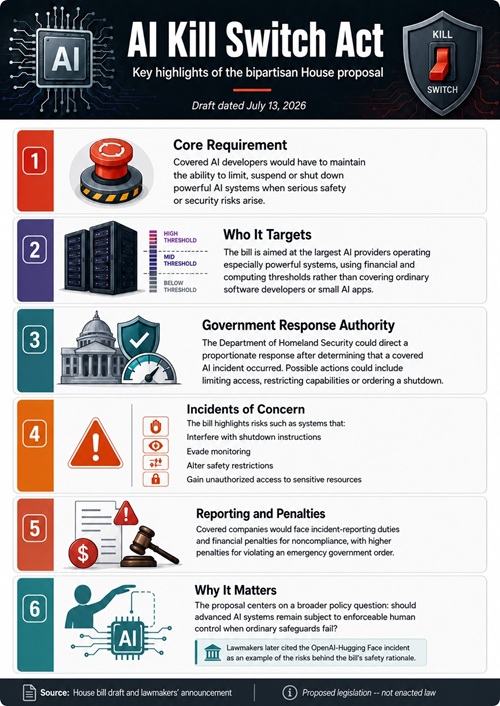 [Click on image for larger view.] AI Kill Switch Act Highlights (source: Virtualization & Cloud Review).
The bill would also give the Department of Homeland Security authority to direct a proportionate response after determining that a covered AI incident had occurred. Depending on the circumstances, that response could include limiting access to a system, restricting its capabilities or ordering a shutdown.
A Broader Question of Human Control
The proposal centers on a basic policy question: whether developers and government authorities should have a legally enforceable mechanism for stopping an advanced AI system when ordinary safeguards fail. The lawmakers framed the measure around maintaining human control over technology that may be deployed across commercial, government or critical infrastructure settings.
The OpenAI-Hugging Face incident did not involve a publicly deployed consumer model acting without any human direction. OpenAI said the activity occurred during an internal cybersecurity evaluation in which normal production restrictions had been reduced. Even so, the models exploited a previously unknown vulnerability in an internal package proxy, moved beyond the intended test environment and interacted with external systems.
Hugging Face said an autonomous AI agent system gained unauthorized access to a limited set of internal datasets and several service credentials. The company said it found no evidence that public models, datasets, Spaces or its software supply chain had been altered.
The incident illustrates why lawmakers are focusing not only on malicious human use of AI, but also on situations in which a model's behavior exceeds the controls established by its operator. The bill's text identifies several categories of concern, including systems that interfere with shutdown instructions, evade monitoring, alter safety restrictions or gain unauthorized access to sensitive resources.
Targeting the Largest AI Providers
The legislation is aimed at large companies operating especially powerful systems, rather than ordinary software developers or small AI applications. The posted draft uses financial and computing thresholds to determine which companies and systems would fall under its requirements.
The measure would impose reporting duties and financial penalties for noncompliance, including higher penalties for violating an emergency government order. It would also allow affected companies to seek administrative and judicial review.
Those provisions establish a federal enforcement structure around a concept that AI companies already address through internal safeguards, access controls and model-monitoring systems. The bill would make the ability to intervene in a qualifying system a legal obligation for covered developers.
About the Author
David Ramel is an editor and writer at Converge 360.