News
OpenAI to Retire Custom GPTs, Replace Them with Plugins
OpenAI is preparing to retire Custom GPTs and move the specialized workflows built around them to a new plugin architecture spanning ChatGPT and its Codex coding agent.
The company announced the change Sept. 11 and currently schedules Custom GPT retirement for Dec. 11, 2026, although it says timing and migration availability can vary by account and workspace.
For affected Enterprise workspaces, OpenAI's current migration schedule targets Oct. 26 for ending creation of new Custom GPTs. Qualifying Enterprise customers with approved deferrals can continue using them until Feb. 11, 2027.
OpenAI has changed its UI to make GPTs less prominent, and when users choose to try creating a new Custom GPT, they are now prompted with an option to create a plugin instead.
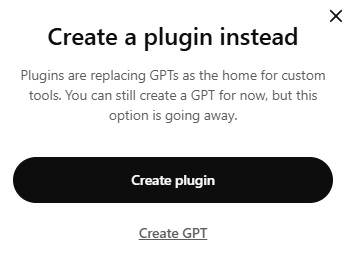 Create Plugin Instead (source: OpenAI).
From Custom Assistants to Reusable Capabilities
Rather than maintaining separate customized versions of ChatGPT, OpenAI is shifting customization toward plugins that can package reusable instructions, reference material and connections to outside services.
Under OpenAI's plugin architecture, a plugin can include one or more skills containing instructions and resources for repeatable workflows, a Model Context Protocol (MCP) server exposing tools and external systems, or both. ChatGPT and Codex share a universal plugin directory, although some capabilities can remain specific to a particular environment.
For organizations, that makes the change more than a simple renaming exercise. A company could package recurring workflows into skills while using MCP servers or connected apps to give those workflows access to enterprise systems and data.
OpenAI says creators will be able to migrate an existing GPT through the My GPTs interface. The GPT's instructions become a skill in the replacement plugin, while knowledge files are copied into plugin reference files and connected apps can be carried over.
Migration Comes with Caveats
Not everything transfers automatically. Existing GPT conversations do not migrate, the selected model does not carry over and Custom Actions may have to be rebuilt using an available app or a custom MCP server.
Sharing also changes. Migrated plugins start private, existing GPT users do not automatically receive access to the replacement and prior sharing settings do not carry over.
OpenAI is also cautioning organizations against assuming that migration will preserve behavior exactly. "A migrated plugin may respond differently," the company says, recommending that users retest familiar prompts, reference-material use, required output formats and integrations before relying on the replacement.
That warning has contributed to pushback from some GPT builders, who argue that plugins do not fully reproduce the dedicated and predictable environment of a Custom GPT. Other complaints have focused on sharing, migration complexity and differences in how migrated workflows use instructions and reference material.
Despite those concerns, OpenAI is clearly consolidating around plugins as its common mechanism for extending its AI products. Its developer documentation now describes plugins as packages users can "discover, install, share, and publish" across ChatGPT and Codex, replacing the separate-custom-assistant model with reusable AI capabilities that can be combined with enterprise tools and services.
About the Author
David Ramel is an editor and writer at Converge 360.