News
AI Infrastructure Tops Enterprise AI Challenges, Survey Finds
Enterprise AI projects are running into infrastructure questions as organizations move from planning toward deployment, according to Digital Realty's September 2026 Global Data Insights Survey. Forty percent of respondents cited a lack of specialized infrastructure required by AI as a main challenge to adopting a formal AI strategy, up from 9% in the company's 2024 research.
The Global Data Insights Survey 2026 points to a widening mix of infrastructure models behind enterprise AI. Half of respondents host AI models in private clouds, 86% are pursuing or exploring sovereign AI, 92% tie data-location strategy to their AI plans and 88% follow a distributed-data approach.
The research is based on an online survey of 2,131 IT decision-makers across 19 countries and 11 industries, conducted from Nov. 23, 2025, through Feb. 4, 2026.
Organizations also appear to be shifting from AI planning toward execution. The share actively executing AI to achieve operational efficiency or reduce costs rose from 27% in 2024 to 37% this year. Only 3% reported no measurable ROI to date, while 63% expect returns within the next six months to two years.
Infrastructure Moves to the Front
Specialized infrastructure led the survey's list of AI adoption challenges at 40%, followed by regulatory and personal-data concerns at 35%. Data availability and quality, storage capacity, interconnection, compute resources and staffing also ranked as significant constraints.
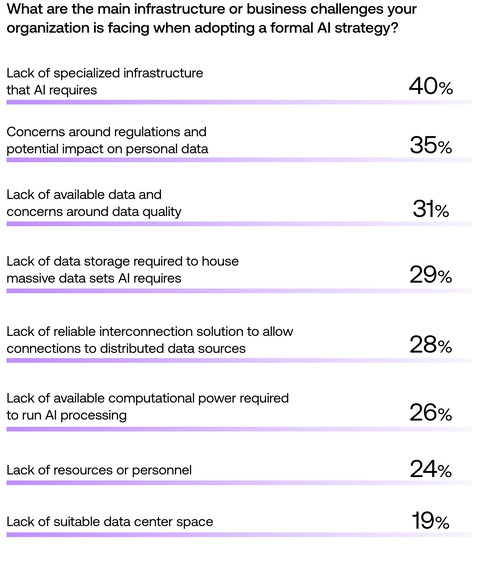 [Click on image for larger view.] AI Infrastructure Challenges Lead Survey (source: Digital Realty).
Those requirements are also shaping workload placement. Integration with existing IT or data infrastructure ranked first at 43%, while regulatory compliance and performance were each cited by 37%. Data proximity, sovereignty, sustainability, cost and intellectual property protection also factored into hosting decisions.
Private Cloud Takes a Large Share of AI Hosting
Private cloud features prominently across the report's AI hosting categories, but enterprises are clearly using a mix of private cloud, public cloud, on-premises infrastructure and colocation. Private cloud accounted for 50% of custom-built AI model hosting and 47% for open-source or fine-tuned large language models (LLMs).
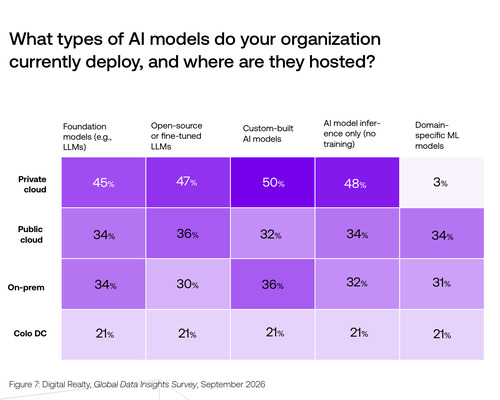 [Click on image for larger view.] Private Cloud Leads AI Hosting (source: Digital Realty).
Sovereignty is another part of that placement decision. Thirty-two percent consider sovereign AI -- in which data and AI models remain within a single national or regulatory jurisdiction -- a requirement, while another 54% are exploring it. The findings point toward hybrid environments in which infrastructure location, governance and data control increasingly overlap.
Distributed Data Becomes Part of the AI Architecture
Data location is increasingly connected to AI planning. Ninety-two percent tie their data-location strategy to AI plans, up from 73% in 2024, while 77% expect to add between one and 10 additional points of presence during the next two years.
The share following a distributed-data approach reached 88%, up from 78% two years earlier. The leading reasons were better data governance, faster processing and alignment with IT strategy, followed by lower breach risk and keeping data closer to users.
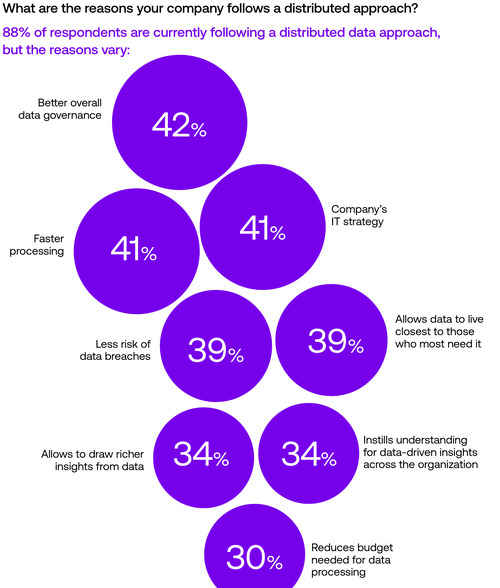 [Click on image for larger view.] Why Enterprises Distribute Their Data (source: Digital Realty).
Real-Time AI Pushes Compute Closer to Data
Real-time AI adds another reason to distribute compute. In the survey, 38% of respondents put 26%-50% of their workloads in the real-time AI category, while 33% put the share at 51%-75%. Another 16% were in the 1%-25% range and 12% in the 76%-100% range.
Separately, 98% expect to have real-time AI workloads requiring immediate data processing and response within the next 12 months. The report links that shift to more inference taking place in metro-adjacent and edge locations, with the share of colocation sites hosting active AI projects projected to rise from 41% today to 47% by 2028.
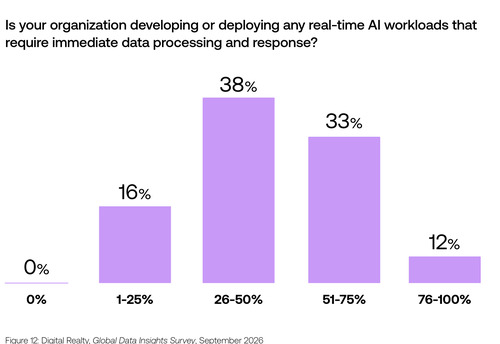 [Click on image for larger view.] Real-Time AI Workload Deployment Levels (source: Digital Realty).
Data Center Portfolios Are Also Changing
Forty-eight percent plan to retire some data centers even as enterprises add distributed capacity. Connectivity is becoming more important at the same time: 86% have processes for exchanging data with business partners, and 92% consider direct or dynamic connections between their platforms and partners or vendors a key requirement.
Sustainability remains part of the infrastructure equation, with 95% reporting that sustainability goals affect their AI strategy. Low power usage effectiveness, renewable energy and green-building credentials were among the leading criteria used to evaluate infrastructure vendors.
The survey does not point to a simple migration from public cloud to private infrastructure. Instead, enterprises are combining private and public cloud, on-premises systems and colocation while adding distributed capacity, pursuing data sovereignty and demanding more direct connectivity. As AI moves further into production, infrastructure decisions increasingly revolve around where compute and data reside -- and how those environments connect.
About the Author
David Ramel is an editor and writer at Converge 360.