News
Cloud Policy Misconfigurations Are Hitting Production, CSA Survey Finds
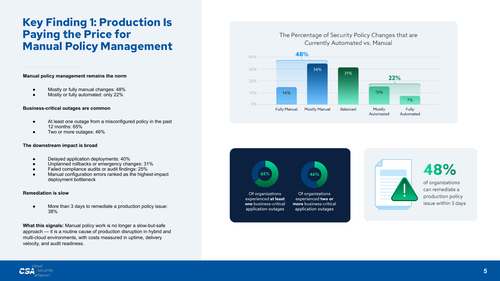
Security policy mistakes are reaching production in hybrid and multi-cloud environments, with 65% of IT and security professionals surveyed by the Cloud Security Alliance reporting at least one business-critical application outage attributed to a misconfigured security policy during the previous 12 months.
The finding comes from CSA's The State of Hybrid and Multi-Cloud Security Policy Management, a survey report examining how organizations manage application connectivity policies across public cloud, private cloud and on-premises infrastructure. In addition to the 65% who reported at least one outage, 46% reported two or more. The survey also found that 40% had experienced a delayed application deployment associated with a policy gap or misconfiguration, 31% reported an unplanned rollback or emergency change, and 25% reported a failed compliance audit or audit finding.
The research is based on an online survey conducted by CSA in May 2026 that received 515 responses from IT and security professionals at organizations of various sizes and locations. The study was commissioned and financed by security vendor AlgoSec, which co-developed the questionnaire with CSA research analysts. CSA said its research analysts conducted the data analysis and interpretation. Some 60% of respondents were in the Americas, and 43% worked for organizations with 500 or fewer employees. A sampling frame, response rate, margin of error and confidence intervals are not documented. Independent verification of the outages and other incidents reported by respondents is also not documented.
Policy Errors Are Reaching Production
The outage numbers sit alongside data showing that policy administration remains substantially manual. Some 48% of respondents described their security policy changes as mostly or fully manual, compared with 22% who described them as mostly or fully automated. Another 31% reported a balanced mix of automation and manual work. The report's results page breaks the manual figure down further, with 14% describing policy changes as fully manual and 34% as mostly manual.
 [Click on image for larger view.] Policy Misconfigurations Hit Production (source: csa).
The operational impact extended beyond outages. Respondents associated policy gaps or misconfigurations with near-miss security incidents in 34% of cases, while 18% reported an actual security incident or breach. Remediation was not necessarily quick after a production problem was identified: 23% said they could remediate in less than 24 hours and another 25% within one to three days. However, 38% said remediation typically took four days or longer, including 6% who reported more than two weeks. Another 9% said remediation times varied too widely to estimate.
The report also ranks manual configuration errors, cross-team coordination and security policy approvals as the three most significant deployment bottlenecks. CSA describes manual configuration errors as carrying the heaviest weighted impact, but the report itself cautions against treating the result as a clear runaway leader: the weighted scores for manual configuration errors, cross-team coordination and policy approvals were 3.24, 3.37 and 3.42, respectively, putting all three within 0.18 points of one another.
Visibility Spans Teams and Consoles
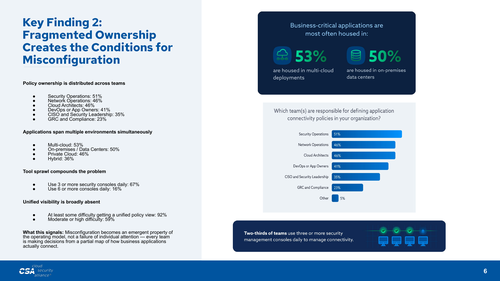
The survey points to fragmented administration as another part of the operational problem. Security Operations was identified as responsible for defining application connectivity policy by 51% of respondents, followed by Network Operations and Cloud Architects at 46% each and DevOps or application owners at 41%. CISO and security leadership were named by 35%, while GRC and compliance were named by 23%. Respondents could select multiple teams.
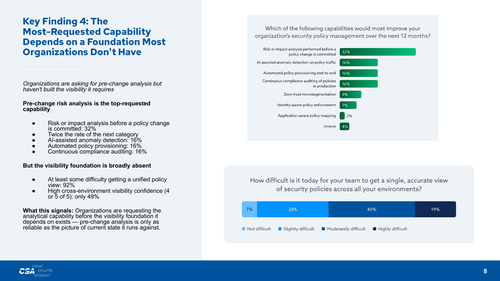
Those teams are also working across multiple management interfaces. Sixty-seven percent said they use three or more security management consoles daily to manage connectivity, including 16% who use six or more. At the same time, 92% reported at least some difficulty getting a single, accurate view of security policies across all environments. Of those respondents, 40% called obtaining that view moderately difficult and 19% called it highly difficult. Only 7% said it was not difficult.
 [Click on image for larger view.] Fragmented Policy Visibility (source: csa).
The infrastructure itself is similarly distributed. Respondents said business-critical applications were housed in multi-cloud deployments at 53% of organizations, on-premises or in data centers at 50%, private clouds at 46%, hybrid environments at 36% and single-provider public clouds at 29%. Because respondents could select multiple answers, the results depict organizations operating several types of infrastructure simultaneously rather than migrating cleanly from one model to another.
CSA lead author Hillary Baron summarized the shift in an official press release, saying, "What was once primarily a network-configuration problem has become an application-connectivity problem."
Automation Remains Limited
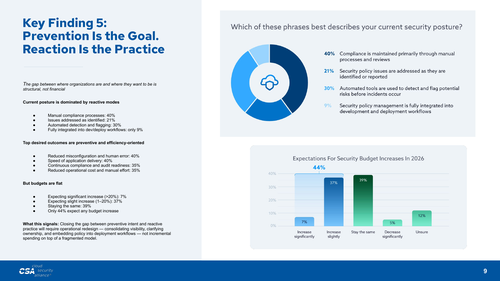
The survey's maturity results show relatively few organizations have moved policy management completely into application delivery workflows. Forty percent described their current posture as one in which compliance is maintained primarily through manual processes and reviews, while 21% said security policy issues are addressed as they are identified or reported. Another 30% said automated tools are used to detect and flag potential risks before incidents occur. Only 9% said security policy management is fully integrated into development and deployment workflows.
The desired outcomes reflect both reliability and delivery concerns. Speed of application delivery and reducing misconfiguration and human error were each selected by 40% of respondents as important organizational outcomes. Continuous compliance and audit readiness and reducing operational cost and manual effort were each selected by 35%.
When respondents were asked to choose the single capability that would most improve security policy management over the next 12 months, pre-change risk or impact analysis led at 32%. AI-assisted anomaly detection on policy traffic, automated end-to-end policy provisioning and continuous compliance auditing of policies in production each received 16%. Zero-trust microsegmentation was selected by 9%, identity-aware policy enforcement by 7% and application-aware policy mapping by 2%.
 [Click on image for larger view.] Pre-Change Risk Analysis Leads (source: csa).
CSA connects the demand for pre-change analysis to the visibility findings: an organization must first know its current policy state and application dependencies before it can reliably determine what a proposed change will affect. That sequence is the report's interpretation of the survey results, rather than a separately tested survey finding.
The Survey's Operational Prescription
The report recommends treating policy management as an operating-model issue rather than simply adding more security tooling. Its proposed sequence starts with unified policy visibility across environments, followed by pre-change risk analysis, automation of routine policy provisioning and continuous compliance evidence. CSA also calls for clearer ownership and tighter integration of security policy management into deployment workflows.
The budget data provides context for that recommendation. Thirty-nine percent of respondents expected their 2026 security budgets to remain unchanged, 37% expected an increase of between 1% and 20%, and 7% expected an increase greater than 20%. Five percent expected a decrease and 12% were unsure. Overall, 44% expected some increase. CSA concludes that organizations are unlikely to close the gap between manual or reactive practices and integrated policy management through incremental spending alone. That conclusion should be read as CSA's interpretation of the findings rather than as a causal result established by the survey.
 [Click on image for larger view.] Prevention Versus Reactive Operations (source: csa).
For cloud and infrastructure teams, the more immediate findings are measurable: policy changes remain highly manual, ownership crosses multiple operational groups, most teams have difficulty assembling an accurate cross-environment policy view, and respondents report that misconfigurations are reaching production. The survey does not establish that manual management caused every reported outage or that any particular technology would eliminate the problem. It does show that policy administration has become closely connected with application availability, deployment operations and recovery work across hybrid and multi-cloud estates.
About the Author
David Ramel is an editor and writer at Converge 360.