In-Depth
KubeCon Salt Lake City Day 1: Autonomous Agents, Sandboxes, Bridging AI Infrastructure and ... Kubernetes
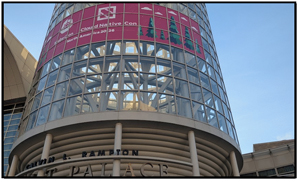
Being back at the Salt Palace in Salt Lake City for KubeCon + CloudNativeCon North America after a year-long hiatus feels familiar, yet the conference's content and focus have drastically transformed to match the new reality of the data center.
 [Click on image for larger view.]
The venue remained the same, but the story has dramatically shifted. Two years ago, at the same venue, we were digging into cluster plumbing, multi-tenancy, and traditional microservice orchestration, and not a word about AI. This year, stepping onto the show floor and taking in the morning keynotes made it unmistakably clear that the industry has crossed a major threshold, and all the talk is about deploying and managing AI on Kubernetes.
The conversation is no longer about orchestrating containers or scaling inference endpoints; it is about how cloud native infrastructure is adapting to support autonomous, nondeterministic AI agents. Between the keynote sessions, a briefing with Linux Foundation leaders, and conversations with vendors tackling these challenges head-on, day one delivered plenty of technical substance for enterprise IT professionals.
CNCF Announcements and Project Evolution
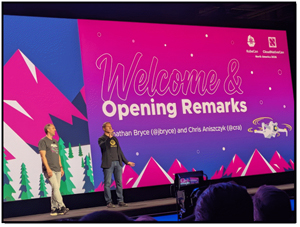
The keynotes kicked off at 9 a.m. sharp on Tuesday, Nov. 10, before a packed audience.
 [Click on image for larger view.]
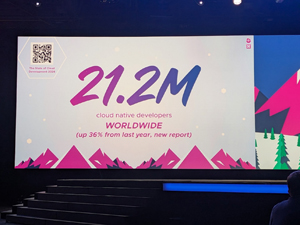
The Cloud Native Computing Foundation (CNCF) opened the conference by highlighting the community's unprecedented momentum. CNCF Executive Director Jonathan Bryce and Linux Foundation CTO Chris Aniszczyk reported that the foundation now has over 82,000 attendees annually across its global events, supported by a contributor base that grew 17 percent year over year to over 350,000 engineers. Worldwide, the number of cloud native developers has swelled to an estimated 21 million, marking a 36 percent increase over the past year.
 [Click on image for larger view.]
More tellingly, Jonathan Bryce noted that in just the past eight months, inference traffic across providers has surged fourfold, with network traffic outpacing even compute growth. To address the skills gap around these emerging workloads, CNCF introduced two new certifications: the entry-level Kubernetes AI Associate and the hands-on Certified Kubernetes Inference Engineer.
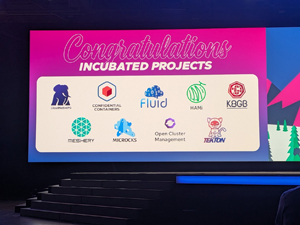
The foundation also celebrated significant milestone movements across its 230-plus project portfolio. Graduating from incubation this cycle were major stalwarts including OpenTelemetry, KEDA, Kyverno, Cloud Native Buildpacks, CubeFS, and KubeVirt. Concurrently, 10 projects advanced from the sandbox into the incubating tier, notably including CloudNativePG, Microcks, Confidential Containers, Fluid, KubeRay, and Open Cluster Management.
 [Click on image for larger view.]
A few projects stand out to me as ones I want to dig deeper into:
CloudNativePG is an open-source Kubernetes operator designed to manage the entire lifecycle of high-availability PostgreSQL database clusters natively on Kubernetes, handling everything from continuous backup and point-in-time recovery to automated failover without external proprietary tooling. As someone who has always shied away from doing this manually because of its complexity, I think this will be a boon for small and mid-sized developers.
Microcks is an open-source, cloud-native platform for API mocking, testing, and validation that enables developers to simulate and test microservices, REST APIs, GraphQL, and event-driven architectures before backend dependencies are even built.
K2Sa, a CNCF Sandbox project initiated by Siemens, is an open-source, lightweight Windows-native edge distribution that runs Kubernetes directly on Windows systems using a single Linux virtual machine layer, allowing industrial and enterprise automation environments to execute containerized workloads seamlessly alongside legacy Windows applications. This is one of the first projects I will be testing in my lab.
KubeVirt is an open-source virtualization add-on for Kubernetes that lets platform teams run, manage, and schedule traditional virtual machine (VM) workloads alongside container pods on a shared, declarative infrastructure control plane. VMs, largely due to agent workloads, are seeing a resurgence of interest, and this project will help developers implement VMs in their K8S environment.
These are just the projects I found most interesting, but with over 200 projects, this is just the tip of the iceberg of what people can explore.
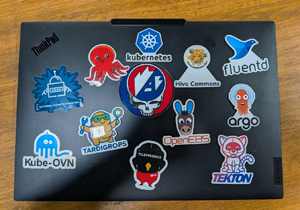 [Click on image for larger view.]
The Overarching Keynote Theme: Cloud Native Without Limits
The dominant theme across the opening keynotes was that cloud native infrastructure has expanded far beyond its original container boundaries to confront two major enterprise constraints: physical hardware scarcity and runtime security control. As Linux Foundation leaders emphasized, the rapid emergence of agentic workloads has shifted the operational dynamic. While code generation has become cheap, deterministic trust, isolation, and security have become extraordinarily expensive.
The keynotes demonstrated that Kubernetes is cementing its standing as the de facto universal control plane not only for containers, but for VMs, heterogeneous GPU clusters, specialized distributed training frameworks like Ray, and isolated sandbox runtimes. Rather than treating AI agents as benign, stateless workers, the consensus across keynotes was that agents must be treated as nondeterministic, potentially untrusted entities that require robust, out-of-band architectural containment before being granted access to enterprise networks and production databases.
One of the things I like about KubeCon keynotes is that instead of one or two long speakers, they break it up into 10- to 15-minute segments covering a lot of areas.
Keynote Session Deep Dives
Although all the sessions were noteworthy, a few piqued my interest.
DolphinGemma
As a fan of The Day of the Dolphin, a 1973 American science fiction thriller film starring George C. Scott, I found this session especially interesting.
Google DeepMind staff researcher Ravine Kumar and open-source contributor Sahil Arora presented an intriguing look at how fine-tuning and reinforcement learning (RL) unlock specialized domain intelligence, taking the stage to introduce DolphinGemma. Highlighting that intelligence is not one-size-fits-all, Kumar explained how his team leveraged over 40 years of vocalization recordings from marine biologist Denise Herzing to build DolphinGemma, an open language model designed to analyze and generate synthetic dolphin vocalizations to eventually decipher cross-species communication.
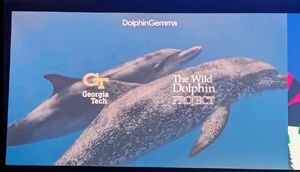 [Click on image for larger view.]
Arora then addressed the steep operational barriers to running post-training workflows, stating that "all the frameworks that we have are very monolithic; they tightly couple the RL code with the infrastructure." To address this, they introduced OpenRL, a newly accepted CNCF sandbox service that abstracts reinforcement learning primitives so platform engineers can schedule training and sampling steps across GPU pools using Dynamic Resource Allocation (DRA) without writing complex orchestration scripts by hand.
One Kubernetes, Different Environments
After interviewing Dilpreet Bindra, vice president of engineering at VMware, during VMware Explore this year, I was excited to see his keynote. His keynote did not disappoint.
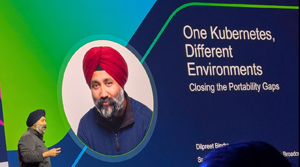 [Click on image for larger view.]
He tackled the persistent, thorny friction between multi-cloud deployments and enterprise virtualization. Bindra emphasized that simply having clusters conform to base Kubernetes standards does not guarantee that applications behave identically across varied clouds. To address this gap, Broadcom partnered with SIG Apps and SIG Architecture to launch the Kubernetes Workload Conformance Working Group, aimed at creating true workload-level behavioral predictability across heterogeneous distributions.
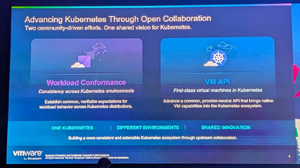 [Click on image for larger view.]
Addressing modern AI infrastructure demands, Bindra pointed out that "34 percent of organizations are expanding their VMs for AI and agentic workflows today," largely driven by the need for strict I/O isolation and state management. To unify this architecture, Broadcom introduced VM API into the CNCF sandbox. VM API extends Kubernetes declarative primitives to virtual machines natively, allowing IT administrators to manage high-performance VMs alongside containers under a single, provider-neutral control plane without sacrificing low-level hardware performance.
It is always good to see companies give back to the community.
Physical AI and the Future of Kubernetes
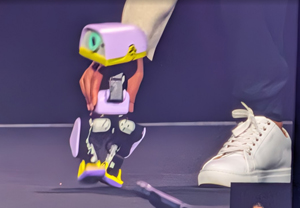
Shifting from the digital world to the physical world, Avinash Balachandran, Director of Robotics at NVIDIA, brought out a small bipedal robot named "Quack," developed alongside Hugging Face and Pollen Robotics.
 [Click on image for larger view.]
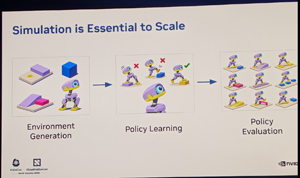
Balachandran explained that while large language models train on vast corpuses of internet text, physical AI foundation models take in sensor feeds and output action tokens like joint angles and steering vectors that move atoms in the real world. Because real-world data collection is strictly bounded by the laws of physics, scaling embodied intelligence requires training robots inside hyper-realistic simulations.
 [Click on image for larger view.]
Balachandran framed this as a unified challenge requiring three distinct computers: a high-end graphics computer to render simulations, a massive training cluster to optimize models, and an embedded edge processor on the robot running low-latency inference. NVIDIA demonstrated how Kubernetes serves as the operational glue orchestrating all three phases, leveraging upstream contributions like Run:ai and heterogeneous GPU scheduling to close the loop between data center training and edge robotics execution.
One danger with live demos is that they sometimes go off the rails, and when Quack decided to sit down and rest during the presentation, it drew a few laughs from the audience.
 [Click on image for larger view.]
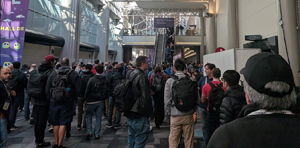
After the keynotes, the audience filed out of the auditorium to explore the Expo center and attend sessions while I and other analysts, influencers, and journalists went to debriefing.
The Press Conference: Pragmatism Amid the Agentic Boom
The press briefing featured Jim Zemlin, Jonathan Bryce, and Chris Aniszczyk.
 [Click on image for larger view.]
The conversation shifted from stage demos and canned presentations to the realities confronting the CNCF community. Jim Zemlin said the Linux Foundation experienced its largest growth year to date, expanding membership by 40 percent year over year. He offered a candid assessment of the shift in enterprise software development, pointing out that in several member organizations, agents now author more than 80 percent of the code. However, Zemlin warned that automated code generation has overwhelmed open-source maintainers with bug reports and chained security vulnerabilities. In response, the Linux Foundation launched the Akrites project, bringing together over 30 enterprises to dedicate engineering teams inside secure enclaves to triage, deduplicate, and patch critical infrastructure vulnerabilities upstream.
Jonathan Bryce elaborated on the enterprise governance conundrum, noting that while developer adoption of coding agents is almost universal, personal and operational enterprise agent adoption lags significantly because organizations fundamentally do not trust autonomous processes. He highlighted that projects like OpenShell and Agent Substrate are gaining traction because they let enterprises wrap agents in isolated sandboxes using trusted cloud-native tooling like Kata Containers, gVisor, SPIFFE/SPIRE for ephemeral runtime identity, and Envoy-based gateways for policy enforcement.
During the Q&A, they confirmed that while AI acceleration is opening up silicon diversity across NVIDIA, AMD, and custom TPUs, the CNCF's primary role remains providing vendor-neutral orchestration layers that let platform architects maintain flexibility across any underlying compute fabric.
After the press briefing, I had time for one-on-one meetings during the afternoon.
Vendor Perspectives from the Show Floor
Between sessions and my briefings, I walked the Solutions Showcase floor. I spent time with engineering leaders at Testkube, Nutanix, and Komodor to hear how their products are helping K8S users navigate this agentic transition.
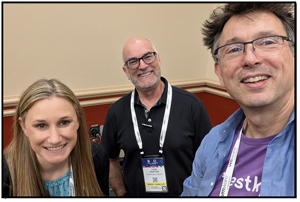
At Testkube, Ole Lensmar, CTO, walked me through how enterprise testing pipelines are shifting under the weight of AI-generated code and how Testkube is assisting them in this endeavor.
 [Click on image for larger view.]
Testkube is historically known for managing scalable CI/CD test execution natively within Kubernetes clusters; Testkube has seen dynamic infrastructure validation become a primary pain point.
Enterprise customers are deploying autonomous agents to write and modify software, but those agents cannot operate safely without an automated execution and remediation harness. Testkube explained that its platform now supports agentic pipelines, integrating with the Model Context Protocol (MCP) to let agents trigger targeted test suites, analyze logs, deduce root causes, and propose remediation pull requests. While autonomous remediation is technically possible, their customers predominantly operate in a read-only or human-in-the-loop posture, using strict policy guardrails and skill sets to prevent automated code changes from touching business-critical production paths.
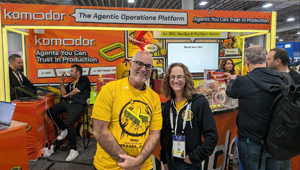
A few aisles over at Komodor, I caught up with Amy Ariel, the company's CMO.
 [Click on image for larger view.]
The focus was centered on day-two agentic operations and fleet management. Building on their Kubernetes troubleshooting foundation, Komodor recently launched their Agentic Operations Platform. Amy highlighted that while spinning up a prototype agent on a laptop is trivial, managing a production fleet of enterprise agents is fraught with challenges around context degradation, memory persistence, and runaway token expenses.
Komodor provides an evaluation framework and orchestration gateway that lets organizations deploy pre-packaged AI Site Reliability Engineer (AISRE) workflows or bring their own internal agents. By sitting between the agents and the infrastructure, the platform deduplicates alerts, scopes credentials dynamically, and enforces strict cost and token-spending ceilings. Amy echoed Ole's caution regarding autonomous blast radiuses and stressed that enterprise trust must be earned through transparent execution graphs; their system presents investigative hypotheses and diagnostic evidence before any automated remediation script runs.
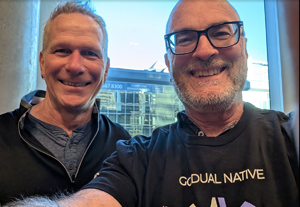
Tucked away upstairs at the Hyatt Regency away from the buzz of the convention floor, I sat down with Dan Ciruli, Vice President and General Manager of Cloud Native at Nutanix.
 [Click on image for larger view.]
We took a technical look at Nutanix Kubernetes Platform (NKP) and Nutanix Enterprise AI (NAI). With nine quarters under their belt since bringing D2iQ into the fold, Ciruli explained that their core mission is to give platform engineers the same frictionless, API-driven on-premises experience they expect from managed cloud offerings like EKS or GKE, without forcing them to assemble and patch together a fragile DIY stack from loose open-source components. NKP delivers a curated, production-ready environment that wraps pure upstream Kubernetes with automated lifecycle management, monitoring, service mesh, and Cluster API fleet controls.
The most candid portion of our conversation centered on enterprise AI economics. Ciruli walked through Nutanix's own internal wake-up call: after their 3,000 engineers embraced AI coding assistants, their monthly token bill shot into seven figures almost overnight. That rapidly prompted board approval for a $20 million on-premises hardware investment projected to break even within a single year, with an operational mandate to generate 80 percent of model tokens on-prem and restrict expensive public frontier models to the critical 20 percent. To enforce this, NAI utilizes an intelligent brokering gateway that applies departmental budgets and dynamically routes queries between public APIs, cloud-hosted open weights, and local clusters.
Much like the morning keynotes, Ciruli emphasized that autonomous agents cannot safely execute in shared container namespaces because their code paths and actions are nondeterministic. To address this, Nutanix is building a spectrum of isolation, from lightweight sandboxes like gVisor to dedicated, production-hardened AHV virtual machines for long-running agents, backed by Nutanix AOS distributed storage to feed high-throughput pipelines.
On the hardware front, Nutanix is expanding silicon diversity by adding AMD GPU drivers and conformance testing, preparing ARM support for edge and NVIDIA Vera platforms in early 2027, and integrating their recent acquisition of French research firm Ryax Technologies to optimize workload placement across mixed CPU and GPU resources. For teams feeling the squeeze from VMware Cloud Foundation licensing changes, Ciruli pointed out that AHV paired with NKP, open-source Cluster API extensions like Karen, and Nutanix Database Service provides an enterprise-grade, upstream-aligned path forward that bypasses proprietary hypervisor lock-in.
After an exhausting Day 1, I was ready for the night's activities for some R&R.
Expo Crawl and After-hours Events
The day ended with an expo-center hall crawl and an after-hours event sponsored by vCluster.
People seemed to enjoy themselves at the crawl. I have to tip my hat to vCluster for putting on an excellent happy hour. The food was plentiful; they poured High West (a Utah-distilled whiskey) generously, and, most importantly, the setting was quiet enough for peer-to-peer conversations.
 [Click on image for larger view.]
I ended up having a great discussion with an engineer from Leadville, Colorado (the highest town in the U.S.) about ambient voice AI and skiing, adventure riding in the Colorado Rockies--an excellent end to the first day at KubeCon.
Final Thoughts
Day one of KubeCon Salt Lake City drove home a critical lesson for any enterprise systems administrator or platform architect: the cloud native ecosystem has entered its agentic phase. We are moving rapidly past the initial novelty of generative chatbots and into the hard work of running autonomous workloads at scale.
The primary takeaway for me is that agents cannot simply be unleashed on standard, shared Kubernetes worker nodes. If an agent has access to a prompt, a file system, and API tokens, it will attempt every execution path to achieve its goal, making strict sandboxing, short-lived ephemeral identities, and out-of-band proxy gateways mandatory operational requirements. Projects like OpenShell, Agent Substrate, and VM API prove that Kubernetes is evolving to become the universal control plane capable of corralling this complexity. For platform engineers, the mandate is clear: the focus must immediately pivot from manual approvals to rigorous, automated policy governance to manage the scale required for today's workloads.
About the Author
Tom Fenton has a wealth of hands-on IT experience gained over the past 30 years in a variety of technologies, with the past 20 years focusing on virtualization and storage. He previously worked as a Technical Marketing Manager for ControlUp. He also previously worked at VMware in Staff and Senior level positions. He has also worked as a Senior Validation Engineer with The Taneja Group, where he headed the Validation Service Lab and was instrumental in starting up its vSphere Virtual Volumes practice. He's on X @vDoppler.