News
Microsoft Ignite 2026: Top Azure Announcements for Enterprise IT
Microsoft kicked off Ignite 2026 with a wave of Azure announcements spanning AI-powered cloud operations, agent-led application and infrastructure modernization, hybrid cloud governance, AI agent security and enterprise data services for AI applications.
The announcements include expanded capabilities for Azure Resource Manager, Azure SRE Agent and Azure Monitor; a new Azure Catalyst modernization offering; security baseline remediation for Azure and multicloud servers; new Microsoft Entra controls for AI agents; and knowledge graphs and retrieval improvements in Microsoft Foundry.
Here are five of the most consequential announcements for enterprise cloud and IT professionals from the opening of Microsoft's annual technology conference, which began Nov. 17.
Azure Expands AI Agents for Cloud Operations
Microsoft is expanding its AI-driven cloud management capabilities with updates to Azure Resource Manager (ARM) MCP Server, Azure Copilot, Azure SRE Agent and Azure Monitor. The changes, detailed in an Azure Infrastructure Blog announcement, are designed to give AI agents more operational context and the ability to perform infrastructure management tasks under existing governance controls.
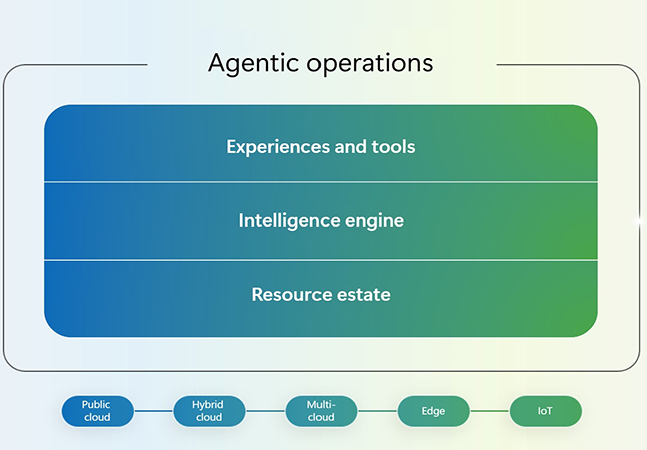 [Click on image for larger view.] Agentic Ops (source: Microsoft).
One of the biggest changes is expanded write access through the ARM MCP Server. Previously focused on resource discovery and read operations across more than 3,500 Azure resource types, the server now supports creating, managing and updating resources. Requests remain subject to Azure Policy, including organizational rules governing deployment regions, resource types and configurations. See more about this on our sister site, Visual Studio Magazine.
Azure Copilot's deployment agent is now generally available, allowing administrators to translate natural-language requirements into infrastructure and deployment code. Copilot spaces and custom skills are in public preview, providing ways to incorporate organizational context and operational knowledge.
Microsoft also announced public preview enhancements to Azure SRE Agent, including customer-managed encryption keys, Entra Agent ID integration and cross-agent communication. Microsoft Teams integration extends investigations across multiple clouds.
Meanwhile, Azure Monitor health models are generally available, connecting infrastructure telemetry with application dependencies and business impact. The models provide additional context for identifying failures and prioritizing remediation.
The combined changes extend AI agents beyond operational assistance into infrastructure changes, incident investigation and remediation workflows, with Azure's established identity, permissions and policy controls governing their actions.
Azure Catalyst Targets VMware, Hyper-V and Application Modernization
Microsoft introduced Azure Catalyst, a unified modernization offering that combines Azure Migrate and GitHub Copilot modernization capabilities with AI agents for discovering, assessing, planning and migrating applications, databases and infrastructure.
According to the Azure Catalyst announcement, the offering connects infrastructure discovery with application code analysis, allowing teams to trace dependencies between servers, databases and the applications they support.
The system uses those findings to help organizations evaluate modernization alternatives, estimate costs and potential benefits, design Azure landing zones and organize migration waves.
For virtualization administrators, the offering includes VMware and Hyper-V workload discovery, replication and migration tracking, with Azure Local as a supported destination. Microsoft said supported Azure Arc settings can be preserved during migration. Direct migration to Trusted Launch is now generally available for eligible virtual machines.
Azure Catalyst also expands assessment capabilities for containers, SQL databases, MongoDB, Oracle databases, file servers and network-attached storage. New capabilities include assessing container workloads for Azure Kubernetes Service or Azure Red Hat OpenShift and planning SQL migrations in waves through integration with Azure Database Migration Service.
For application modernization, organizations can use GitHub Copilot to assess and transform .NET and Java applications alongside their databases. Governance rulebooks and bring-your-own-model support are now generally available, while many of the expanded workload capabilities remain in public preview.
Azure Catalyst also incorporates security analysis into modernization planning, identifying known vulnerabilities and providing developer tools for addressing problems during application transformation.
Azure Arc Extends Security Remediation Across Hybrid and Multicloud Servers
Microsoft announced enhancements to Azure Machine Configuration, including centralized machine inventory, automated security baseline remediation and new recovery management capabilities for Azure Arc-enabled servers.
The updates, described in the Azure Governance and Management Blog, expand Azure's ability to inspect and manage operating-system configurations across Azure virtual machines, on-premises infrastructure and servers running in other clouds.
A new Machine Configuration hub in the Azure portal brings together enrollment, inventory, compliance assessment and governance management.
Machine Inventory provides centralized visibility into applications, certificates, services, accounts, groups and Windows roles. Linux inventory covers software and daemons. Administrators can inspect individual machines or query inventory information across their environments using Azure Resource Graph.
Perhaps the most significant addition is security baseline remediation, now in public preview. Previously, administrators could assess machines against customized security baselines. The new functionality allows supported settings to be actively maintained, with Machine Configuration correcting deviations from desired values.
The preview supports remediation for Azure Security Baselines on Windows and Linux and CIS Linux benchmarks. Microsoft also added CIS Windows Server benchmarks in audit mode and Linux STIG baselines with audit and remediation support.
The updates extend to multicloud management through Azure Arc Multicloud Connector. Servers discovered and onboarded from AWS and Google Cloud can be enrolled in Machine Configuration and assigned security baselines.
Microsoft also added centralized Windows Recovery Environment management for Arc-enabled servers, including support for configuring Quick Machine Recovery to address eligible startup failures on Windows Server 2025.
Microsoft Entra Adds Identity and Security Controls for AI Agents
Microsoft is expanding Entra with new capabilities to discover, identify, govern and restrict AI agents operating across enterprise environments.
The Ignite Entra announcement introduces additional controls for managing agents as distinct identities rather than relying exclusively on the permissions of human users.
Microsoft Entra Agent ID for discovered local agents, now in preview, supports discovery of 60 local agent types, including OpenAI Codex, Claude Code and GitHub Copilot CLI. Discovered agents receive identities that administrators can use for access governance.
Automated lifecycle management for agent identities is now generally available. Administrators can create policies that evaluate whether agents remain active, have a human sponsor and are still required. A default policy disables identities that have been inactive for 60 days.
Microsoft also announced preview capabilities for dynamic agent risk assessment and Conditional Access policies that distinguish between users and agents acting on their behalf. These policies can restrict risky agents or sensitive operations without necessarily interrupting the user's broader session.
Additional security controls include an MCP firewall in preview, designed to govern communications between AI agents and MCP servers, tools and resources. Entra Global Secure Access is also gaining agent-specific network visibility and controls.
For infrastructure administrators, expanded Privileged Identity Management capabilities in preview include just-in-time access to Azure and Azure Arc virtual machines, privileged session monitoring and session recording.
Microsoft Foundry Adds Knowledge Graphs and New AI Retrieval Model
Microsoft introduced additional enterprise knowledge capabilities in Foundry IQ, including knowledge graphs, permission-aware SharePoint integration and a specialized retrieval model designed for AI agents.
According to the Microsoft Foundry announcement, knowledge graphs are now in public preview. They allow organizations to map relationships between entities in enterprise documents and query those relationships using natural language or Graph Query Language.
The new capabilities are intended to help AI agents understand relationships among information stored across different documents rather than relying solely on traditional search results.
Microsoft Retriever 1, also in public preview, is a specialized model that plans retrieval operations against existing indexes. Microsoft said the approach is designed to reduce the number of searches and associated costs required to retrieve relevant information for an agent.
SharePoint integration with permission enforcement is now generally available. The capability allows agents to access indexed SharePoint content while respecting users' Entra group and SharePoint site permissions.
Microsoft also announced that Foundry IQ Serverless will become generally available in December, offering consumption-based pricing and the ability to scale to zero when idle. Integration of a managed Foundry IQ resource into new Foundry projects is scheduled for public preview in December.
The updates expand the infrastructure available for enterprise AI applications that need to retrieve internal information, preserve access restrictions and use business context across multiple data sources.
About the Author
David Ramel is an editor and writer at Converge 360.