In-Depth
KubeCon 2026 EU Final Day Recap -- The Evolution and Future of Kubernetes
Looking back at
the keynotes on Thursday, the last day of KubeCon, I saw them as an
exploration of the evolution and future of the technologies
that CNCF supports and promotes.
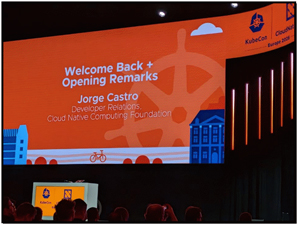
George Castro,
Developer Relations at CNCF, kicked off the final day of KubeCon by
emphasizing that cloud-native technology has evolved from a
collection of tools into a global movement.
 [Click on image for larger view.]
He imagined and
described a future in which technology is no longer just consumed by
its users but is driven by a feedback loop that incorporates our
challenges into projects. They reinforced that the day's
narrative centered on this transition from mere participation to
becoming the engine of innovation.
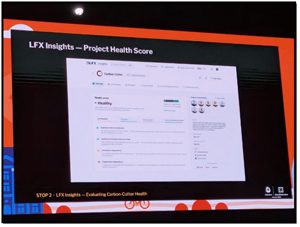
Chad Beaudin,
Chief Engineer at the Boeing Software Factory, used a fictitious
company, Cycle AI, to illustrate this. He sought to manage spiraling
AI costs by navigating the CNCF landscape.
 [Click on image for larger view.]
His search led
him to the made-up project, Carbon Cutter, an incubated project
supported by the Technical Oversight Committee (TOC) and Technical
Advisory Groups (TAG). He then discussed how end-users can interact
with projects through their TAGs, which guide projects through
four maturity states.
By way of
reference, Sandbox projects are for niche, green-field ideas,
while Incubated projects demonstrate significant production
adoption and vendor neutrality. Graduated projects are those
that have matured into established products and are widely used. But
the community is highly dynamic, so conversely, the Archival
state exists for projects that have lost momentum or usefulness.
Baptiste
Assmann, Director of Product at HAProxy, delivered a sponsored
session in which he addressed the reality of interconnected
systems, noting that business growth inevitably creates heterogeneous
infrastructures that can be difficult to manage. He proposed
Universal Mesh as an architectural response to the limitations of
traditional service meshes. This will ensure high availability
and compliance across diverse environments, including legacy virtual
machines and multiple cloud providers. This will provide the
consistency that is vital for projects like Agones, a multiplayer
game server project used by Ubisoft and Discord, which was
moved to the CNCF as a sandbox project.
 [Click on image for larger view.]
Agones is
interesting as it addresses the challenge of in-memory state in
gaming, where servers cannot be shut down without crashing active
sessions. By using Agones for the launch of Rainbow 6 Mobile,
Ubisoft demonstrated a "build once, deploy everywhere"
mindset, standing on the shoulders of thousands of CNCF contributors.
Platform
engineering optimization was further explored by Abby Bangser,
Principal Engineer at Syntasso, who focused on the challenges posed
by system bottlenecks. I could appreciate her use of Amsterdam's
insane bicycle traffic -- after almost getting mowed over
multiple times by bikes -- as a metaphor. She explained that scaling
vertically by making a single bike faster does nothing to solve
systemic congestion like ferry waits or traffic jams. This
metaphor holds in software development as well; any developer could
attest that adding more engineers to a project does not
necessarily speed it up, as it results in similar queues.
Optimization
requires scaling horizontally through a marketplace-driven,
flexible architecture that enables providers to deliver value
independently. Bangser introduced the 8 Platform Capability
Factors as an evolution of the 12-factor app methodology
pioneered by Heroku in 2011. These factors define what it means
to be a good citizen on a platform, ensuring that builders have the
unrestricted freedom to keep it performant as software production and
development accelerate.
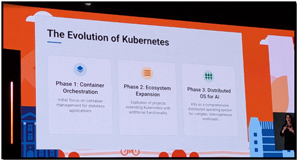
One of the major
thrusts of the morning keynotes, which builds on the major theme of
KubeCon 2025, was how K8s is evolving toward being the
distributed operating system for AI workloads.
 [Click on image for larger view.]
Jago Macleod,
Engineering Director, Google, described Kubernetes as the narrow
waist of the hourglass of infrastructure, acting as a
bidirectional megaphone that connects hardware providers to various
high-level frameworks. The third phase of Kubernetes evolution
(distributed OS for AI) is focused on velocity of change and
resource utilization, while managing complex hardware topologies to
drive innovation.
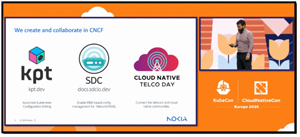
The potential
for autonomous infrastructure was highlighted by Nokia's work
in the telecom sector.
 [Click on image for larger view.]
Gergely
Csatari, Senior Open-Source Specialist at DMTS, Nokia, discussed
managing massive private clouds with over 70,000 cores, which require
various CNCF projects to handle configuration blueprints. He
highlighted that KPT was designed expressly for closed-loop
automation.
The day concluded
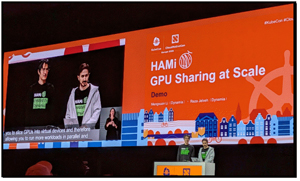
with live demonstrations of technology solving critical production
problems. The HAMi project demonstrated how to prevent resource
starvation by using GPU slicing, MIG partitions, and custom memory
isolation to share hardware across workloads.
 [Click on image for larger view.]
Spotify
demonstrated how the Backstage portal is integrating AI to help
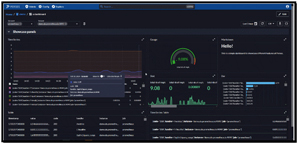
engineers find API owners via simple prompts. Finally, the Perses
project, which the European Union has funded since last year,
showcased how it is a visualization tool based on an open
specification.
 [Click on image for larger view.]
By providing
reusable React components and a consistent dashboard format, Perses
aims to eliminate the need for teams to rebuild visualizations
when migrating between different observability tools.
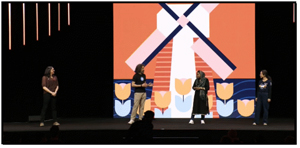
The conference's
closing message was a call to move from consumption to
contribution.
 [Click on image for larger view.]
Closing the loop
between consumers and developers is a technical and cultural goal for
CNCF. It is based on end users' feedback, incorporating lessons
into the projects they use. This sustainable evolution ensures
that maintainers always integrate real-world feedback into their
roadmaps. By moving beyond mere consumption, the community
ensures that the cloud-native ecosystem remains the vital foundation
for the next decade of global infrastructure.
Vendor Discussions
KubeCon is more
than the CNCF; it is also about the ecosystem surrounding
Kubernetes, containers, and other cloud-native technologies. One
of the more interesting/enjoyable parts of KubeCon is talking with
people and companies on the showcase floor. Below is a recap of a
discussion I had with one of the vendors.
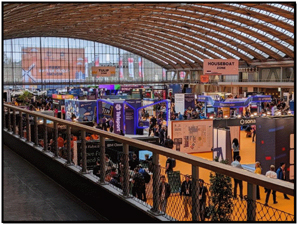 [Click on image for larger view.]
Spectro Cloud
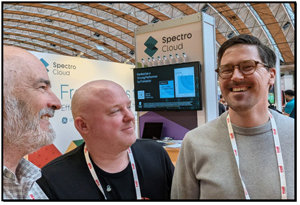
Anthony
Newman, Director of Content Marketing, Justin Barksdale,
Distinguished Solutions Architect at Spectro Cloud, and I
discussed Spectro Cloud, one of the companies I have seen at multiple
KubeCons and never had an opportunity to investigate.
 [Click on image for larger view.]
For background,
Spectro Cloud is an enterprise-grade, cloud-native infrastructure
management company that simplifies Kubernetes complexity. Its
flagship platform, Palette, provides a unified orchestration plane
that enables organizations to manage the full lifecycle of their
Kubernetes stacks, from the operating system to the application
layer, across diverse environments, including bare metal, virtualized
infrastructure, public clouds, and the edge. By using profiles, the
platform ensures consistent, repeatable governance of clusters while
giving platform engineering teams the flexibility to select their
preferred integrations for networking, security, and storage without
being locked into a single vendor's ecosystem.
Over the years,
the company has carved out a niche in edge computing and highly
regulated industries, where traditional cloud-native tools often
struggle to meet the connectivity and security constraints. Their
architecture is decentralized enough that edge clusters can
continue to enforce policies and run applications locally even if
they lose their connection to the central management plane.
At KubeCon this
year, it announced a major expansion of its PaletteAI
ecosystem, specifically targeting the "AI Factory" model of
distributed infrastructure. A key highlight was their strategic
partnership with WEKA to bring high-performance data services closer
to AI workloads, alongside a collaboration with 6WIND and NVIDIA
to integrate BlueField DPUs for hardware-accelerated networking and
zero-trust security. Additionally, they showcased Hadron,
their lightweight, security-hardened Linux base designed for
modern enterprise edge deployments, reinforcing their commitment to
providing a production-grade foundation for immutable and secure
sovereign cloud environments.
You can get more
information about Spectro Cloud here.
Final Thoughts
On the final day,
the conversation evolved to treat the future of cloud-native
technologies as a global movement driven by a continuous feedback
loop between users and developers. I showed you how projects
mature through various adoption stages and how universal
architectural patterns help manage increasingly complex,
interconnected systems. Whether through optimizing game server
stability or addressing systemic bottlenecks in software delivery,
the emphasis remained on creating a flexible, marketplace-driven
architecture. These sessions highlighted that true optimization
requires moving beyond vertical scaling to embrace horizontal
growth that empowers independent value delivery.
The event
concluded with a vision of the ecosystem as the distributed operating
system for the next generation of artificial intelligence.
Infrastructure is becoming more autonomous and resource-aware,
using specialized tools to maximize hardware efficiency and
streamline engineering workflows. The overarching message was a call
to transition from simple consumption to active contribution,
ensuring that real-world lessons are integrated back into the
software roadmaps. By closing this loop, the community secures a
sustainable foundation for the future of global digital
infrastructure.
 [Click on image for larger view.]
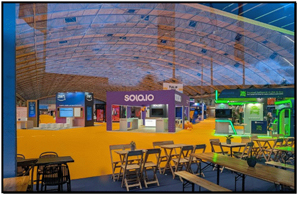
As the show was
winding down and I walked past the empty showcase floor, I thought
about an article I had written earlier, "Why I Need to Attend
KubeCon Europe 2026." I was right, I did need to attend the
event, yes, the flight from Amsterdam was a slog, but the
content was fresh and reflected the unprecedented rate of change that
we are seeing in IT, not only in AI usage but in the underlying
technologies that are being developed to enable and deliver it. I
am certain that KubeCon 2026 America, which will be in Salt Lake City
this November, will reflect this as well, and I have a hunch it
will even top the record-setting number of attendees (13,500) at this
event.
The CNCF keynote
speeches were recorded and will be available on the CNCF's YouTube
channel within two weeks after the event.
About the Author
Tom Fenton has a wealth of hands-on IT experience gained over the past 30 years in a variety of technologies, with the past 20 years focusing on virtualization and storage. He previously worked as a Technical Marketing Manager for ControlUp. He also previously worked at VMware in Staff and Senior level positions. He has also worked as a Senior Validation Engineer with The Taneja Group, where he headed the Validation Service Lab and was instrumental in starting up its vSphere Virtual Volumes practice. He's on X @vDoppler.