News
Amid Rise of AI Agents, Advice for Dealing with 'Non-Human Identities'
The rise of autonomous AI agents is intensifying a longstanding identity and access management problem: applications, workloads, devices and other software-driven entities need access to systems, but they do not follow the business processes used to manage employees and other human users.
A new Cloud Security Alliance (CSA) report frames those actors as non-human identities, or NHIs, and argues that organizations need a separate governance model for them. The July 22 "Defining Non-Human Identity" report, produced by CSA's Identity and Access Management Working Group, covers service and integration accounts, workloads and microservices, infrastructure, devices and autonomous agents.
CSA defines an NHI by its ability to authenticate and receive authorization to access resources. That means an API key, certificate or token is not necessarily an identity by itself. The identity is the application, workload, device or agent using that credential. The distinction is central to the report's recommendations because ownership and lifecycle policies apply to the identity, while rotation, renewal and cryptographic controls apply to the credential.
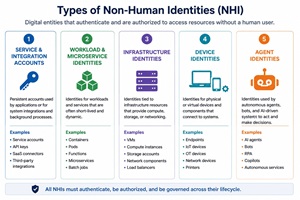 [Click on image for larger view.] NHI Types (source: Virtualization & Cloud Review).
AI agents add urgency to the issue because they can act with delegated authority, invoke multiple tools and services, and create multi-step chains of activity. An agent may begin with a task authorized by a person, call an API, access a data source and invoke another agent before completing its work. Without tightly scoped access and complete audit records, organizations may have difficulty determining who authorized the activity, which identity was used and whether the final action remained within the original request.
The report's primary advice is to stop treating NHIs as an informal byproduct of software deployment. CSA recommends integrating them into formal identity governance, with controls that operate at the speed of cloud infrastructure, automation and AI systems.
Start with Discovery, Classification and Ownership
CSA says organizations should first identify the NHIs operating across cloud platforms, SaaS applications, on-premises systems, container environments, deployment pipelines and AI platforms. That inventory should include the identity subject, associated credentials, purpose, permissions, dependencies and business context.
Every identity should have a designated owner accountable for its lifecycle and security posture. For AI agents, the report recommends both a human sponsor and an oversight owner. Ownership should be established during application or agent onboarding rather than added after deployment.
Organizations should also classify NHIs according to risk. Relevant factors include the systems and data they can access, their privilege level, whether they are shared, how long they remain active and whether they can delegate or expand access through other identities.
The report identifies unowned identities as an immediate governance gap. Service accounts and application identities can remain active after teams reorganize, projects end or applications are retired. Agent identities can similarly persist after a task, session or workflow is complete. CSA recommends prioritizing stale, orphaned and highly privileged identities for remediation.
Automate the Entire NHI Lifecycle
Traditional identity governance often depends on employee events such as hiring, transfers and termination. NHIs instead originate from application deployment, workload startup, infrastructure provisioning, pipeline execution, device enrollment and agent invocation.
CSA recommends building lifecycle controls around those technical events. Provisioning workflows should create identities with least-privilege access, defined scopes and documented ownership. Monitoring systems should track activity and identify policy violations. Decommissioning should be triggered when the underlying workload, task, device, project or application ends.
For AI agents, the report advises organizations to define action boundaries and approval workflows before the agent receives access. High-risk operations should require human involvement. When an agent invokes sub-agents, access should remain minimal, short-lived and traceable to the original approved task.
Offboarding should revoke tokens and API keys, disable agent endpoints, remove permissions and preserve relevant logs. The report emphasizes event-driven revocation because periodic reviews may miss short-lived identities created and destroyed between review cycles.
Replace Persistent Secrets Where Possible
CSA recommends moving organizations toward temporary and secretless authentication models. Long-lived passwords, API keys and shared secrets can remain valid until they are explicitly rotated or revoked, increasing the exposure window when a credential is leaked or misused.
Preferred alternatives include short-lived tokens, workload identity federation, temporary cloud credentials and automatically renewed certificates. These credentials can expire after a limited period and can be restricted to a workload, service, task or execution context.
Where static secrets remain necessary, the report recommends centralized vault storage, automated rotation and runtime injection. Credentials should not be embedded in code, configuration files, prompts or deployment artifacts. Rotation processes should also verify that dependent systems received the replacement credential before the previous one is retired.
For signed tokens, CSA advises short expiration periods, narrow scopes and audience restrictions. Certificates should be renewed automatically, while hardware-backed credentials should use non-exportable keys and integrity checks for the execution environment.
Develop Detection for Machines and Agents
Human-oriented identity detection often looks for signals such as unexpected locations, unusual login times or impossible travel. CSA says those methods do not map well to workloads and agents that operate continuously and programmatically.
The report proposes NHI-specific threat detection based on continuous discovery, identity graphs, behavioral baselines and real-time anomaly detection. Identity graphs should connect NHIs with their owners, credentials, permissions, resources and delegated trust relationships.
For AI agents, monitoring should show which tools and data sources the agent normally uses, which actions it performs and how authority moves through downstream systems. Organizations should detect unexpected tool use, privilege expansion, new data access and behavior outside the approved task.
CSA also recommends rapid intervention capabilities. Organizations should be able to revoke credentials, isolate affected workloads and stop agent activity when suspicious behavior is detected. High-severity or ambiguous incidents should retain human validation before replacement credentials are issued.
Use a Phased Implementation Plan
The report organizes implementation into foundation, automation and optimization phases. The foundation phase covers inventory, ownership, baseline policies and remediation of high-risk identities. The automation phase adds policy-driven provisioning, secrets management, credential rotation and SIEM integration.
The optimization phase moves toward just-in-time access, secretless authentication, behavioral analytics and continuous compliance reporting. CSA recommends dashboards and audit records that show inventory coverage, ownership, credential rotation, least-privilege compliance and incident response performance.
The report's central message for organizations is that NHI governance cannot be limited to a list of service accounts or a secrets-management project. It must connect identities, credentials, owners, permissions and technical lifecycle events. AI agents make that work more pressing because they can carry delegated authority through multiple systems and act without a person approving every individual step.
About the Author
David Ramel is an editor and writer at Converge 360.