In-Depth
KubeCon Salt Lake City Day 2: Operating at Agent Speed, Platform Engineering, and Enterprise Reality
After a jam-packed opening day in Salt Lake City, I returned to the Salt Palace Convention Center on Wednesday, Nov. 11, for Day 2 of KubeCon + CloudNativeCon North America 2026.
 [Click on image for larger view.]
While the first day of the conference (read my Day 1 recap) focused on foundational announcements and containment architectures, Day 2 shifted to the practical use of CNCF products. Between the morning keynotes, my in-depth vendor interviews on the show floor, and a full slate of evening networking events, it became clear that enterprise IT teams are no longer treating AI agents as an experiment. They are running them in production right now, and the strain on existing infrastructure is forcing a rapid rethink of how we build, test, and govern cloud-native platforms.
 [Click on image for larger view.]
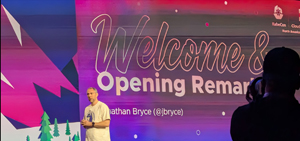
Day 2 picked up where Day 1 left off, even opening with Jonathan Bryce sharing a behind-the-scenes story about NVIDIA engineers performing real-time "micro-duck surgery" via Zoom 15 minutes before Quack took the stage yesterday after an overly enthusiastic backflip knocked a component loose. Where Day 1 focused on vendor frameworks, silicon diversity, and upstream sandboxing like OpenShell and Agent Substrate, Day 2 turned the stage over to enterprise CNCF product users, and we heard directly from organizations like CVS Health, Adyen, Meta, and Uber about how they are actually surviving the operational fallout of agentic traffic and machine learning at planetary scale.
The Overarching Keynote Theme: Human Speed vs. Agent Speed
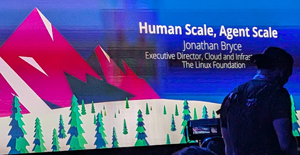
If Day 1 was about containing untrusted agents, Day 2's unifying theme was surviving the sheer velocity of "agent speed." Kicking off the morning, Jonathan Bryce pointed out a fundamental architectural mismatch: our enterprise systems, networks, and caches were designed for human speed, yet they are increasingly being hammered by autonomous agents. Comparing this transition to the smartphone revolution--which transformed mobile networks from voice-and-SMS pipes into global HD video backbones--Bryce noted that agents now generate 70 percent of all tracked inference traffic. Unlike humans, who follow predictable browsing and caching patterns (such as searching for candidates on Election Day), agents behave chaotically. Bryce cited Wikipedia as a prime example: 35 percent of page views now generate most of the resource-intensive traffic because automated agents crawl and query data in non-uniform ways.
 [Click on image for larger view.]
The takeaway across the morning's segments was that cloud-native platforms must evolve from passive infrastructure into self-healing environments with policy-enforced guardrails. Whether through internal developer platforms (IDPs), GitOps promotion pipelines, or automated resource schedulers, platform teams can no longer rely on manual tickets and static capacity sizing.
 [Click on image for larger view.]
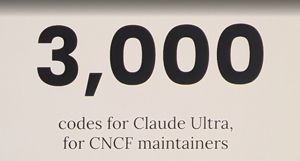
As Anthropic's Lucy Wyman noted before announcing a donation of 3,000 six-month Claude Ultra codes to CNCF project maintainers, frontier AI relies directly on open-source foundations like Kubernetes, Prometheus, and Envoy--and keeping those foundations resilient requires shifting governance and optimization directly into the platform layer.
Keynote Session Deep Dives
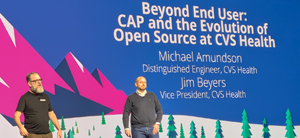
CVS Health: Shipping Code on Day One with CAP
Jim Beyers and Distinguished Engineer Michael Amundson from CVS Health took the stage to explain how a heavily regulated healthcare giant enables new developers to ship production code on their very first morning.
 [Click on image for larger view.]
Operating across three major public hyperscalers and private cloud data centers with complex network topologies, the CVS Developer Experience (DevEx) team built the CAP Application Platform in roughly ten months. Today, hundreds of engineers use CAP to manage thousands of applications and execute tens of thousands of deployments per month.
To eliminate steep learning curves around kubectl, Helm, Istio, and OpenTelemetry, CAP abstracts dozens of underlying Kubernetes clusters into a single logical cluster with an automated placement engine, OpenCost, and multi-cluster service meshes with automatic cross-region failover. Crucially, governance is baked into the platform so that both human developers and AI agents remain compliant with regulatory controls automatically without filing manual tickets. Building on their prior work with OpenFeature, which now handles hundreds of millions of feature flag evaluations daily at CVS, Jim announced that CVS Health is transitioning from an end user to an open-source contributor by launching the CAP Registry API and a feature flag controller as open-source projects.
Apple Container
I am not an Apple user, but I was intrigued when Apple open-source maintainers Katherine and Liz demonstrated how the Swift-native Apple container project bridges the gap between local macOS development and production Kubernetes environments. Built specifically for Apple silicon, the tool executes each OCI-compatible Linux container inside its own lightweight virtual machine via Apple's Virtualization framework, achieving sub-second boot times while isolating host files and providing a dedicated sandbox for AI coding agents.
Alongside standard containers and container machines (persistent Linux development environments that share the user's macOS home directory), the speakers highlighted a major new addition: container clusters. With a single container cluster create command, developers can spin up a real, upstream Kubernetes cluster bootstrapped via kubeadm where every node runs as an isolated Linux VM. It integrates directly with macOS networking to expose services without port forwarding, supports custom CNI plugins like Cilium out of the box, and can share the local container image store so locally built images run immediately in the cluster without pushing to an external registry.
ScaleOps: Taming Spiky, Wasteful Agent Workloads
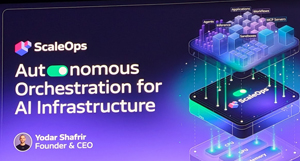
Yodar Shafrir, founder and CEO of ScaleOps, addressed a painful financial and operational reality of agentic infrastructure: autonomous agents are both wildly resource-inefficient and prone to crashing.
 [Click on image for larger view.]
Shafrir explained that agents sit idle waiting for prompts, then trigger sudden CPU and memory spikes while communicating with large language models and external tools. Because DevOps teams have to provision pods for peak spikes, expensive memory and compute sit idle during downtime. Worse, Shafrir noted that ScaleOps sees agents fail 80 percent more often than traditional microservices due to unpredictable resource exhaustion, and when an hour-long agent step crashes, the entire workflow has to restart, burning massive amounts of tokens and compute.
To solve this without manual YAML tuning, ScaleOps demonstrated its autonomous, context-aware orchestration engine. By continuously analyzing historical behavior and real-time cluster context, ScaleOps dynamically right-sizes workloads and reclaims idle memory from paused agents so other pods can use it, cutting infrastructure costs by 70 to 80 percent overall and making agent execution up to 90 percent more cost-efficient.
Uber: Open-Sourcing Michelangelo AI
Closing out the morning keynotes, Uber Senior Director of Engineering Viv Keswani paused to honor the veterans in the audience on Veterans Day before dropping the news that Uber is open-sourcing Michelangelo AI, the Kubernetes-native machine learning platform that powers its global marketplace.
 [Click on image for larger view.]
Keswani shared operational metrics to illustrate why Uber needed a unified foundation: every second, Uber's models evaluate millions of trip requests across 15,000 cities, adding up to more than 10 million trips per day. Powering real-time pricing, ETA predictions, and driver matching requires over 5,300 distinct models running in production, generating roughly 45 million unique predictions per second with millisecond latency and four-nines reliability.
Rather than forcing data scientists to wrestle with underlying cluster plumbing, Michelangelo abstracts away the complexity of distributed training, feature stores, and low-latency inference across both on-premises data centers and public clouds. By releasing Michelangelo AI to the open-source community at KubeCon, Uber is giving enterprise platform teams a battle-tested blueprint for running traditional ML, generative models, and autonomous agents on a single Kubernetes foundation.
Show Floor Interviews: Practical Enterprise Tooling
After the keynotes, I spent time on the expo floor talking with four vendors solving operational headaches on the ground: CloudBolt, Akuity, Flox, and LocalStack.
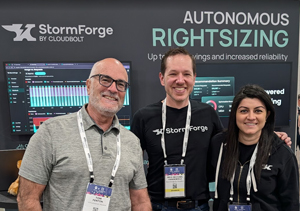
At CloudBolt, we discussed their StormForge Kubernetes rightsizing engine and their newly announced pod-level GPU optimization capabilities.
 [Click on image for larger view.]
Standard GPU monitoring typically exposes utilization only at the physical device level, making chargebacks nearly impossible in multi-tenant clusters. CloudBolt's in-cluster agent scrapes DCGM and container metrics to map GPU, CPU, network, and token costs directly to individual pods and teams. For organizations nervous about letting automation modify production workloads, they use policy-driven guardrails, letting administrators roll out resource reductions in gradual 10 percent increments and enforce strict budget caps on autonomous agents.
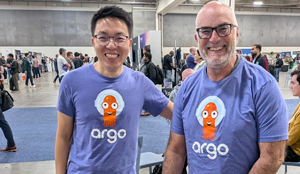
Over at Akuity, co-founder and CEO Hong Wang, one of the original creators of Argo CD and Kargo, walked me through how enterprises scale GitOps beyond single-cluster setups.
 [Click on image for larger view.]
While open-source Argo CD manages roughly two-thirds of Kubernetes clusters today, Akuity re-architected the control plane into a distributed system that can manage up to 26,000 applications from a single instance. Wang highlighted their new Fleet Management features for phased, failure-threshold rollouts across edge locations, including retail chains and even commercial aircraft running Kubernetes clusters for inflight entertainment, as well as an Agent Control Plane that uses the Model Context Protocol (MCP) to feed live cluster context to coding agents while enforcing strict read-only or approval-gated permissions.
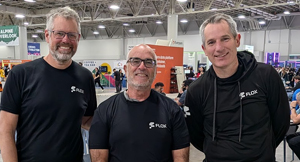
I then talked to the folks behind Flox, and explored how deterministic software packaging solves dependency sprawl and security patching.
 [Click on image for larger view.]
Built on the 20-year-old functional package manager Nix, Flox creates cryptographically reproducible environments straight through CI pipelines into production. When a critical vulnerability like an OpenSSL flaw drops, Flox already knows every exact dependency across the fleet and pre-builds patched environments in the background so teams can deploy fixes immediately rather than burning up engineering time on reactive maintenance.
Finally, LocalStack Head of Marketing Colin Neagle explained how local cloud emulation is accelerating both human and agentic development.
 [Click on image for larger view.]
Instead of waiting 30 minutes to deploy test builds to AWS and racking up cloud waste, developers and coding agents run a lightweight container on their local systems that emulates over 120 AWS services (alongside Snowflake and Azure emulators). Teams can snapshot and share exact environment states to reproduce bugs, catch IAM misconfigurations locally, and run air-gapped reinforcement learning sandboxes without exposing production cloud credentials.
 [Click on image for larger view.]
After the show ended for the day, I headed outside to reflect on the day and enjoy some of the unseasonably warm weather SLC was experiencing.
Final Thoughts on Day 2
Walking out of the Salt Palace at the end of Day 2, one pattern stands out above everything else: the infrastructure industry is building a protective wrapper around AI. Look at the thread connecting everything I saw today: CVS Health is baking compliance directly into its internal developer platform, ScaleOps is reclaiming wasted memory from spiky agent pods, LocalStack is sandboxing agentic test loops on local laptops, and Akuity is locking down what MCP-connected agents can touch in production.
As IT professionals, we have spent the last decade mastering declarative infrastructure for predictable microservices. Now we have to adapt those exact same Kubernetes primitives -- isolation, observability, resource quotas, and GitOps to handle software that writes itself and operates at machine speed. It is a messy transition, and the show floor feels a bit more spread out than in years past, but the engineering pragmatism on display in Salt Lake City shows that the cloud-native community is already building the guardrails enterprise IT needs.
About the Author
Tom Fenton has a wealth of hands-on IT experience gained over the past 30 years in a variety of technologies, with the past 20 years focusing on virtualization and storage. He previously worked as a Technical Marketing Manager for ControlUp. He also previously worked at VMware in Staff and Senior level positions. He has also worked as a Senior Validation Engineer with The Taneja Group, where he headed the Validation Service Lab and was instrumental in starting up its vSphere Virtual Volumes practice. He's on X @vDoppler.