News
Gartner: Cloud Gains Share, but On-Prem Database Spending Keeps Growing
Cloud databases are taking a bigger slice of enterprise spending, but the on-premises database business is still getting bigger, too: Gartner says its growth nearly doubled in 2025.
That finding is one of the broader takeaways in the research firm's Nov. 12 Magic Quadrant for Cloud Operational Database Management Systems, which describes a market being reshaped by AI agents, database consolidation and demands to keep control of where data lives.
On-premises database spending increased 7.4% in 2025, up from 3.8% growth in 2024. Gartner attributes that resilience to higher vendor maintenance fees and a possible increase in demand for hybrid and on-premises infrastructure. The figures describe spending, rather than a count of deployments or evidence of wholesale cloud repatriation.
Cloud services nevertheless captured most of the gains. The global database management systems market grew 17.9% to $140.2 billion in 2025, with cloud deployments accounting for 67% of spending and on-premises systems 33%. Those totals cover both operational databases and lakehouse systems, rather than just the operational products evaluated in this report.
Gartner projects database platform as a service will reach 84% of total market spending by 2030. Its account of the market's direction, however, leaves a continuing role for infrastructure outside public clouds.
Control Still Matters
Data residency requirements, geopolitical concerns and currency volatility are pushing enterprise architects to retain control over where data resides and executes, according to the report. Organizations are adopting distributed and hybrid designs spanning sovereign on-premises data centers, edge systems and multiple public clouds to address lock-in and outage risks.
Vendors are responding with Kubernetes operators, shared hybrid control planes such as Microsoft Azure Arc and Google Distributed Cloud, and partnerships that bring Oracle databases into other hyperscalers' environments. The emphasis is on consistent identity, failover and encryption governance across deployment boundaries.
The sovereignty theme also featured in Virtualization & Cloud Review'
s earlier coverage of Gartner's strategic cloud platform research, which examined how geopolitical concerns were changing provider selection.
As far as the leaders in this MQ report, the "Big 3" hyperscalers top the Leaders board, as usual.
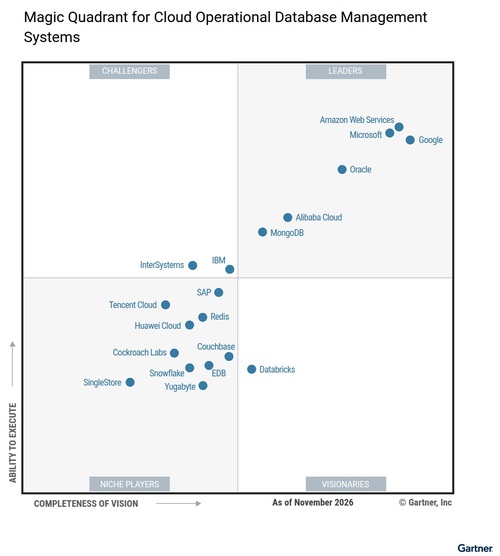 [Click on image for larger view.] Figure 1: Magic Quadrant for Cloud Operational Database Management Systems, November 2026 (source: Gartner).
AI Changes the Database Workload
Alongside those deployment choices, Gartner describes operational databases becoming reliable memory stores for autonomous agents, combining transactional work with semantic search and context management. It says autonomous operational DBMSs can generate 10 to 100 times more interactions than human users, increasing concurrency and compute utilization.
That pressure is bringing cost management into the database itself. Vendors are prioritizing built-in FinOps controls across compute, storage and networking, while automated tuning and embedded governance address performance and compliance demands.
The report also describes relational, document, graph and vector capabilities converging in broader platforms. Buyers are seeking to consolidate transactions, real-time analytics and AI processing to lower total costs and reduce data silos, while native change-data-capture and mirroring features connect operational systems with lakehouses.
Gartner has itself split the research: Operational databases and data lakehouse platforms now have separate Magic Quadrants, reflecting different buyers, architectures and risk profiles. It cautions that vendor positions in this new operational assessment cannot be compared directly with the earlier cloud DBMS quadrant, and that the chart should be only one input into a purchasing decision.
Note that while Gartner usually provides research only to paid clients, the MQ series of reports are often made available in licensed-for-distribution versions published by the vendors covered in the reports, easily discoverable by a simple web search of the report name.
About the Author
David Ramel is an editor and writer at Converge 360.