News
Agentic AI Pushes Enterprise Infrastructure Toward an Upgrade Cycle, Google Report Says
Google Cloud's latest infrastructure research says enterprises are encountering a sizable infrastructure gap as agentic AI systems move from experiments and pilots into production. According to the report, 83% of surveyed organizations believe their current infrastructure requires some level of upgrade to support production-grade agentic AI systems.
The 2026 State of infrastructure in the agentic AI era report focuses on the different demands created by autonomous agents. Google says a single agentic prompt can initiate hundreds of downstream actions as agents independently browse, query and execute across multiple systems. The report describes production agentic workloads as persistent, stateful and potentially long-running, requiring infrastructure that can provide access to multiple data sources while supporting continuous execution, security and governance.
"This report isn't just a survey of the landscape; it's a roadmap for establishing the new standard for production-grade autonomous systems," said Nirav Mehta, VP of product management at Google Cloud.
The findings build on Google's 2025 infrastructure research, which we covered last year (see "Google Cloud Report Shows Infrastructure Is the Missing Piece in GenAI Strategy"). That report found near-universal GenAI experimentation but focused on the infrastructure needed to move those efforts into production, highlighting data governance and integration, cost efficiency, hybrid cloud and edge deployment. The 2026 research shifts the emphasis to the demands of autonomous agents already moving toward production: infrastructure upgrades, governance and MLOps for continuous inference, more distributed execution at the edge, and power consumption as a factor in hardware selection. In that sense, the new report moves the infrastructure discussion from supporting GenAI broadly to supporting agents that continuously reason and act across systems.
Most Organizations Report an Infrastructure Readiness Gap
The report breaks the 83% readiness figure into several levels of required work. Twelve percent of respondents said their infrastructure requires significant fundamental upgrades, 29% reported major upgrades to specific core systems, and 27% said they need minor integration work and tuning. Another 16% said their infrastructure can support initial pilot agents with minimal effort. Only 17% reported full confidence in supporting mission-critical, production-grade agents.
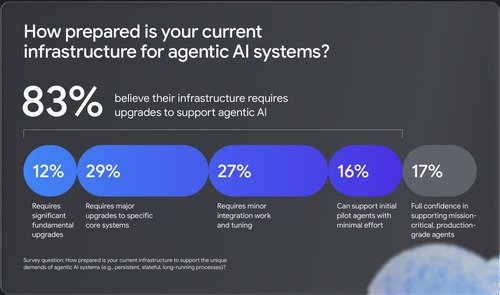 [Click on image for larger view.] Agentic AI Infrastructure Readiness Gap (source: Google Cloud).
Google ties that readiness gap to characteristics that differ from traditional application workloads. Agents need to maintain context across workflows and data sources, interact with systems such as ERPs and CRMs, retain longer-term memory and sustain chains of actions at scale. Also, infrastructure must provide security and data residency controls across on-premises, edge and cloud environments. For developer and platform teams, the report specifically points to orchestration and observability tools for coordinating multi-step workflows, managing data movement between agents and legacy systems, monitoring agent activity and supporting human intervention.
Governance Moves Into the Production Infrastructure
Security and governance rank among the most frequently cited barriers to scaling inference. In the survey, 79% of technology leaders identified security, governance and operations, including MLOps, among their top challenges. Business and system alignment was cited by 64%, while another 64% cited model performance and efficiency. The same chart reports that 46% call security a top challenge and 39% identify cost management as a top challenge.
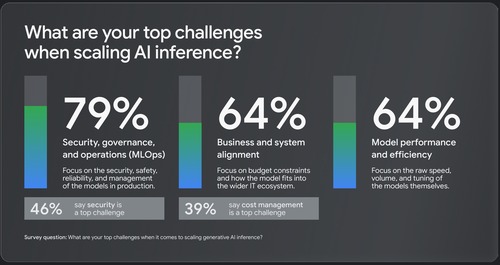 [Click on image for larger view.] AI Inference Scaling Challenges (source: Google Cloud).
The report argues that autonomous agents change the security model because agents may be authorized to read email, query databases and invoke APIs rather than simply return information to a user. It identifies indirect prompt injection, tool poisoning, compromised training data, open-source model dependencies, multi-tenant data leakage and unauthorized model access among areas requiring controls. Google consequently describes governance as part of the underlying infrastructure rather than a separate process added after deployment.
That approach extends to how agents are managed. Moving from disconnected tools to a central control plane can provide a common system of record for agent permissions and workflows. Google describes human-in-the-loop oversight as a way to require approval before an agent proceeds with specified actions. More broadly, organizations are moving toward integrated cloud platforms as they seek centralized control over production AI systems.
Edge Deployment Becomes Part of the AI Architecture
The survey also points to a distributed deployment model. Ninety percent of respondents said deploying generative AI models at the edge is important to their organizations, with 72% rating it extremely or very important. Google describes edge locations as including mobile devices, IoT devices and other environments closer to where data is generated.
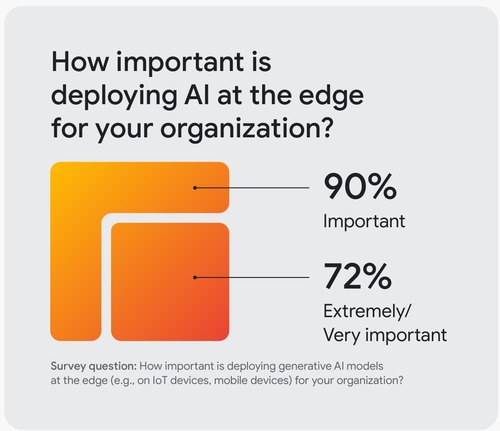 [Click on image for larger view.] AI Edge Deployment Importance (source: Google Cloud).
There are three reasons for placing some inference closer to the point of use: latency, cost and operational resilience. For workflows involving voice or video, round trips to centralized infrastructure can limit responsiveness. Local inference can also reduce reliance on central cloud compute for high-volume workloads, while edge deployments can continue operating when the primary network connection is interrupted. Google presents this model as a division of work in which centralized infrastructure can continue handling training and complex tasks while selected inference runs closer to users and data.
Power Consumption Enters Hardware Selection
Energy efficiency is another highlighted infrastructure consideration. Google reports that 91% of leaders now factor power consumption and energy efficiency into their selection of AI hardware and platforms for inference. Sixty-one percent describe energy efficiency as a significant factor. Those decisions are connected to both the availability of electrical capacity and regulatory requirements that affect data center operations.
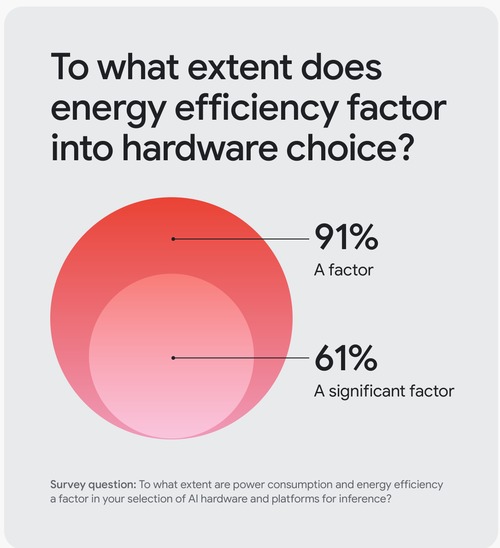 [Click on image for larger view.] Energy Efficiency In Hardware Selection (source: Google Cloud).
Germany and Ireland were cited as examples of jurisdictions imposing data center energy requirements. Google says new data centers in Germany must achieve a Power Usage Effectiveness rating of 1.2 or lower and reuse 10% of waste heat, while large centers in Ireland must provide on-site dispatchable generation matching their grid draw. Google says those constraints make performance and energy efficiency part of infrastructure capacity planning rather than a separate sustainability consideration.
The research was finalized in January 2026 and was conducted by Google Cloud and GBK Collective. It surveyed 1,402 senior IT decision-makers across the United States, Canada, United Kingdom, France, Germany, Australia, Japan, Korea, Mexico, Brazil, China and India. Respondents worked at the manager level or higher, were familiar with generative AI, considered AI important to their organizations' futures and either had a generative AI workload or planned to have one within the following 12 months. Companies represented in the research had at least 1,000 employees, with a 500-employee threshold in Asia Pacific and Latin America.
About the Author
David Ramel is an editor and writer at Converge 360.