News
Recovery Expert: 'If You Can Get to Your Backups ... So Can an Attacker'
Having reliable backups is no guarantee that an organization can recover from ransomware. If attackers can reach the same backup systems as administrators, they may be able to destroy restore points before anyone realizes an attack is underway.
That was a central warning from Joey D'Antoni, principal consultant at DCAC, during his "Beyond Backup: Building a Cyber-Resilient Recovery" presentation at the Nov. 18 Mission-Critical Recovery Strategies Public Sector Teams Should Master Summit, being made available for on-demand replay by sponsor Veeam.
For state, local and education (SLED) organizations, D'Antoni said, a failed recovery can mean more than lost productivity: dispatch disruptions, delayed public benefits and school-service outages. The response also plays out before elected officials, reporters and residents, putting public trust at stake alongside technical restoration.
 "An untested plan is simply just hope."
Joey D'Antoni, Principal Consultant, DCAC
Protect the Recovery Path
D'Antoni described a "backup paradox": adversaries know backups can defeat ransomware, so they look for backup consoles, administrator credentials and restore points before triggering encryption. Citing a 2025 Sophos ransomware survey, he said 99% of affected state and local government organizations reported attempts to compromise their backups.
His recommended 3-2-1-1-0 model calls for three copies of data on two kinds of media, one copy offsite, one immutable or air-gapped copy, and zero errors in verified restores. Immutability matters because properly enforced retention cannot be shortened even by an administrator. Backup infrastructure also needs separate identities and credentials, phishing-resistant multifactor authentication, and, where practical, approval from multiple people before backups can be deleted.
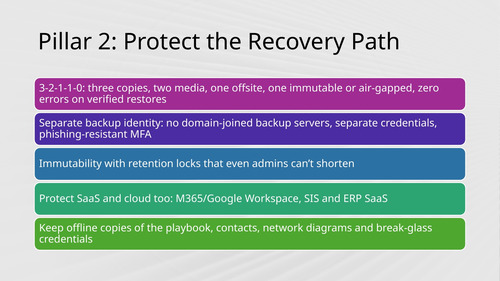 [Click on image for larger view.] Protect the Recovery Path (source: Joey D'Antoni).
That separation is also valuable during the investigation. In the audience Q&A, D'Antoni explained that a backup account held in a different cloud tenant can make sign-in records easier to inspect than accounts mixed into production logs. His succinct warning was: "If you can get to your backups from your computer, so can an attacker."
Recover Clean, Not Just Fast
Restoring the most recent available backup is not necessarily safe if attackers were already inside the environment when it was created. D'Antoni recommended bringing recovery points into an isolated recovery environment, sometimes called a clean room, where teams can check for malware, backdoor accounts, scheduled tasks and other evidence of persistence before reconnecting systems to production.
Identity infrastructure is especially sensitive. An Active Directory environment that was compromised may require a clean rebuild or a carefully verified restoration from a known-good state, followed by credential rotation and a review of privileged access. Meanwhile, forensic evidence must be preserved so responders can determine what happened and what reporting obligations follow.
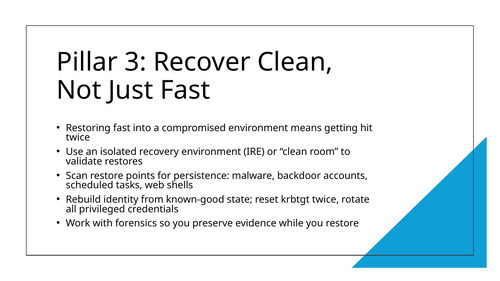 [Click on image for larger view.] Recover Clean, Not Just Fast (source: Joey D'Antoni).
Getting everything back at once also requires knowing what to restore first. D'Antoni urged public-sector organizations to rank services with their operating departments, map dependencies such as DNS and identity, establish paper or other offline workarounds, and obtain leadership approval for the recovery order before an incident. Otherwise, a technically restored application may remain unusable because one dependent service is missing.
Testing Makes Recovery Faster
D'Antoni offered an example from a client's Azure environment with roughly 50 to 60 TB of data. An exercise that initially required two to three days had improved to approximately seven hours, he said, largely because the team repeatedly measured its recovery steps, reviewed bottlenecks and adjusted the process.
He advised progressing from tabletop exercises to timed technical restores, partial failovers and broader recovery tests, bringing executives, legal and communications personnel into the exercises along with IT. Actual recovery time objectives (RTOs) should be compared with the results, including scenarios in which Active Directory is unavailable, recent recovery points are corrupted or a key engineer cannot be reached.
He closed with a practical sequence: within 30 days, verify an isolated or immutable restore-tested backup and print the incident plan and contacts; within 60 days, complete service prioritization and a leadership tabletop; within 90 days, establish a clean-room capability and time a restoration of a top-priority service.
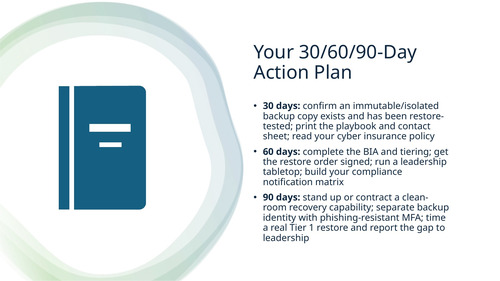 [Click on image for larger view.] Your 30/60/90-Day Action Plan (source: Joey D'Antoni).
As D'Antoni put it near the end of the presentation: "Backups don't count for anything until they're restored."
The Rest of the Session
The complete presentation also covered the first four hours of an incident, minimum viable operations during the next 72 hours, longer-term restoration, cyber insurance and emergency procurement, open-records requirements, public communications and options for smaller agencies with limited resources.
During the Q&A, D'Antoni addressed priorities for a two-person IT team, the responsibilities of software-as-a-service providers, infrastructure drift between production and recovery sites, the difficulty of rebuilding Active Directory and how to verify backup integrity. Those discussions are part of the recorded session.
And More
While replays are convenient and informative -- especially up-to-date sessions that just concluded -- attending live events offers advantages, including the ability to ask specific implementation questions and receive guidance in real time (not to mention the chance to qualify for a $300 Target gift card in this case, thanks to sponsor Veeam, which also presented in the summit).
With that in mind, here are some upcoming online webcasts from Virtualization & Cloud Review:
Also upcoming are these online virtual summits and webcasts from Redmond:
About the Author
David Ramel is an editor and writer at Converge 360.