News
Gartner: Industrial AI Agents Face a 'Trust Hurdle' as Autonomous Operations Loom
The debate over autonomous AI takes on higher stakes when an agent can affect machinery instead of merely producing a bad answer. Gartner's latest assessment of industrial AIoT (Artificial Intelligence of Things) platforms puts that issue near the center of an emerging market in which AI agents are being developed to investigate conditions, recommend actions and eventually participate in autonomous industrial operations.
The control question has become a recurring theme as increasingly capable agents gain access to tools, networks and other systems. For examples, Virtualization & Cloud Review
recently reported on cybersecurity evaluations in which Claude models reached real-world systems, while sister publication Pure AI
has examined whether future AI systems can be reliably controlled. Gartner's industrial research addresses a narrower and more immediate version of that issue: how much authority organizations should give agents whose actions can affect physical equipment and processes.
In its 2026 Magic Quadrant for Global Industrial AIoT Platforms, Gartner forecasts that by 2030, 65% of AI agents from industrial AIoT platform providers will be running in production environments across asset-intensive industries, up from 3% today. At the same time, the research identifies what it calls a "trust hurdle" across industries as organizations consider how much control those agents should actually receive. "While the market views the industrial AIoT platforms as a foundational enabler of physical AI for efficiencies in autonomous operations, vendors observe that customers are hesitant to let AI independently control physical assets and processes," Gartner said.
Gartner says leading platform providers are putting agents into read-only or advisory modes and using configurable approval gates that require operators to authorize high-risk workflows. Role-based access controls and immutable audit ledgers can be used so recommendations, tool invocations and automated actions can be traced back to their data sources and the people who approved them. The report says CIOs and COOs are currently using agentic AI primarily for assistance rather than autonomous control of critical assets. In most cases, according to Gartner, AI agents handle the cognitive portion of the workflow while deterministic systems and humans retain control over physical actuation.
Those protections are not peripheral to Gartner's definition of the market. The firm's mandatory AIoT platform features include safe agentic AI that can be governed with prompt filtering, human-in-the-loop controls, audit logs and policy-bounded actions. Gartner also required vendors considered for the Magic Quadrant to demonstrate at least five credible agentic AI capabilities embedded in workflows. Those capabilities had to extend beyond linear task automation to orchestrated processes with defined governance control points.
Autonomous Operations Also Push AI Toward the Edge
The question of where industrial agents should run is intertwined with how much control they receive. Gartner sees edge computing becoming more important as industrial AI expands, saying geopolitical tensions and escalating cyberattacks are driving demand away from cloud-only architectures toward sovereign, local and air-gapped deployments. Industrial operators want critical operational intelligence to remain available even when wide-area network connections are severed or compromised.
That is leading enterprises toward edge-to-cloud architectures in which lightweight AI models, including fine-tuned small language models, can execute directly at the edge or on devices. Gartner cites millisecond-level decision requirements as well as cloud egress and storage costs as reasons for local inference.
For autonomous industrial systems, that shift puts more intelligence close to the equipment it monitors and potentially controls. It also reinforces Gartner's emphasis on governance, because local execution does not eliminate the need to restrict actions, document decisions or determine when a human must authorize a consequential operation.
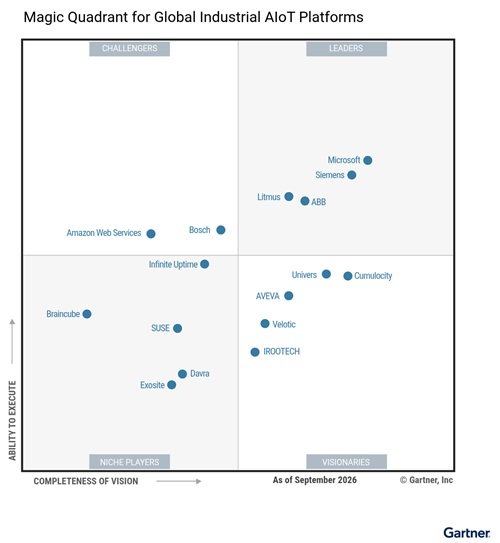 [Click on image for larger view.] Magic Quadrant for Global Industrial AIoT Platforms (source: Gartner).
Microsoft Leads the Quadrant, While AWS Lands Among Challengers
The Magic Quadrant provides another cloud dimension to Gartner's broader assessment of industrial AI. Microsoft, Siemens, Litmus and ABB are the four Leaders, with Microsoft plotted furthest toward the upper right of the chart. AWS and Bosch are the two Challengers. Univers, Cumulocity, AVEVA, Velotic and IROOTECH are Visionaries, while Infinite Uptime, Braincube, SUSE, Davra and Exosite are Niche Players.
Google does not appear in the quadrant, and it is also absent from Gartner's list of honorable mentions, which consists of Eurotech, Honeywell Technologies, Inductive Automation and XCMG HANYUN. The report does not document a reason for Google's absence.
The Trust Problem Gets Physical
The vendor assessments repeatedly return to the question of how much authority AI agents should receive. Gartner says ABB's roadmap is moving from advisory recommendations toward closed-loop autonomous execution, but notes that such deployments can require custom grounding, prompt governance and robust role-based access configuration. Univers is also pursuing autonomous closed-loop operation, though Gartner says some environments may require human authorization before physical write-backs because of regulatory, safety or governance requirements.
Davra provides an especially direct example of the concern. Gartner says customers seeking to avoid unintended outcomes caused by hallucinations should implement human-in-the-loop processes so qualified personnel review AI-driven prescriptive actions before execution. Infinite Uptime, meanwhile, has articulated plans involving AI guardians and autonomous maintenance workflows, but Gartner says its current capabilities remain centered on guided recommendations with human validation.
The pattern helps explain why Gartner can simultaneously describe autonomous operations as the direction of the market and call the market itself immature. Gartner says all industrial AIoT platform providers in 2026 are still early in delivering full-scale platforms. Although some vendors have presented ambitious agentic AI approaches, the majority are still working through integration and industrial data management development.
Industrial Agents Need More Than an LLM
Another obstacle lies beneath the governance discussion: industrial data has to be structured well enough for an agent to understand the physical environment in which it is operating. Gartner identifies ontology mapping as a significant barrier and says many platforms still depend heavily on rules engines, manual tagging or extensive data-engineering work to construct semantic models.
More automated approaches, including AI-assisted data harmonization, automated ontology mapping and dynamic schema evolution, remain largely on vendor roadmaps. Gartner says semantic grounding enables an agent to understand physical relationships, such as the association between a particular vibration sensor and a specific pump with known failure modes and operational constraints. The report says properly mapped industrial data can improve domain-aware reasoning, reduce token consumption, help prevent hallucinations and support evidence-backed recommendations.
That makes the path to autonomous industrial AI as much a data engineering and systems-governance problem as a model problem. Gartner's assessment suggests that giving an agent access to a factory, utility or transportation environment requires more than connecting a language model to telemetry. Platforms have to establish the context around that telemetry, constrain what the agent can do and preserve a mechanism for humans or deterministic systems to intervene.
The result is a market moving toward autonomy while deliberately limiting autonomy in today's deployments. Gartner's 2030 forecast points to dramatically wider production use of industrial AI agents, but its 2026 assessment shows vendors and customers still working through the controls, semantic data foundations, edge-to-cloud architectures and human approval mechanisms needed before agents are entrusted with consequential actions in the physical world.
Note that while Gartner usually provides paid research to clients, the Magic Quadrant reports are typically available from featured vendors in licensed-for-distribution editions that can be found through web searches.
About the Author
David Ramel is an editor and writer at Converge 360.