News
Gartner: Broadcom's VMware Deal Has 'Reinvigorated' Server Virtualization
The server virtualization market is undergoing its most significant disruption in more than a decade, according to Gartner, which says Broadcom's acquisition of VMware has "reinvigorated" a market being reshaped by licensing changes, forced bundling and changing vendor strategies. The upheaval is prompting enterprises to reassess long-term virtualization investments and giving commercial vendors, cloud providers and open-source projects new opportunities to compete for workloads.
That is one of the clearest themes beyond the vendor placements in Gartner's Sept. 14, 2026, Magic Quadrant for Server Virtualization Platforms. Gartner says organizations are evaluating alternatives that can provide comparable functionality while offering greater flexibility, reduced operational complexity or lower total cost of ownership. The server virtualization market itself is said to remain a foundational technology across private cloud, hybrid cloud and enterprise infrastructure strategies.
The quadrant provides a useful snapshot of the changing competitive field. On the chart, labeled as of August 2026, Nutanix is plotted highest on the Ability to Execute axis, while Broadcom (VMware) is plotted farthest to the right on Gartner's Completeness of Vision axis. Microsoft and Red Hat join those two vendors in the Leaders quadrant. HPE, Canonical and Oracle are Challengers, while SUSE, Platform9, H3C Technologies, IDT SYSTEM and Sangfor Technologies are Visionaries. Gartner places Proxmox, Vates, VergeIO, Citrix and Scale Computing among the Niche Players. Gartner cited Nutanix strengths as platform maturity, cloud-based IaaS, and expanded storage flexibility.
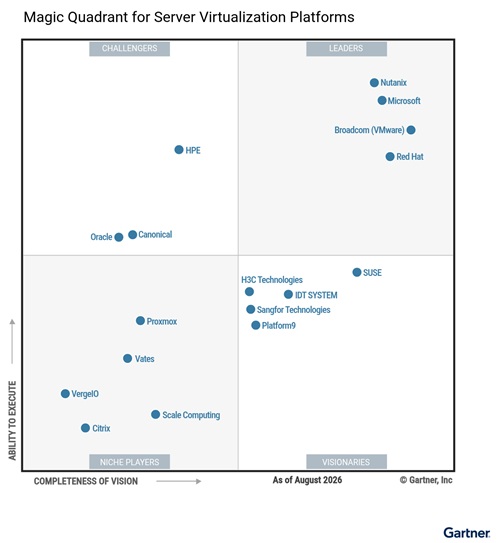 [Click on image for larger view.] Magic Quadrant for Server Virtualization Platforms (source: Gartner).
Broadcom Changes the Competitive Equation
Gartner directly connects the renewed competition to Broadcom's acquisition of VMware. Licensing changes, forced bundling and evolving vendor strategies have reshaped the market alongside changes in infrastructure economics and the addition of AI functionality to virtualization platforms. The resulting reassessment has accelerated competition among commercial suppliers, cloud providers and open-source ecosystems seeking to become strategic infrastructure platforms.
The report's Broadcom section illustrates why licensing has become such a prominent part of that reassessment. Gartner says its clients have reported significant cost increases associated with the transition to per-core subscriptions, along with minimal negotiating flexibility. Gartner also lists fewer licensing options as a caution, saying the shift to a subscription-based VMware Cloud Foundation model requires customers to purchase the full stack, including vSAN and NSX, while clients have reported sales pressure toward VCF and NSX.
Competitors increasingly differentiate themselves partly through alternative commercial models. Gartner highlights Canonical's flat per-node pricing, HPE's socket-based licensing for VM Essentials, Oracle licensing that covers as many as two sockets in the same server, Vates' flat per-host pricing and VergeIO's per-physical-server model. H3C Technologies and Sangfor Technologies offer both perpetual and subscription-based licenses. Proxmox, meanwhile, makes its full open-source enterprise stack freely downloadable, with subscriptions available for support.
The Market Is Expanding Beyond the Hypervisor
The changing market is also visible in Gartner's definition of the technology itself. Server virtualization platforms still start with a Type 1 hypervisor, live migration, centralized management, storage support, virtual networking, security and life cycle management. But Gartner's optional capabilities extend into software-defined infrastructure, data services, integrated VM and container management, confidential computing, GPU support and processor architectures beyond x86, including ARM, IBM Power and RISC-V.
That broader scope appears throughout the vendor assessments. Broadcom's VMware Cloud Foundation combines compute, storage, networking and Kubernetes. Nutanix Cloud Infrastructure similarly combines compute, networking, storage and a hypervisor for VMs and containers within a unified hybrid cloud platform. Red Hat's OpenShift Virtualization uses KubeVirt to operate VMs within a Kubernetes-based platform alongside containers and serverless workloads. SUSE likewise integrates virtualization into a Kubernetes control plane, while Canonical combines bare-metal provisioning, private cloud, containers and distributed edge virtualization across products including MAAS, OpenStack, MicroCloud and LXD.
Migration Costs Include More Than Software
Another recurring theme is preservation of existing infrastructure during a platform change. Gartner highlights Platform9's ability to use existing servers, storage and networks and its vJailbreak tool, which automates conversion of clusters to Platform9 on existing hardware without requiring separate migration hardware. Nutanix has added support for external storage platforms including Dell PowerStore and Everpure, formerly Pure Storage, which Gartner says can help organizations reuse existing hardware and reduce transition costs.
Similar considerations appear elsewhere. VergeIO's node-based model is described as allowing organizations to reuse server assets, while Broadcom's future investments include hardware-utilization improvements intended to alleviate replacement costs. Gartner also cites HPE Morpheus Software's hardware-independent approach and ability to manage KVM, VMware and public cloud environments through a common control plane.
That backs the research firm's characterization of virtualization migrations as broader infrastructure decisions rather than simple hypervisor substitutions. Enterprises may need to account for the reuse of servers and storage, backup and disaster recovery integrations, management tooling, staff skills, application certifications and cloud dependencies in addition to software licensing.
AI Becomes Part of the Virtualization Platform
AI also appears increasingly within Gartner's definition of platform competition. GPU support, including partitioning and resource pools, is listed among optional server virtualization capabilities, and Gartner says Leaders increasingly address workloads ranging from basic virtualization and private clouds to AI. Its description of Visionaries likewise cites advanced AI-assisted operations and sovereign cloud architectures among characteristics appearing in that quadrant.
Individual vendors are adding AI-related capabilities in different ways. Gartner cites Broadcom's GPU virtualization and AI capabilities, HPE's work on agentic AI operations, H3C's integration of virtualization with AI compute and vGPU technology, and Nutanix's planned topology-aware GPU scheduling. IDT SYSTEM is targeting mixed VM, container and bare-metal environments for AI inference, while Sangfor is working on pooling CPU and GPU resources from multiple vendors.
Those developments add to Gartner's broader picture of a market that is again in motion. Server virtualization remains centered on running and managing VMs, but the competitive questions now encompass licensing economics, cloud control planes, Kubernetes integration, hardware reuse, security, sovereignty and AI infrastructure. Gartner's assessment is that Broadcom's VMware acquisition helped trigger that reassessment, while the resulting competition is giving organizations a wider range of architectures and operating models to evaluate.
The research firm tracks more than 40 vendors in the market, with 17 meeting the inclusion requirements for this Magic Quadrant. Among other conditions, qualifying products had to have all mandatory features generally available by May 1, 2026, and vendors needed at least 10 production customers per region in at least four of seven specified geographic regions. They also had to address four of six use cases defined in Gartner's related Critical Capabilities research.
Note that while Gartner usually provides paid research to clients, the Magic Quadrant reports are typically available from featured vendors in licensed-for-distribution editions that can be found through web searches.
About the Author
David Ramel is an editor and writer at Converge 360.