News
Grafana Survey: AI Adoption Outruns Trust in Autonomous Operations
Artificial intelligence is becoming part of enterprise operations faster than IT leaders are getting comfortable letting it act on its own, according to a new Grafana Labs survey. While 85% of respondents are comfortable with AI conducting read-only investigations, just 50% are comfortable letting it deploy changes to production.
Grafana Labs, which sells observability software and services, released the findings Oct. 19, drawing on a survey conducted with ETR, a Futurum company. The research covers 300 senior IT and engineering decision-makers with budget or purchasing influence over observability tools.
The State of Observability, 2026 report examines two sides of enterprise AI adoption: using AI to help operate existing systems and monitoring the AI applications organizations are developing. Both are showing up in spending decisions, alongside questions about reliability, cost attribution and how much authority to give automated systems.
Investigation Is Easier to Trust Than Action
Some 68% of organizations have moved beyond investigating AI into pilots or production use in their observability environments. Nearly half, 47%, say AI is already running in production somewhere in their environment or is core to their strategy.
That adoption comes with different comfort levels depending on the task. In addition to the 85% comfortable with read-only investigation, 84% are comfortable with AI recommending a fix. Comfort falls to 56% for making code or configuration changes, 52% for fully autonomous remediation and 50% for deploying production changes.
Respondents also report benefits from AI tooling: 67% say it has improved the on-call experience for engineering teams, including 28% who report significantly reduced on-call burden and alert fatigue.
Reliability remains the leading adoption barrier, cited by 26%, followed by regulatory or compliance constraints at 23% and customer trust at 21%. Asked what would build trust, respondents most frequently identified explainability and a proven accuracy track record, each at 45%.
"There's a meaningful difference between trusting it [AI] to tell you what's wrong and letting it make a change in production," Grafana Labs co-founder Anthony Woods said in the announcement.
Monitoring the AI Applications Themselves
Beyond using AI in operations, 80% of respondents' organizations are building or operating features or products powered by large language models (LLMs). That includes 42% already in production and 38% in development or pilot stages.
Among organizations building or piloting those applications, 63% monitor model output quality or accuracy, and 53% trace LLM calls for latency and token usage. Other practices are less common: 44% monitor cost attribution, 42% track hallucination rates, 41% examine user feedback loops and 39% track prompt versioning.
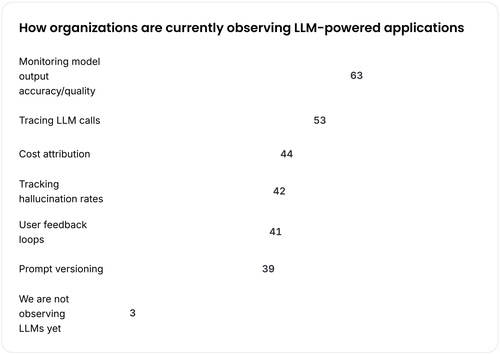 [Click on image for larger view.] How Organizations Monitor Their LLM Applications (source: Grafana Labs).
The tooling is often assembled internally. The report says 45% have put together an AI observability solution from multiple open-source projects, while 30% built something entirely in-house. A quarter use a purpose-built paid solution.
For respondents building or piloting LLM-powered applications, the most frequently cited challenge is unclear cost attribution across models and teams, at 25%. Non-deterministic output quality follows at 23%, with tools not designed for the use case at 19%.
Spending Rises, but Value Is Harder to Measure
Observability spending increased over the past year for 78% of respondents, and 73% expect it to increase again over the next 12 months. The report identifies new AI-related features and expanding coverage as AI accelerates development as the two leading drivers, cited by 61% and 60%, respectively. Business growth accounts for 51%, and vendor price increases for 49%.
Most respondents see a return: 97% report at least some value from increased spending. The report breaks that down into 61% who say the increase in value is proportional to spending growth and 36% who see value but cannot yet quantify it clearly.
Financial operations, or FinOps, practices are widespread but varied. Ninety percent report some approach, including a dedicated tool at 31%, a dedicated team using business intelligence tools at 26%, spreadsheets at 17% and engineering-built tools at 16%.
For AI pricing, half say a per-user, per-month model is easiest to budget for and defend internally. Token-based pricing follows at 19%, while outcome-based pricing accounts for 11%.
Consolidation and the Next Priorities
More than half of organizations, 53%, describe their observability approach as a unified, organization-wide platform. Another 25% are transitioning toward a unified strategy, while 20% remain siloed by team or function and 2% have no defined strategy.
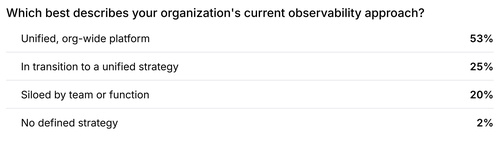 [Click on image for larger view.] Where Organizations Stand on Observability Consolidation (source: Grafana Labs).
Consolidation is very or extremely important to 79% of respondents. Reported success differs by where organizations stand: 96% of those that have completed the move to a unified platform describe consolidation efforts as successful, compared with 66% of organizations still operating in silos.
Asked to identify the most consequential observability trend over the next two years, 28% chose AI-driven autonomous operations and 25% chose observability for AI itself. Observability-security convergence followed at 22%, cost intelligence within the observability layer at 17% and OpenTelemetry as a universal standard at 9%.
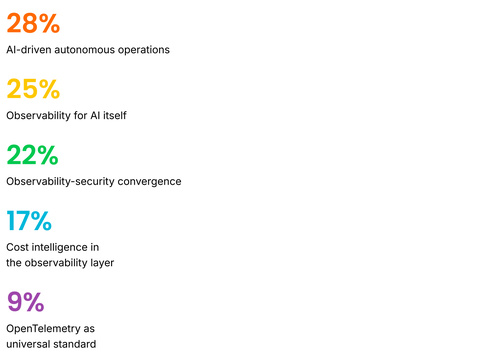 [Click on image for larger view.] IT Leaders Rank Future Observability Priorities (source: Grafana Labs).
ETR conducted the survey in June 2026 among director-level, vice president-level or higher decision-makers. The sample included 150 respondents in the United States and 50 each in Japan, Latin America and Western Europe. Results are unweighted, and percentages may not total 100 because of rounding.
About the Author
David Ramel is an editor and writer at Converge 360.