News
Red Hat OpenShift 5 Brings AI Agents to Cluster Troubleshooting and Upgrades
Red Hat is moving AI agents into the work of running enterprise infrastructure, announcing OpenShift 5 with tools to investigate cluster problems, assess upgrade readiness and propose changes while leaving operators responsible for approving them.
The company announced general availability Nov. 9 at KubeCon + CloudNativeCon North America in Salt Lake City. The release continues OpenShift's role as a common platform for containers, virtual machines and AI workloads across on-premises infrastructure and public clouds.
From Answering Questions to Investigating Problems
OpenShift Lightspeed now does more than provide conversational guidance. Red Hat's operational AI overview describes generally available augmented troubleshooting that accepts symptoms in natural language, investigates a probable cause and presents a proposed fix for an administrator to evaluate and apply.
The same post distinguishes that capability from autonomous troubleshooting, which is entering Technology Preview. In that mode, alerts can initiate an agent investigation of the underlying signals, but operators still review and approve changes before they reach the cluster. Red Hat says the AI features are optional.
Upgrade assistance follows a similar split. Update risk analysis is generally available for automated pre-checks and monitoring; agentic updates are in Technology Preview. The agent compiles readiness findings and potential blockers into a proposed run that administrators inspect before approving an update. Figure 1 shows the cluster update readiness view.
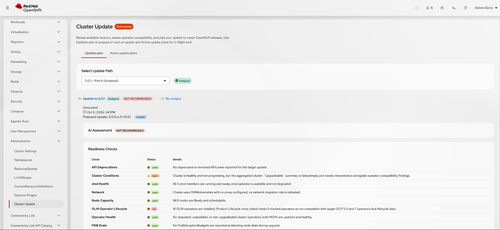 [Click on image for larger view.] Figure 1: Automated cluster update readiness analysis in OpenShift 5. (source: Red Hat).
For observability, Lightspeed can generate Perses dashboards from chat, a generally available capability intended to reduce manual query and panel construction. Red Hat describes an architecture that combines customer-provided model endpoints, MCP gateways and servers, temporary role-based permissions and short-lived execution environments. Figure 2 shows Lightspeed alongside a Perses dashboard.
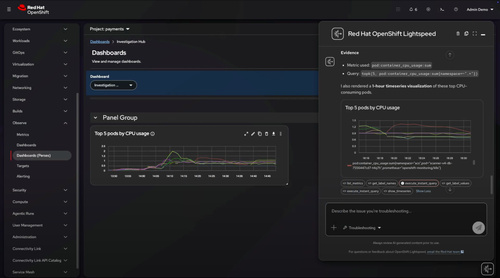 [Click on image for larger view.] Figure 2: OpenShift Lightspeed creates a Perses dashboard showing pod CPU usage. (source: Red Hat).
For IT teams, the distinction between investigation and execution matters: the announcement does not make unattended remediation the default. Evaluating these workflows means examining the evidence behind a recommendation, the permissions an agent receives and the approval required to change production infrastructure.
The release overview also puts Model Context Protocol (MCP) server and gateway support at general availability. OpenShift 5 is based on Kubernetes 1.36 and CRI-O 1.36, and Red Hat describes the move from OpenShift 4.22 as an in-place update rather than a cluster migration.
Other News for Cloud and AI Operations Teams
Related announcements and technical posts address the infrastructure, security and development practices surrounding those operational agents:
- Agent isolation and AI workload security. Red Hat's security overview describes the Red Hat build of Agent Sandbox, in Technology Preview, using sandboxed containers and VM isolation for untrusted agent code. Confidential GPU support is generally available on supported bare-metal systems to protect data in use, while platform changes also strengthen network isolation and post-quantum protections.
- Longer platform support. The new lifecycle policy extends standard OpenShift support from 18 to 24 months. Designated Extended Life Cycle releases, beginning with 5.2 and occurring every third release, can receive three additional years through an add-on, for up to five years total.
- Developer Hub 2.1 and governed agent access. The portal update gives AI tools organizational context, approved software templates and access to workflow actions, with MCP actions and the AI catalog described as developer previews. It also extends support from six to 10 months and modernizes plugin architecture. The press release's availability section says GA is expected this month, although its closing summary calls it generally available.
- RHEL diagnostics and local AI guidance. The RHEL 10.3 and 9.9 announcement describes MCP-based host diagnostics and a developer-preview option to run the command-line assistant with customer-hosted inference. RHEL 10.3 adds sealed OS images and post-quantum support in the Go toolchain; the releases are planned for the coming weeks.
- OpenShift Service on AWS. Red Hat's ROSA update brings Lightspeed troubleshooting into the service's console, with answers grounded in OpenShift and ROSA documentation. OpenShift 5 is available for ROSA's hosted-control-plane architecture, alongside the platform's security and lifecycle changes.
- Developer workspaces and local agents. A developer tooling roundup covers Dev Spaces 3.31 with bundled Copilot Chat, Podman 6 support in Podman Desktop and Kaiden 0.4 sandboxing for coding agents. These tools extend the operational discussion to the environments where teams build and test applications before deployment.
- Open-source inference operations. Red Hat's EnMaaS report describes an internal model-serving pilot combining Praxis and llm-d to handle engineering inference demand. It is an account of Red Hat's deployment and cost-management approach, rather than a new generally available product announcement.
- Virtualization deployments. A customer roundup highlights OpenShift Virtualization use across organizations including NASA's Jet Propulsion Laboratory. The examples provide context for Red Hat's effort to manage existing VM estates alongside containers and AI workloads on one platform.
About the Author
David Ramel is an editor and writer at Converge 360.