News
AI Agents Get Cloud Access Despite Near-Universal Concerns, LocalStack Survey Finds
Enterprise software teams are giving artificial intelligence agents access to cloud environments despite widespread concerns about leaked credentials, misconfigurations and costs, according to a new LocalStack-sponsored survey.
The State of AI in Cloud Development 2026 report found that 79% of respondents grant agents cloud access for development, testing or staging, while 97% expressed concerns about providing that access. Among those granting access, 26% said agents can also reach production environments.
Dimensional Research surveyed 309 hands-on developers and team managers at companies with more than 1,000 employees in the United States and Canada. Conducted Sept. 7-14, the online survey captures respondents' experiences and estimates, including how much AI-generated code their teams actually ship.
LocalStack sells a local cloud development platform for developers and AI agents.
Note that LocalStack has a direct connection to the AWS development ecosystem: Its LocalStack for AWS product emulates AWS services on local infrastructure so teams can develop and test applications before deploying them to the cloud, although the findings cover public-cloud development generally rather than AWS alone.
Access Extends Beyond Development
Of all respondents, 61% said agents occasionally have access to cloud development, testing or staging environments, and 18% said they always do. The remaining 21% said agents never have that access.
The leading concern was the potential for leaked credentials, cited by 67%, followed by misconfigurations at 62%, increased cloud costs at 53% and failures in production at 51%. Just 3% reported no concerns.
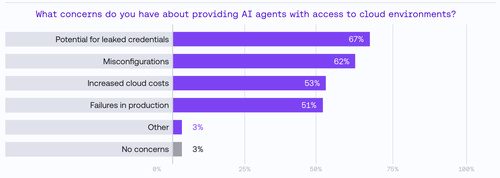 [Click on image for larger view.] Leading Concerns About Agent Cloud Access (source: LocalStack).
Concerns also persisted among respondents who always grant agents cloud access: 92% of that group expressed reservations. Misconfigurations led their list at 65%, followed by potential credential leaks at 55%.
Among respondents who give agents cloud access, 89% allow access to testing environments, 85% to development, 55% to staging and 26% to production. Those percentages describe the access-granting subgroup, rather than the full survey population.
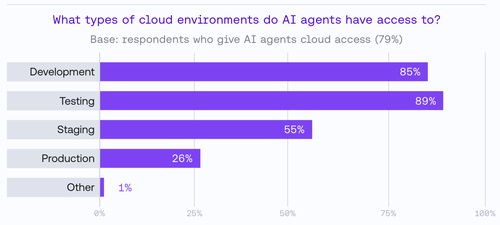 [Click on image for larger view.] Cloud Environments Available to AI Agents (source: LocalStack).
Access was more common at larger employers. Among respondents at companies with more than 5,000 employees, 84% granted agents cloud access, compared with 72% at companies with 1,000 to 5,000 employees.
More Code Does Not Mean More Releases
AI has increased code output for many surveyed teams: 65% said they generate at least twice as much code as before adopting AI, and 32% reported at least a fivefold increase. But respondents estimated that only 61% of AI-generated code reaches production, on average.
A quarter estimated that their teams ship less than half of their AI-generated code. By comparison, 24% said they release at least 80%. These are reported estimates of release rates, rather than measurements of code quality or deployment activity.
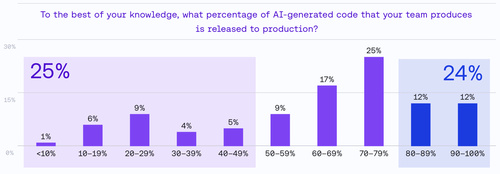 [Click on image for larger view.] How Much AI Code Reaches Production (source: LocalStack).
Quality concerns were common. More than half of respondents, 54%, said they encounter more bugs in AI-generated code, while 31% reported fewer bugs. On debugging, 47% said human-generated code is easier to debug, compared with 30% who said AI-generated code is easier.
Developers and managers differed sharply on some assessments. While 23% of developers said AI-generated code has significantly more bugs than human-generated code, just 6% of managers agreed. Developers were also more likely to say they felt significantly more confident shipping human-generated code: 27%, compared with 15% of managers.
Staging Delays and Missed Failures
Cloud staging environments presented another set of reported obstacles. When asked how long staging takes to reflect a code update, 87% reported waits of at least two minutes. Some 42% waited longer than 10 minutes, and 11% waited more than an hour.
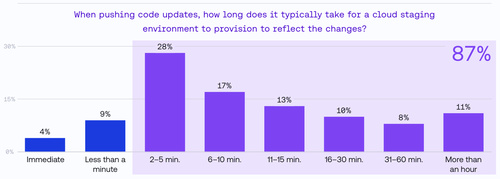 [Click on image for larger view.] Waiting for Cloud Staging to Update (source: LocalStack).
Shared environments were also widespread: 84% of respondents relied on shared staging environments, and 45% said more than 10 developers typically share a single environment. Among those sharing staging environments, 82% said downtime disrupted their work at least weekly.
Only 9% said staging perfectly matches production. Nearly all respondents, 97%, reported production failures that staging struggles to catch. Networking and connectivity issues led at 51%, followed by differences in resource limits and quotas at 47%, secrets and configuration drift at 44%, and cross-account or cross-region resource references at 42%.
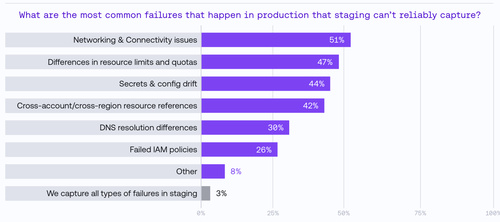 [Click on image for larger view.] Production Failures That Staging Environments Miss (source: LocalStack).
In its accompanying announcement, LocalStack framed validation as the central constraint, describing writing code as no longer the slow part of the software development lifecycle and stating, "Validating it in the cloud is."
Cost Visibility Remains a Concern
Beyond code quality and testing, 58% of respondents agreed that management wants them to manage cloud and token costs but that they lack the information required to do so.
Meanwhile, fully autonomous operation was still occasional for most respondents reporting it. Some 41% said agents occasionally operate without waiting for human prompts, while 8% said that happens frequently.
The report recommends tracking code that reaches production, providing agents with isolated testing environments, reducing validation delays and incorporating developers' views alongside managers' assessments. The recommendations focus on release rates and validation capacity alongside code-generation output.
About the Author
David Ramel is an editor and writer at Converge 360.