News
Codex Study Points to Work's Agentic AI Future -- with Some Surprises
New research from OpenAI points to a shift from AI as a chat-based assistant to AI as an agentic work system -- with some of the most notable findings coming from non-developer use as workers quickly adapt to new tools and ways of working across the board.
An OpenAI post and accompanying research paper on Codex usage were published today, June 25 from the GenAI pioneer.
The paper, "The Shift to Agentic AI: Evidence from Codex," analyzes usage data from OpenAI's Codex tool across three populations: external personal-account users, external organizational-account users and workers within OpenAI. The authors describe Codex as an agentic coding and work platform that was initially built for software development but is now used for tasks outside coding, including drafting documents, analyzing data and coordinating communication.
One graphic shows how that broader use appeared inside the company. The chart breaks down Codex output tokens by inferred OpenAI department and work category, showing that engineering and coding work remained prominent but did not account for all usage. Finance/Biz Ops, Product/Marketing/Ops and other departments also showed substantial shares of knowledge work, data analysis, financial analysis and other tasks.
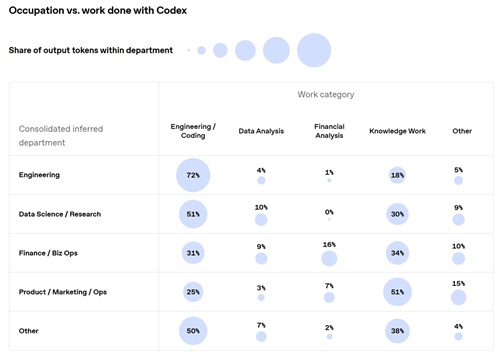 [Click on image for larger view.] Occupation vs. Work Done with Codex (source: OpenAI).
The OpenAI-internal data is not presented as representative of typical enterprise adoption, but it illustrates the paper's broader point: Codex usage is not limited to code generation. The post says Codex is being used for "some kind of agentic work" by non-developers, while the paper says users are increasingly delegating work that includes software tasks, documentation, data analysis and coordination.
OpenAI's post frames the shift this way: "Agentic AI changes the unit of knowledge work from single interactions to delegated, long-horizon tasks." The paper makes a similar distinction between conversational AI and agentic AI, saying traditional chatbot interfaces are primarily conversational, while agentic systems let users delegate multi-step tasks to tools that can inspect files, execute commands and create or modify artifacts.
Codex vs. ChatGPT in the Study
The paper separates Codex from ChatGPT for analytical purposes, referring to ChatGPT as a conversational AI tool and Codex as an agentic AI tool. The authors caution that the distinction is not absolute: ChatGPT has agentic capabilities such as browsing and code execution, while some Codex interactions are conversational.
Still, the paper says the observed usage patterns differ. Codex use is "strongly oriented toward delegated production," with users asking it to perform concrete tasks such as debugging, refactoring, validating changes, configuring applications, drafting documents and analyzing data.
"These activities are better understood as production than as consultation," the paper says. In the authors' formulation, "users are asking Codex to do work, not only to provide advice or information."
That point is central to OpenAI's argument. The paper says the relevant unit of analysis for agentic AI is not just a single conversation, but a delegated workflow in which the system performs actions on behalf of the user.
Three User Groups, Different Adoption Patterns
The study does not treat all Codex users as OpenAI employees. Instead, it compares three groups: individual users on personal plans, organizational users on Business and Enterprise plans, and OpenAI workers.
The adoption pattern was uneven across those populations. The paper says Codex usage grew more than fivefold in the first half of 2026, but agentic tooling remains much less broadly used than ChatGPT overall. Among OpenAI workers, however, Codex largely replaced ChatGPT as the main interface for work-related AI use.
As of June 11, 2026, Codex accounted for 99.8 percent of output tokens generated by OpenAI workers across Codex and ChatGPT, the paper says. Among organizational users, the corresponding share was 63.3 percent. Among individual users, it was 16.5 percent.
The OpenAI workforce finding is the most dramatic, but also the least generalizable. The paper says OpenAI is an unusually favorable environment for agentic AI because workers are familiar with frontier models, usage is cheap at the margin, organizational buy-in is high, internal training and knowledge sharing are common, and many workflows are close to the systems being developed.
"OpenAI usage is therefore not representative of the typical organization today," the paper says.
The Surprise: Non-Developers Are Moving Fast
Codex began as a coding tool, and software development remains the core usage area. But OpenAI's research says non-developer adoption is growing quickly.
The OpenAI post says non-developer users rose 137x among individual users, 189x among organizational users and 12x within OpenAI since August 2025. Inside OpenAI, the company said every department, including Legal, Finance and Recruiting, now uses Codex as its primary AI tool for work.
That does not mean non-developers are using Codex the same way engineers do. The post says more non-developers are using Codex "for some kind of agentic work." The paper's task categories include not only software activities but also data analysis, research, knowledge artifacts, collaboration and business-function workflows.
OpenAI's post says the average lawyer or recruiter at the company now generates more than 85 percent of output tokens on Codex. It also says Legal, Finance and Recruiting crossed into majority Codex use around April 2026, after engineering had moved first.
For software development readers, the notable point is not that Codex writes code. It is that OpenAI is presenting Codex as evidence of a broader workplace shift in which agentic systems are used to delegate technical and knowledge-work tasks across departments.
Longer Tasks and Parallel Agents
The paper also looks at task complexity, runtime, concurrency and repeated workflows. OpenAI says users increasingly delegate longer-horizon work to Codex.
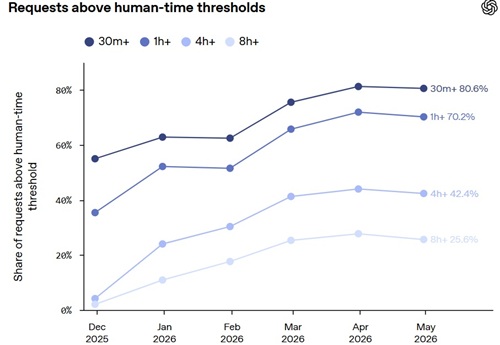 [Click on image for larger view.] Requests Above Human-Time Thresholds (source: OpenAI).
OpenAI says that by May 2026, 80.6 percent of sampled individual users had made at least one Codex request estimated to exceed 30 minutes of human work, 70.2 percent had made one estimated to exceed one hour, and 25.6 percent had made at least one request estimated to exceed eight hours.
The paper says those duration figures are model-estimated and are based on a sample of individual users who opted to allow their queries to be used in training. OpenAI's post also says the thresholds should be treated as directional rather than exact.
The broader pattern is that heavy Codex users appear to use the tool differently from occasional users. The paper says intensive users are more likely to use skills, run longer and more complex tasks, and operate multiple agents concurrently. Among the most intensive OpenAI users, the paper says Codex is "less an assistant answering requests and more like a workflow system."
What the Study Does, and Does Not, Show
OpenAI presents the research as evidence of how agentic AI use is developing at the frontier. The paper documents adoption, user groups, task categories, task complexity, concurrency and output-token patterns across Codex and ChatGPT.
It does not directly prove productivity gains, software-quality improvements or business outcomes. Output tokens can indicate AI-mediated work, but they are not the same as completed work, higher-quality work or economic value. The paper's strongest evidence comes from OpenAI's own workforce, which the authors explicitly describe as atypical.
Even so, the research provides a detailed look at how usage changes when an AI tool can operate inside work environments, inspect files, execute commands and produce artifacts. OpenAI's conclusion is that agentic AI changes what adoption means: the question is not only whether people use the tool, but what work they delegate to it and how workflows are reorganized around repeated or parallel delegation.
For developers and software teams, Codex remains a coding and software-production tool. But OpenAI's own data suggests the bigger story is that coding agents may become a template for broader workplace automation -- not only by writing code, but by turning AI interaction into delegated work.
About the Author
David Ramel is an editor and writer at Converge 360.