News
Global Survey Links Cloud-Based Physical Security to 2.6x AI Adoption
Cloud deployment and artificial intelligence adoption are increasingly moving together in physical security, according to new global research from Verkada, which found fully cloud-managed organizations actively use AI at 2.6 times the rate of those operating fully on-premises systems.
The company's 2026 State of Cloud Physical Security research, based on a Dynata survey of 2,741 IT and physical security leaders, suggests the old argument over whether physical security belongs in the cloud is giving way to a different question: how much AI organizations can put on top of that infrastructure.
The study covered organizations with at least 100 employees across 13 countries grouped into 10 reporting markets. Verkada also emphasized the cloud disparity in its Aug. 12 report announcement.
Cloud and AI Travel Together
The biggest infrastructure split appears in active AI use. Fully cloud-managed organizations came in at 57%, compared with 38% for hybrid environments and just 22% for fully on-premises deployments.
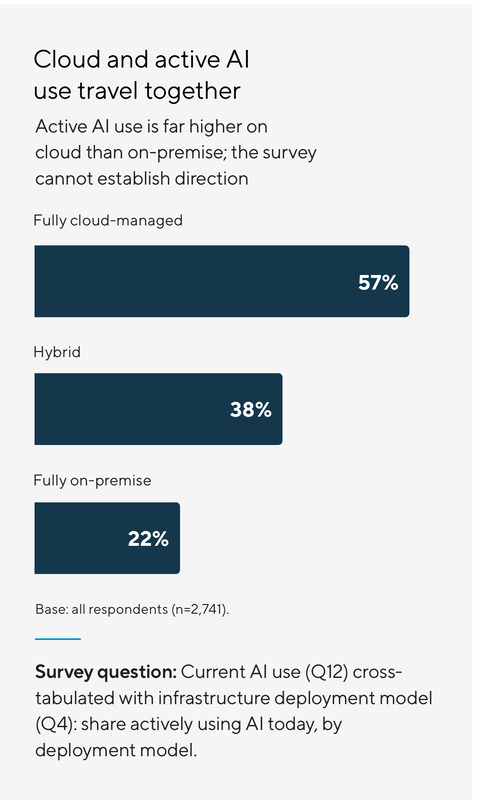 [Click on image for larger view.] Cloud And AI Adoption Travel Together (source: Verkada).
Verkada's explanation is architectural. With traditional on-premises systems, available compute can be largely fixed when hardware is purchased, while cloud-managed systems can shift heavier analysis to scalable infrastructure and deliver new AI capabilities through software. That is Verkada's hypothesis, however, not something the survey proves: the report notes that fully cloud-managed organizations also tend to have more sites and larger or faster-growing budgets.
The larger migration picture reinforces the cloud theme. Some 70% of respondents still operate hybrid environments, while 22% are fully cloud-managed and only 8% remain fully on-premises. Among organizations that aren't already fully cloud-managed, 94% say they have begun planning or are already carrying out some form of cloud transition. The survey also found 89% agree that the future of physical security is cloud-based.
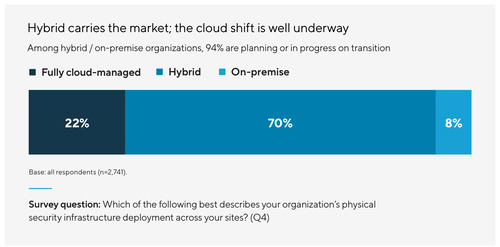 [Click on image for larger view.] Hybrid Dominates Physical Security Deployments (source: Verkada).
Cloud, Cybersecurity and AI Compete for Budget
The infrastructure and AI shifts are also converging in spending plans. Some 81% of organizations expect their physical security budgets to increase during the next year, while cybersecurity was named the top investment priority by 26%, cloud storage and infrastructure by 25%, and AI analytics and video intelligence by 23%.
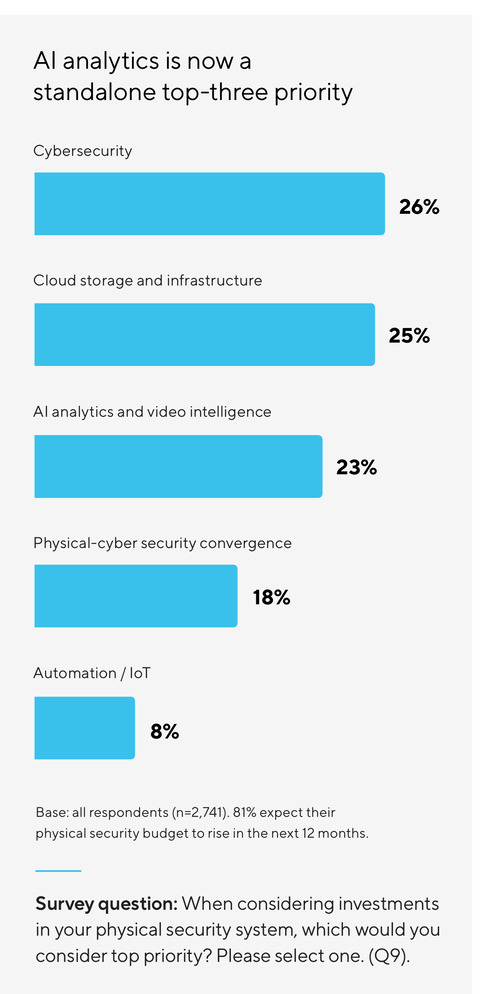 [Click on image for larger view.] AI Joins Top Investment Priorities (source: Verkada).
Beyond the cloud findings, other results help show what organizations are doing with that infrastructure:
- AI is already widespread: 41% say they actively use AI in physical security and another 39% are piloting it. Among users and pilots, the most common capabilities are AI-verified alarm monitoring at 55%, AI-generated incident reports at 53% and real-time alerts at 47%.
- Governance is lagging deployment: Only 41% report comprehensive AI governance specific to physical security and 38% have formal, quantified ROI measurements. Those rates are much higher among organizations already actively using AI than among those still piloting it.
- Cameras are becoming operational data sources: 92% use or plan to use camera data beyond security, led by workplace safety and compliance at 66% and operational efficiency at 58%.
- Moving intelligence to the cloud brings its own concerns: Privacy, cybersecurity and cost rank among the leading barriers to expanded AI use, and the report notes that concentrating video and identity information off-premises can expand the attack surface.
The cloud/AI alignment also matches Verkada's own technology direction. In July, the company announced a collaboration with NVIDIA aimed at accelerating what it calls "physical AI" across more than 2.4 million devices, including work involving AI-powered video search, multimodal embeddings and vector retrieval.
For IT teams, then, physical security increasingly looks less like a collection of isolated cameras and recorders and more like another distributed cloud and AI workload. Verkada's data suggests hybrid infrastructure will remain the norm for now, but organizations that remain entirely on-premises are becoming the exception -- and are also the group reporting the least AI use.
About the Author
David Ramel is an editor and writer at Converge 360.