News
Private AI, Not Public Cloud: Broadcom's Message With VMware Cloud Foundation 9.1
Broadcom announced VMware Cloud Foundation 9.1 on May 5, positioning the release as a private cloud platform update for production AI workloads, Kubernetes applications and traditional virtual machine environments.
The release gives Broadcom another update to the VMware Cloud Foundation 9 line as customers weigh where to run AI infrastructure, containerized applications and existing enterprise workloads. In its VCF 9.1 announcement, Broadcom described the release as a secure, cost-effective infrastructure platform for production AI workloads, with integrated security and mixed compute infrastructure support across AMD, Intel and NVIDIA.
Broadcom said VCF 9.1 is aimed at enterprises deploying inference and agentic AI applications with lower costs, enhanced security and choice across GPU and CPU hardware. The company also tied the release to Kubernetes scale, application delivery, network interoperability, cyber recovery and compliance features.
Broadcom's private cloud positioning aligns with its preview of the Private Cloud Outlook 2026 report, which said 56 percent of surveyed organizations are running or planning to run production AI inferencing in private cloud, compared with 41 percent for public cloud. The preview also said public cloud use for production inference fell 15 percent year over year, while 62 percent of IT leaders reported being very or extremely concerned about generative AI infrastructure costs and 36 percent said AI is driving new requirements for data protection, privacy, security controls and risk management.
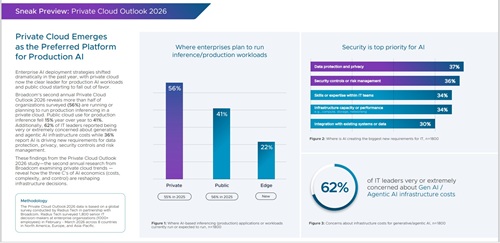 [Click on image for larger view.] Private Cloud Outlook 2026 (source: Broadcom).
Private AI and Infrastructure Efficiency
In addition to private cloud, private AI also figures prominently in the company's direction. The company quoted a customer attesting to the importance of that initiative. "By deploying VCF Private AI Services on our existing VMware Cloud Foundation infrastructure, we will run AI-powered content summarization, heading generation, and editorial assistance directly on our private cloud," said V V Jacob, senior general manager, systems for Malayala Manorama Co Ltd. "
Broadcom cited internal April 2026 estimates or test results for several efficiency claims, including lower server costs through intelligent memory tiering, lower storage TCO through compression and deduplication, lower Kubernetes operational costs and faster cluster upgrades. The company said those internal estimates were subject to change.
According to Broadcom, VCF 9.1 includes advanced memory tiering and storage compression intended to increase workload density on existing infrastructure. The company said the release can also double management capacity to 5,000 hosts and deliver faster cluster upgrades across distributed and air-gapped environments.
In a blog post on VCF 9.1 efficiency and resilience, Broadcom said enhanced NVMe memory tiering introduces a unified memory model in which hot data stays in DRAM and colder pages are offloaded to NVMe. The company said vSAN global deduplication and enhanced compression are designed to reduce physical storage requirements across a cluster by eliminating redundant data and improving compression efficiency.
Broadcom also said vSphere Elastic Provisioning is intended to simplify host onboarding and workload assignment through parallel imaging, automated discovery and consistent configuration. Other listed infrastructure updates include support for up to 5,000 ESX hosts, increased upgrade scale with parallel lifecycle operations, topology-aware scheduling, real-time operational observability and enterprise support for Ubuntu OS images.
Broadcom indicated organizations are facing three critical challenges in using AI for competitive advantage: data and IP privacy, surging infrastructure costs and agentic AI readiness. "VCF 9.1 is a single unified platform that addresses all three and delivers one of the most advanced infrastructures for Private AI. We enable zero-trust security for AI, reduce costs through intelligent infrastructure optimization and hardware choice, and provide the flexibility to run both agentic workflows and accelerated inferencing on the same platform," said Krish Prasad, senior vice president and general manager of the VMware Cloud Foundation Division.
Kubernetes Scale and App Delivery
Kubernetes is another major part of the VCF 9.1 release. Broadcom said the release provides 2.6 times increased cluster scale, 70 percent faster deployments and 75 percent shorter upgrade windows compared with preview versions, based on the company's internal estimates or test results.
Another blog post on VMware vSphere Kubernetes Service in VCF 9.1 said VKS in the release will support 500 clusters per control plane, up to 70 percent faster cluster provisioning, 75 percent faster upgrades and multi-network support. The post also listed intelligent node pool placement, multiple clusters per zone, distributed transit gateway support, automated secret injection and granular access controls.
Broadcom said VCF 9.1 also introduces a Container Service runtime through VCF Automation. According to the VKS post, the container runtime executes directly on ESX without cluster overhead and is intended to provide an on-ramp from simpler container deployments to full Kubernetes capabilities when application architecture changes.
The release also includes live application stack blueprints. Broadcom said the capability lets platform teams capture running application environments, including compute, networking and storage configuration, and convert them into reusable templates for deployment across development, test and production environments.
Automation and Self-Service Updates
VCF 9.1 adds automation changes for private cloud consumption. In a VCF Automation blog post, Broadcom said the release will separate three runtime options: VM Service, Container Service and VMware vSphere Kubernetes Service. The same VCF Automation 9.1 post said Container Service access will include lifecycle management for deploying, configuring, monitoring, upgrading and deleting containers through the interface.
The automation post said Fast Deploy capabilities will apply to VM and VKS cluster provisioning. For VKS, Broadcom said cluster deployments move from 37 minutes to 11 minutes, a 69 percent improvement, while cluster upgrades move from 6.9 hours to 1.7 hours, a 75 percent improvement.
The same post listed additional self-service and network-related automation features, including tenant IP address pre-allocation, multiple external connections, multiple transit gateways per tenant, direct data center access, VPN deployment, gateway firewalls, shared subnets and VLAN extensions.
Networking and Hardware Support
Networking changes in VCF 9.1 include EVPN-VXLAN interoperability with physical switch fabrics. In a blog post, Broadcom said VCF 9.1 networking updates include standards-based interoperability between VCF and physical switch fabrics including Arista UCN, Cisco Nexus ONE and SONiC.
The networking post said distributed connectivity from ESX hosts directly to the physical fabric eliminates the need for dedicated network edge nodes, reduces capital costs and addresses scaling bottlenecks associated with centralized connectivity. Broadcom also said VCF 9.1 enables multiple external connections and multiple transit gateways with distributed VLAN connections per tenant, including isolated VPN, static routes and custom NAT configurations.
On the hardware side, Broadcom said VCF 9.1 supports AMD and Intel CPU platforms, AMD and NVIDIA GPUs, and standards-based EVPN-VXLAN interoperability with Arista Universal Cloud Network. The company also cited support for NVIDIA ConnectX-7 NICs and NVIDIA BlueField-3 with Enhanced DirectPath I/O for multi-host AI training and data-transfer scenarios.
The networking post said Enhanced DirectPath I/O for NVIDIA ConnectX-6 DX, ConnectX-7 or BlueField-3 adapters in NIC mode is optimized for AI, machine learning and distributed computing, with support for GPUDirect RDMA. It also said Uniform Passthrough for NVIDIA ConnectX-7, BlueField-2 and BlueField-3 adapters in NIC mode is optimized for non-AI high-performance workloads and uses VMXNET3 Hardware Emulation.
Security, Compliance and Recovery
Broadcom said VCF 9.1 integrates security at the infrastructure layer for AI workloads, proprietary models and training data. The announcement listed on-premises ransomware recovery, continuous compliance enforcement, zero-downtime live patching, zero-trust lateral security and self-service security with automation among the release's security capabilities.
A VMware Cloud Foundation security blog post on continuous compliance and cyber recovery said VMware Advanced Cyber Compliance 9.1 extends compliance monitoring and remediation to the VCF stack, including workloads and infrastructure, against benchmarks such as PCI DSS and VCF security guidelines. The post also said ACC 9.1 provides integrated cyber recovery to on-premises VCF isolated clean rooms and that CrowdStrike Falcon now integrates with ACC cyber recovery workflows.
Broadcom said live patching in VCF 9.1 supports up to 80 percent of use cases without host evacuation or maintenance windows, based on internal Broadcom estimates or test results. The company also said continuous compliance enforcement is an advanced service for VCF sold separately.
The release leaves VCF 9.1 positioned as a Broadcom update focused on bringing AI infrastructure, Kubernetes operations, networking, security and recovery capabilities into the same private cloud platform.
About the Author
David Ramel is an editor and writer at Converge 360.