News
Google I/O '26 Fills Out Enterprise Agent Stack with Managed Agents, ADK 2.0
Google used I/O 2026 to fill in more of its enterprise agent-development stack, expanding the story beyond individual tools such as Antigravity CLI to a broader set of paths for building, running and governing AI agents on Google Cloud.
The new material builds on an earlier enterprise AI thread. At Cloud Next '26, Google detailed Gemini Enterprise Agent Platform as the foundation for building, scaling, governing and optimizing agents.
The I/O Follow-Up
The Cloud Next message was that Google wants Gemini Enterprise Agent Platform to be the foundation for enterprise agents. The earlier I/O CLI story showed how Google's terminal tooling is being folded into Antigravity. The broader I/O follow-up is that Google is now mapping those pieces into a full stack for agent development.
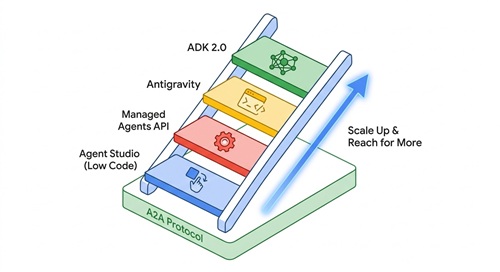
Agent Studio gives business-facing teams a low-code entry point. Managed Agents API gives technical teams a hosted agent runtime. Antigravity provides the coding and orchestration surface. Agent Development Kit (ADK) 2.0 gives engineers a code-first multi-agent framework. Gemini 3.5 Flash provides the model layer. Gemini Spark shows how personal workplace agents can operate across Workspace, enterprise connectors and the web.
 Agent Studio (source: Google).
The through line is that Google is moving agent development toward a common platform model: multiple ways to build agents, one shared foundation for execution, governance, interoperability and enterprise deployment.
A Google Cloud post for agent developers described the I/O announcements as "a unified development toolkit" featuring Antigravity 2.0 and the Managed Agents API. Google said the goal is to bridge high-speed prototyping and secure corporate deployment, with local development and cloud deployment running on a shared protocol layer.
Four Agent-Building Paths
Google's most useful enterprise framing is the four-rung development model. The company said the first rung, Agent Studio, is a visual workspace inside Agent Platform where users can discover models, engineer prompts, wire up tools and ship agents without writing code.
The second rung is the Managed Agents API, which Google said is new at I/O. It is aimed at technical teams that want to define agent behavior while Google Cloud handles the runtime infrastructure. Developers configure the agent, package instructions, skills and tools, and invoke it through the Interactions API.
The third rung is Antigravity, Google's agent-first development platform for coding and orchestration.
During the first day of the event, Google moved Gemini CLI into Antigravity CLI, folding its terminal AI tool into the broader Google Antigravity development platform.
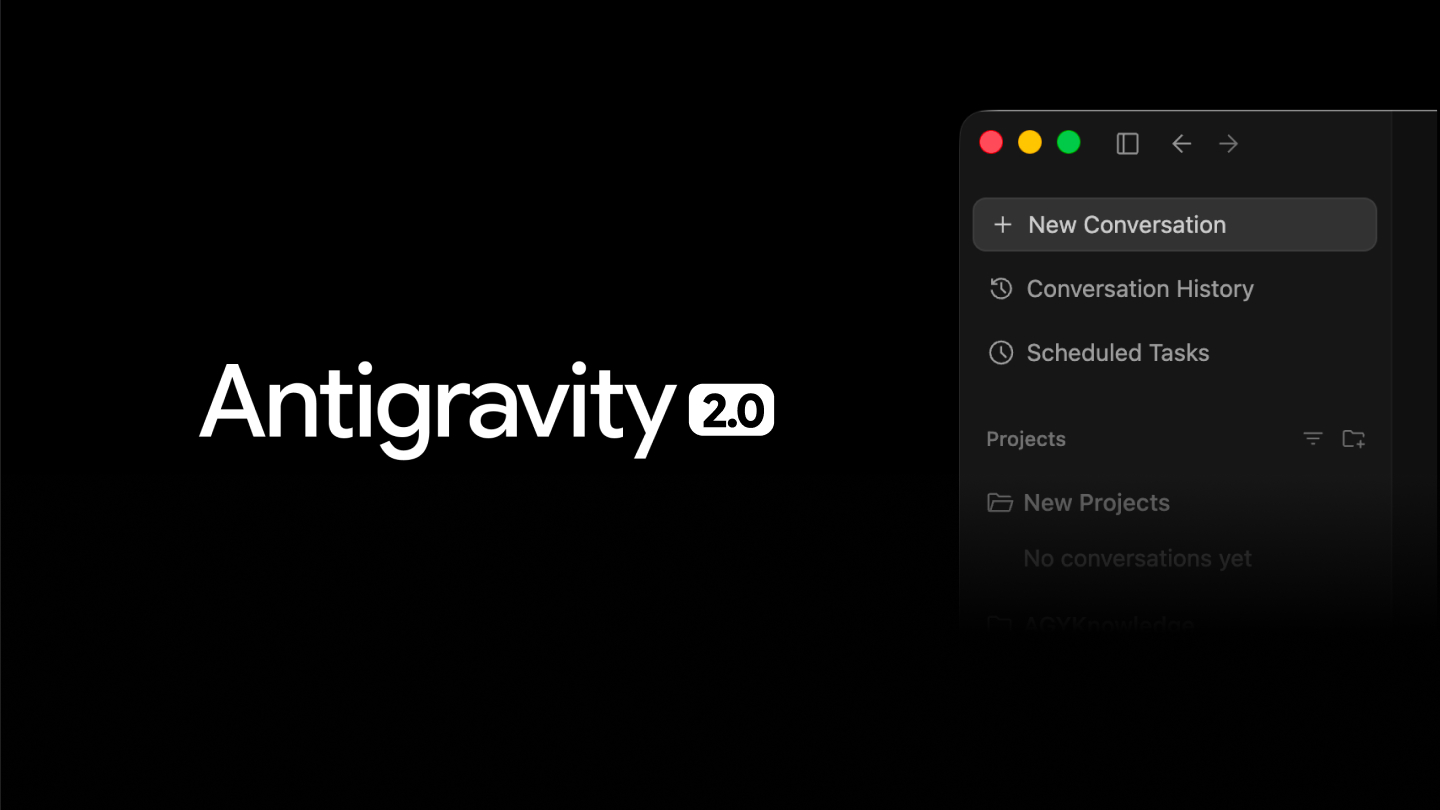 Google Antigravity 2.0 (source: Google).
The fourth is ADK 2.0, a code-first framework for software engineers building custom agent meshes and multi-agent systems.
Google said the four approaches are additive, meaning agents built at one level can be used as part of more complex systems at another level. Underneath the four rungs is the Agent-to-Agent (A2A) protocol, which Google said allows an agent built on the first rung to be called as a subagent on the fourth rung.
For enterprise teams, that is the main I/O architecture message. Google is not only offering separate AI tools; it is describing a range of build options tied back to the same Agent Platform runtime, governance and interoperability model.
That platform-centric shift was also the focus of an Application Development Trends analysis by John K. Waters, which framed Google's I/O AI strategy as an architecture story built around models, agents, development tools and deployment infrastructure.
Managed Agents API Targets Hosted Agent Execution
The most infrastructure-focused addition is Managed Agents in the Gemini API. Google said the capability lets developers spin up an agent with a single API call, using an isolated, ephemeral Linux environment where the agent can reason, plan, call tools, execute code, manage files and browse the web.
Google said Managed Agents are powered by the Antigravity agent and built on Gemini 3.5 Flash. The company also said developers can define custom agents through versionable markdown files such as AGENTS.md and SKILL.md, rather than building complex orchestration layers from scratch.
That same post adds the enterprise deployment detail: each managed agent gets its own ephemeral sandbox provisioned with skills, Model Context Protocol (MCP) servers and server-side tools. Google said full integration with A2A and Agent Platform governance and security is coming soon.
The enterprise value proposition is operational abstraction. Rather than asking every team to build and secure its own agent runtime, Google is offering hosted execution, sandboxing, state handling and tool access through the Gemini API and Agent Platform.
ADK 2.0 Covers the Code-First End
ADK 2.0 occupies the other end of Google's agent-development ladder. Google described it as "code-first" and aimed at software engineers who want to build custom agent meshes with more control over architecture, model selection and workflow design.
Google said ADK 2.0 includes a unified graph-based engine that supports both dynamic, model-led reasoning and deterministic workflows. It also adds collaborative workflows, dynamic workflows and Kotlin support in beta.
The collaborative workflow model supports multiple modes for subagent coordination. Google described chat mode as a full user-interaction handoff to subagents, task mode as a collaboration model with user interaction for clarification and automatic return to the parent, and single-turn mode as parallel execution with no user interaction.
The Kotlin support is also notable for Android and mobile-agent scenarios. Google described it as "ADK for Android," joining Python, Go and Java support so on-device mobile agents can coordinate with backend agents.
Antigravity Remains the Coding Surface
Antigravity remains Google's primary agentic coding and orchestration surface, while Antigravity CLI brings the same harness into the terminal.
At I/O, Google described Antigravity 2.0 as a standalone desktop application for steering, customizing and orchestrating coding agents. Google said it can help with tasks such as refactoring code, generating unit tests and scaffolding service components from a specification.
That same Google Cloud post for agent developers also adds the enterprise deployment path. Google said Cloud customers can use Antigravity 2.0 and Antigravity CLI with their Gemini Enterprise Agent Platform projects by logging in with Cloud OAuth and setting their Agent Platform project ID and region. Google said that routes agent inference through Agent Platform models within the customer's cloud boundary and inherits Google Cloud data privacy protections and terms.
Google also said its platform is designed to work with other coding agents. The company cited Agent CLI and ADK as ways to build and interact with agents from various sources, including Claude Code, while running underlying AI inference on Google Cloud.
Gemini 3.5 Flash Supplies the Model Layer
The new agent tooling is tied to Google's latest model work. In its I/O material, Google said Gemini 3.5 Flash is the first model in the Gemini 3.5 family and is designed around "frontier intelligence with action."
Google positioned the model for coding, agentic workflows and long-horizon tasks. It said Gemini 3.5 Flash is available to developers in Antigravity, the Gemini API in Google AI Studio and Android Studio, and to enterprises through Gemini Enterprise Agent Platform and Gemini Enterprise.
That matters because Google is not presenting Agent Platform only as a control plane. It is also using I/O to connect the platform to a new model layer, hosted agent execution and local development tools.
Gemini Spark Adds a Workplace-Agent Angle
Google also used I/O to introduce Gemini Spark, described in the Gemini app context as a 24/7 personal AI agent that can proactively manage tasks under the user's direction.
In its Google Cloud I/O roundup, Google said Gemini Spark in Gemini Enterprise can work in the background across Workspace, custom connectors and the open web. It can also use Gemini Enterprise connectors including Microsoft SharePoint, OneDrive and ServiceNow.
Google described Spark as running in a fully managed secure runtime on Google Cloud, with each task executing in a fresh, isolated, ephemeral virtual machine. The company said traffic routes through Agent Gateway to enforce Data Loss Prevention policies, and that Spark requires explicit approval for high-risk actions such as sending emails.
The examples are enterprise workflow examples rather than consumer assistant examples. Google said Spark could monitor ServiceNow, check for recurring critical issues, create an escalated Jira ticket, draft an incident report in Docs and message an IT manager in Chat for approval.
Skills, Evaluation and Security Fill in Governance
Google's I/O developer post also points to governance and reuse features that are relevant to enterprise IT teams evaluating agent deployments. Google said Skill Registry, now in public preview, provides a centralized catalog for governing and reusing packaged domain logic.
Google said skills are accessible through Managed Agents API, Agent Platform SDK and ADK through SkillToolset, and that Skill Registry will become part of Agent Registry. The company also pointed to Agent Platform's evaluation suite, including synthetic user simulation, mock API environments, LLM-based autoraters and trace logging.
Security and provenance were also part of the I/O follow-up. Google said CodeMender, an AI code security agent originally developed by Google DeepMind, is being integrated into Agent Platform. Google said CodeMender can identify vulnerabilities, recommend fixes, test them and apply patches with developer approval.
Google also announced an AI Content Detection API on Gemini Enterprise Agent Platform. Google said the API is designed to help organizations identify AI-generated content from Google and other models for use cases such as feed sorting, insurance fraud prevention, fact-checking and synthetic-media labeling.
AI Studio, Chrome and Workspace Become Entry Points
Google AI Studio is also being pulled into the same development flow. In an I/O AI Studio post, Google said developers can export projects directly from AI Studio to Antigravity, bringing conversation history, project files and secrets into the local development environment.
Google also announced native Android support in AI Studio, an AI Studio mobile app and Google Play Console integration for publishing Android apps directly to a test track. Those updates position AI Studio as an entry point for prototyping that can hand off to Antigravity and Google Cloud deployment.
Chrome and Workspace are becoming agent surfaces as well. In a Chrome developer post, Google said Chrome DevTools for agents gives coding agents access to console logs, network traffic and accessibility trees so they can verify and automate fixes. In Workspace, Google announced voice capabilities in Gmail, Docs and Keep, along with Gemini Spark integration with Workspace apps.
For IT organizations, those endpoints matter because they expand where agents interact with business data: the browser, development tools, email, documents, chat, local codebases, SaaS connectors and managed cloud runtimes.
About the Author
David Ramel is an editor and writer at Converge 360.