News
Cloud Giants Back 'Agent Plugins' for Cross-Client AI
Google is joining the core maintainer group behind Agent Plugins, an open specification intended to let developers package AI-agent skills and Model Context Protocol servers once and use them across compatible clients. The move puts Google alongside fellow hyperscalers Amazon and Microsoft in the project's technical governance.
Google announced its participation Aug. 6, saying Kevin Hou, a senior staff engineer at Google DeepMind, will represent the company as a core maintainer. The Google Developers Blog announcement said Agent Plugins 1.0.0 was published by a technical steering committee with representatives from Amazon, Cursor, Microsoft, OpenAI and Vercel. "The core problem isn't the components. It's the manifest," Google wrote, describing the client-specific packaging differences that the specification is designed to address.
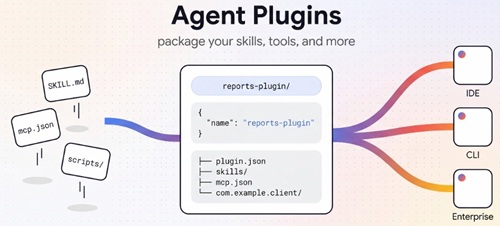 [Click on image for larger view.] Agent Plugins (source: Google).
The result is a vendor-neutral package format rather than another agent runtime. The 1.0.0 specification was published July 24, while Google's Aug. 6 announcement marked its addition to the maintainer group and a broader public rollout of the standard. Agent Plugins standardizes where reusable instructions and MCP server configurations are placed inside a plugin directory. It does not replace the Agent Skills or MCP specifications, which continue to define their respective component formats and runtime behavior.
How the Package Works
An Agent Plugin is a self-contained directory with a required plugin.json manifest at its root. Under the Agent Plugins 1.0.0 specification, the directory can also contain Agent Skills under skills/, MCP server configuration in mcp.json and client-specific files in directories identified by reverse-domain namespaces, such as com.example.client/.
The minimum manifest contains a canonical schema identifier and a plugin name. Optional fields can provide a version, description, author, homepage, repository, license and keywords. The schema is closed, meaning portable top-level fields are limited to those defined by the specification. Client-specific manifest data belongs under an extensions object rather than being added as new portable fields.
The fixed layout is intended to remove the need for clients to infer where components are stored or translate differently shaped manifests. Skills remain in their existing SKILL.md-based format. MCP servers are declared separately in mcp.json, with explicit transport types for standard input and output, Streamable HTTP or the older HTTP plus Server-Sent Events transport.
The specification also defines failure boundaries. A missing optional component location is not an error. If an individual skill is invalid, a client is expected to skip that skill while continuing to load other components. An MCP server that cannot start, connect or authenticate likewise should not prevent the remaining skills or servers from loading.
Which Clients Support It
The project's compatible-clients directory currently lists Visual Studio Code, Cursor, GitHub Copilot, ChatGPT and Codex, and Kiro. Every listed client documents support for Agent Skills. The listed MCP transports vary, although all five entries report support for standard input and output and Streamable HTTP.
Clients can implement the format incrementally. A client that supports skills does not have to implement MCP servers, while an MCP-capable client must support at least one of the two current transports: standard input and output or Streamable HTTP. Support for the legacy HTTP plus Server-Sent Events transport is optional.
Microsoft has also documented the format at the product level. VS Code has supported its own agent-plugin packages since earlier in 2026, but Microsoft updated the page Aug. 6 to describe the open Agent Plugins 1.0 standard and its cross-client format. The revised VS Code agent-plugin documentation says the editor detects a standard package when its root manifest declares the specification's canonical schema. VS Code discovers skills from the fixed skills/ directory and MCP configuration from mcp.json. It continues to recognize existing Copilot, Claude and legacy OpenPlugin package formats separately.
Google said two of its products support the format as of the announcement. Its Agents CLI packages skills for building, evaluating, deploying and operating agents, while the Data Agent Kit provides plugins and MCP integrations for Google Cloud data products including BigQuery, Spanner and Cloud SQL. A schedule for adding support to other Google products was not documented.
Amazon had already been developing plugin-based packages for coding agents before publication of the 1.0.0 specification. In February, AWS introduced an open source Agent Plugins for AWS repository with an initial deployment plugin for Claude Code and Cursor. That package combined skills, MCP servers, hooks and reference material to generate architecture recommendations, cost estimates and infrastructure-as-code for AWS deployments.
About the Author
David Ramel is an editor and writer at Converge 360.