News
Identity, AI Lead CSA's 2026 Cloud Threat List
Identity and access management has overtaken misconfiguration as the top cloud security concern in the Cloud Security Alliance's 2026 ranking, while two artificial intelligence-related issues entered the list for the first time. The CSA Top Threats Working Group surveyed 507 security professionals and used their responses to rank 23 cloud security issues, producing a Top 11 led by identity, AI, third-party resources and APIs.
The findings are detailed in CSA's Top Threats to Cloud Computing Survey Report 2026. The report is the latest installment in the organization's Top Threats research series, which is intended to give organizations an up-to-date, expert-informed view of cloud security risks, threats and vulnerabilities so they can make risk-management decisions about cloud adoption strategies.
CSA says the 2026 results show a change in the cloud threat landscape, with identity, AI, software supply chains and interconnected cloud ecosystems displacing concerns more closely tied to underlying infrastructure and cloud service providers. Denial-of-service attacks, shared technology vulnerabilities, cloud service provider data loss, unauthenticated resource sharing and limited cloud visibility or observability all ranked below the Top 11 this year.
The report is intended to support security program planning, risk prioritization and governance investment decisions across cloud and AI environments. Its target audience includes compliance, risk, technology and information security personnel as well as executive management, and the individual threat analyses cover technical and business impacts, key takeaways, real-world examples and corresponding CSA security controls.
Threats Evolve Since 2024
A comparison between the 2024 and 2026 rankings illustrates how the priorities changed between survey cycles. Identity and access management moved from No. 2 to No. 1, while 2024's top-ranked issue, misconfiguration and inadequate change control, moved to No. 5. Insecure third-party resources rose from No. 5 to No. 3, Advanced Persistent Threats moved from No. 11 to No. 7, and two AI categories appeared in the rankings for the first time.
CSA cautions that the rows in its 2024-versus-2026 chart are not intended as direct one-to-one mappings between issues. Each column represents the relative position of the security issues in that survey year, providing a view of changing priorities rather than a direct comparison of the entries occupying the same row.
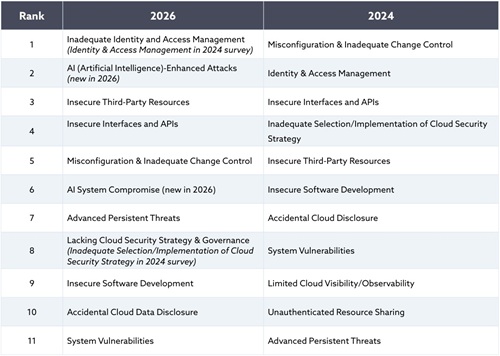 [Click on image for larger view.] Top Threats Change (source: CSA).
The Top 11 Cloud Security Threats
The survey scores were tightly grouped, ranging from 7.95 for the top-ranked issue to 7.45 for No. 11. CSA's ranking and its descriptions of the issues follow.
- 1. Inadequate Identity and Access Management -- 7.95. CSA says IAM risk includes misconfigured trust relationships, weak or exposed credentials, excessive permissions and a growing population of non-human identities such as service accounts, API keys, automated bots and AI agents. Attackers increasingly target active session tokens, overprivileged automation and misconfigured authentication flows, making lifecycle management, least privilege, credential rotation and continuous authorization important parts of identity governance.
- 2. AI-Enhanced Attacks -- 7.91. New to the 2026 ranking, this category covers the use of AI to improve or automate attacks, including phishing, reconnaissance, malware development, social engineering, vulnerability discovery and attack automation. CSA says AI can lower the barrier to sophisticated offensive capabilities while accelerating activities such as scanning, exploit development and lateral movement, creating attack cycles that move faster than traditional remediation processes.
- 3. Insecure Third-Party Resources -- 7.85. CSA uses "third-party resources" broadly to include SaaS dependencies, software packages, managed APIs, CI/CD pipelines, container images, AI models and AI-generated components. A compromised vendor, transitive dependency, build step or maintainer account can affect multiple downstream organizations, which is why the report calls for inventories, provenance checks, software supply chain risk management and continuing review of external dependencies.
- 4. Insecure Interfaces and APIs -- 7.83. Cloud providers, enterprise vendors and internal developers use APIs and user interfaces as primary control planes for cloud services, and the expansion of cloud-native architectures, microservices and integrations has increased both their number and complexity. CSA identifies broken authentication, excessive permissions, poorly governed API keys and tokens, shadow APIs and insufficient monitoring as recurring risks, while AI agents and Model Context Protocol integrations can extend those weaknesses into automated workflows.
- 5. Misconfiguration and Inadequate Change Control -- 7.77. Misconfiguration fell from first place in 2024 but remained in the Top 5, with CSA pointing to excessive permissions, exposed storage, publicly accessible endpoints, exposed credentials and inadequate logging as common problems. The issue now extends beyond traditional cloud infrastructure into model-hosting environments, inference APIs, vector databases, RAG pipelines, MCP servers, AI services and agent permissions, increasing the range of systems affected by configuration drift and unreviewed changes.
- 6. AI System Compromise -- 7.71. The second new AI category focuses on AI systems themselves as targets rather than AI being used to enhance an attack. CSA defines the issue as the exploitation, manipulation, degradation or unauthorized control of systems containing AI or machine-learning components, including models, prompts, training and inference data, connected tools, orchestration logic and decision pipelines. Attack vectors identified in the report include prompt injection, data or model poisoning, adversarial inputs, model theft and compromise of connected APIs, plugins or pipelines.
- 7. Advanced Persistent Threats -- 7.66. CSA describes APTs as coordinated, resource-intensive operations conducted by highly capable adversaries, commonly state-sponsored groups or actors aligned with national strategic objectives. In cloud environments, those campaigns can target privileged accounts, service principals, managed identities, federation relationships, OAuth tokens and CI/CD connections to establish durable access, while credential theft and identity abuse can help attackers maintain a low-visibility presence over extended periods.
- 8. Lacking Cloud Security Strategy and Governance -- 7.64. CSA characterizes inadequate strategy as an inability to state confidently which cloud technologies are being used, where sensitive data resides and whether a threat can be detected and stopped before causing harm. When adoption outpaces governance, organizations can accumulate ungoverned identities, undocumented data flows, unsanctioned AI tools and unreviewed third-party integrations without sufficient visibility or accountability.
- 9. Insecure Software Development -- 7.56. CSA associates insecure software development with weak coding practices and overprivileged automation identities that can expose credentials and give attackers access to cloud control planes. The report identifies CI/CD tooling and hard-coded secrets as areas requiring attention, with hardening of development pipelines and elimination of embedded credentials among the defenses it highlights.
- 10. Accidental Cloud Data Disclosure -- 7.48. The ranking table calls this issue Accidental Cloud Data Disclosure, while the detailed report section uses the title Accidental Cloud Data Exposure. CSA associates the problem with misconfiguration and unauthorized Shadow AI use, describing cloud data exposure as a risk that can emerge when convenience takes precedence over access restrictions and other security controls.
- 11. System Vulnerabilities -- 7.45. CSA says vulnerabilities in cloud infrastructure can compromise data and disrupt operations, with common causes including misconfiguration, zero-day vulnerabilities and weak credentials. The report identifies patching and monitoring as essential defenses for reducing exposure to system weaknesses.
AI Appears on Both Sides of the Threat Model
The two new AI entries address different types of risk. AI-Enhanced Attacks focuses on adversaries using AI to improve or automate offensive activity, while AI System Compromise addresses AI systems as assets that attackers can manipulate, misuse or compromise. CSA's broader discussion also identifies autonomous agents, multi-agent systems and MCP-based integrations as sources of attack surface that existing cloud security programs may not have been designed to address.
The report also ties the identity issue to the growth of non-human identities. Service accounts, API keys, bots and AI agents can accumulate broad privileges and often do not follow the standardized provisioning, review and retirement processes applied to human users. CSA says organizations should extend identity governance to cover those machine identities and agent lifecycles, including access reviews, credential rotation, least-privilege enforcement and retirement of unused identities.
Third-party dependencies and APIs similarly reflect the increasingly interconnected nature of cloud environments. The report treats SaaS services, managed APIs, software packages, CI/CD systems and AI components as part of the supply chain, while API risk is increasingly intertwined with machine identities and automated agents. Together with the governance findings, those rankings form the report's central shift away from a threat model dominated by the underlying cloud platform toward one centered on the identities, dependencies, interfaces and automated systems operating on top of it.
How CSA Ranked the Threats
CSA's Top Threats Working Group conducted the research in two stages. In the first stage, the group started with the 11 threats from its 2024 report, added 12 new issues through discussion and reviewed the resulting 23 issues before presenting them in the survey. Working group members considered the importance of each issue to their own organizations and other organizations with which they were familiar.
In the second stage, 507 security professionals rated those 23 issues on a 10-point sliding scale. Participants were instructed to give each issue a score from 1, meaning "Not very important," to 10, meaning "Most important." CSA totaled and averaged the scores, ranked the issues according to their mean scores and used the results to establish the Top 11.
About the Author
David Ramel is an editor and writer at Converge 360.