The imminent release of vSphere 5 was anything but a secret by the time VMware got around to formally announcing it this week, so it came as no surprise that Citrix, Microsoft and others also tried to steal some thunder by making news of their own.
Citrix got the ball rolling by unveiling the completion of its Cloud.com acquisition, which seemed to be a case of the company doubling down on open source cloud platforms -- CloudStack came along with Cloud.com, and Citrix recently joined Rackspace's OpenStack project.
More
Posted by Bruce Hoard on 07/14/20112 comments
By completing its acquisition of Cloud.com and its CloudStack platform, Citrix has re-emphasized its commitment to open source computing that has been demonstrated by its support of the OpenStack cloud infrastructure developed by Rackspace. Citrix also made it clear that it wants to build on CloudStack technology to offer large-scale clouds such as those built by Cloud.com for companies like Zynga and GoDaddy.com. Terms of the deal were not disclosed.
More
Posted by Bruce Hoard on 07/12/20115 comments
In the course of a recent interview, I have come across some interesting information related to the job status of VMware CEO Paul Maritz. This information came to me during an interview with Raghu Raghuram, VP and GM of VMware's Virtualization and Cloud Platform Group, who told me, "Just to clarify, there's been no real change in Paul's day-to-day responsibilities. The co-presidents are just recognition of the work Paul delegates to that set of four gentlemen, and therefore, the responsibilities that they have for their respective, day-to-day jobs. But it's more a recognition of the level of responsibility that those gentlemen are doing than any change in Paul's responsibility."
More
Posted by Bruce Hoard on 07/07/20115 comments
It wasn't all that long ago that XenServer was on the ropes and headed for what many observers figured to be a career-ending knockout at the hands of VMware, but Citrix made a smart move by converting its beleaguered server virtualization product into a fundamental component of XenDesktop and XenApp, the latter of which is a mega cash cow to the tune of $1.5 billion-plus. Just for good measure, the company further enhanced the free XenServer by making it the foundation for the strategic direction of NetScaler, the company's app-delivery platform for Web apps and clouds.
More
Posted by Bruce Hoard on 07/05/20111 comments
A bunch of credible people recently got together and initiated a cloud computing survey that was sent out to 413 vendors and users, who reported their attitudes on the maturity of cloud computing, along with their perceived barriers/benefits to implementation. The primary survey backer was North Bridge Partners, but GigaOM and The 451 Group were also primary players. The effort was further enhanced by some 30 industry collaborators.
More
Posted by Bruce Hoard on 06/30/20112 comments
It's very simple for vendors to commission surveys that demonstrate the needs for their products and services. Sometimes these self-serving surveys provide interesting information; sometimes they are so biased that they lose all credibility.
A recent survey conducted for automation software vendor UC4 among British IT decision-makers is different because it basically says that if IT shops don't automate their operations, they will not be able to initiate cloud projects.
The UC4 press release cites the burdens faced by admins, the abundance of siloed systems and the general malaise faced by IT organizations as they struggle to keep their heads above water. It also notes that 38 percent of respondents view automation and orchestration as key components of their cloud strategy.
In my opinion, this whole tack of blaming legacy infrastructures for the alleged inability of companies to initiate cloud projects smacks more of scare tactics than it does of benign benevolence. I'm not bad-mouthing the value of automation here -- its true value is widely understood and understandably valued by IT organizations that want to add business value by streamlining their operations.
Having said that, I am curious to know what percentage of companies that are implementing or have implemented cloud projects were only able to do so after significantly automating their operations.
I've been paying attention to this stuff for a while now, and I have yet to hear a great chorus chanting about how only God-given automation has been able to open the cloud doors that had been so securely locked in the past.
Actually, isn't one of cloud's key benefits its ability to enhance system performance by offloading a lot of the burdens associated with non-automated environments? Isn't it possible to kick off a cloud project and let it increasingly make life easier?
Automation: Yes. Automation as the only key to cloud: No.
Posted by Bruce Hoard on 06/28/20111 comments
Clogged-up I/O plumbing can be particularly nettlesome in high-performance virtualization environments, and IO Turbine has taken heed by announcing software using SSD/Flash that runs on the compute server and specifically targets I/O bottlenecks in VMware environments. Accelio works by transparently selecting the highest priority data and shifting IOPS from primary to Flash, where it delivers performance straight to designated VMs.
More
Posted by Bruce Hoard on 06/23/20111 comments
Embotics V-Commander 4.0 Cloud Edition is like comfort food for mid-size and large enterprise data centers. Its tasty treats include a set of easy-to-use management, provisioning and policy-driven automation features that enable users to break through capacity management and performance barriers that have previously stifled private cloud projects.
In addition to rapid provisioning--in some cases, reducing IT asset deployment times from days to hours--V-Commander 4.0 offers self-service, service catalogs, IT costing and chargeback, workflow automation, resource optimization, and lifecycle management capabilities. Looking for a quick ROI? The company said you can have one in "hours" through the reclamation and decommissioning of unused and underused VMs.
More
Posted by Bruce Hoard on 06/20/20110 comments
The Microsoft Desktop Optimization Pack (MDOP) doesn't get a lot of high-level attention, but this primarily client-side management suite is producing some impressive cost and productivity numbers for its ever-growing worldwide user base, which is driven by some 26 million licenses. In an IDC study conducted in February the product, consisting of six separate technologies, was found to produce annual IT savings of up to $252 per year--or a 36 percent reduction in annual cost--for a PC utilizing all six solutions.
More
Posted by Bruce Hoard on 06/16/20110 comments
In preparation for my cover piece in the upcoming June-July issue on Microsoft's virtualization strategies with Hyper-V and System Center, we ran an admittedly non-scientific reader survey to find out what Microsoft customers thought about these two technologies, which have reached a point of maturity where they are becoming legitimate contenders with VMware's vSphere Hypervisor (which is free, and based on ESXi) and vCenter.
More
Posted by Bruce Hoard on 06/14/201111 comments
Microsoft announced today that Windows Thin PC will be generally available for download on July 1. Noting that it has responded to customer demand for the ability to repurpose their existing PCs as thin clients--significantly extending their lifecycles--Microsoft says WinTPC, which is built on Windows 7 and features RemoteFX, will also bolster the company's overall desktop virtualization strategy. The goal of that strategy is "to deliver the flexibility to work from anywhere, improve compliance and business continuity, and simplify management so that IT professionals can deliver better service to employees." Just to make it perfectly clear, another goal is to also drive down the sometimes prohibitive costs of VDI.
More
Posted by Bruce Hoard on 06/07/20112 comments
Back in the not-too-distant past, before virtualization and cloud computing radically evolved into disruptive--if not revolutionary--forces, changes in the world of IT were largely limited to doing more with less, as opposed to totally rethinking and reshaping the traditional technologies that comprised the backbone of corporate computing. Back then, each major organizational entity had its own data in its own silos, and its own team of expert to protect and propagate that data. The more, the merrier.
More
Posted by Bruce Hoard on 06/02/20110 comments
David Davis, The How-To Guy in both the print and online version of Virtualization Review, has a new video course on vSphere Performance, available through TrainSignal.com.
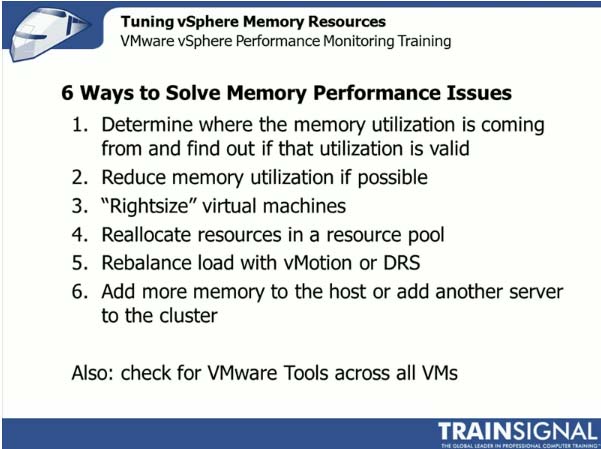 |
Figure 1. Sample screen grab from the vSphere Performance course demo. (Click image to view larger version.) |
More
Posted by Bruce Hoard on 06/01/20116 comments
In my "
Synergy on My Mind
" blog, I mentioned that WhipTail had recently received $60,000 in funding, which created the impression that they were at the bottom end of the food chain. Actually, the $60,000 was spent on their new Web site. The problem was, the $60K was represented to me as a single block of funding, so I wrote about it accordingly. The fact of the matter is that WhipTail has to date received "multi-seven-figure" funding, and is doing just fine at the venture trough, thanks.
Posted by Bruce Hoard on 05/31/20112 comments
The talk on the Synergy exhibition floor was largely about the various aspects of VDI--most prominently management and storage--while a host of VDI ecosystem players such as AppSense, RingCube, Kaviza/Citrix, and Wanova, Liquidware Labs, and Atlantis Computing, among others had booths. I also had a briefing with Desktone CEO Peter McKay, and noticed Unidesk boss Don Bulens patrolling the floor. All in all, lots of great fodder for M&A rumors, not many of which seemed to be in circulation. What it all amounted to was a lot of companies with a lot of good technologies--some of which have a lot of customers, and some of which are more heavy on unfulfilled potential.
More
Posted by Bruce Hoard on 05/27/20112 comments