
Long AI projects can suffer from context pollution as generated material accumulates alongside authoritative instructions, making fresh sessions and an external source of truth essential for consistent results.

VMware Explore 2026 announcements show Broadcom expanding VMware Cloud Foundation into an AI-native private cloud spanning infrastructure, operations, security, agents and data.

Tom Fenton previews KubeCon + CloudNativeCon North America 2026, where AI infrastructure, platform engineering, security and the cloud-native community will take center stage in Salt Lake City.

Tom Fenton previews a VMware Explore 2026 agenda spanning community resources, Raspberry Pi edge workloads, private AI, Kubernetes, memory tiering, CPU scheduling and storage.

VMware Explore 2026 will combine technical education on private cloud and private AI with hands-on learning, community networking and opportunities to reconnect with peers
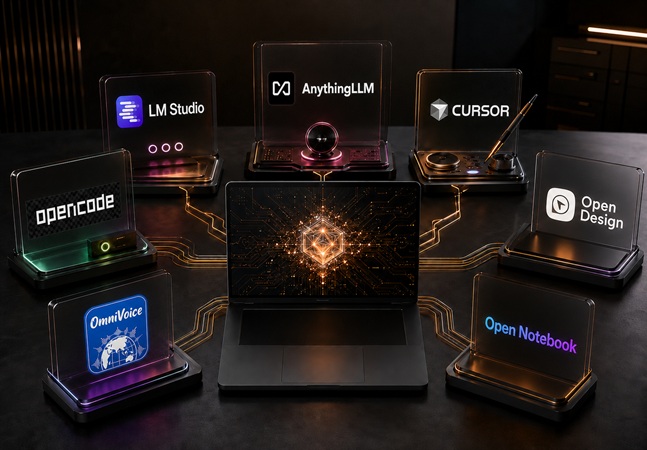
Tom Fenton tackles seven free and open-source AI tools bring local chat, coding, voice, design and research capabilities to personal computers and self-hosted environments.

AI is accelerating attackers' ability to change infrastructure, tools and techniques, making durable behavior-based detection and broader visibility increasingly important to cybersecurity defense.
- By Paul Schnackenburg
- 07/30/2026

Organizations using AI to compensate for limited IT staffing must treat the technology as a critical operational dependency, cloud and data infrastructure analyst Greg Schulz warned.
Tom Fenton examines how vSphere 9 Memory Tiering combines DRAM with enterprise NVMe storage to help organizations offset soaring memory costs, increase VM density and reduce server spending.

Tom Fenton tests whether upgrading a Lenovo ThinkPad P16 Gen 3 from 16 GB to 32 GB of RAM improves everyday office, benchmark and local AI performance.

Tom Fenton reviews the Lenovo ThinkPad P16 Gen 3 21RRZD7UUS as an everyday AI workstation, comparing its RTX PRO 3000 Blackwell GPU, memory, display and build against two other recent ThinkPads.

Speculative decoding can help AI chatbots improve throughput and reduce hardware demand by using a smaller model to draft tokens that a larger model validates.

Microsoft's Global Secure Access has matured into a Zscaler/Netskope competitor, with a new open-source Migrate2GSA tool to ease migrations and expanded AI governance capabilities for enterprise traffic.
- By Paul Schnackenburg
- 07/01/2026

Cybersecurity consultant Sergey Chubarov used a session on defending against intelligent threats to outline how AI is changing attack speed, scale and believability, with the most actionable guidance focused on deepfakes, prompt injection, AI-agent risk, identity controls and AI-assisted security operations.

Tom Fenton benchmarks the Lenovo ThinkPad T1g Gen 8 across SPECworkstation 4, Geekbench AI and Ollama tests to assess its performance for office workloads, local AI and large language models.

Lenovo's ThinkPad T1g Gen 8 brings workstation-style graphics, AI acceleration and classic ThinkPad durability to a business laptop built for demanding mobile professionals.

Effective AI results will increasingly depend less on crafting ever-more-detailed prompts and more on giving systems the relevant, current, and well-structured context they need to understand intent.

Cloud providers are investing heavily in AI infrastructure while adding tools such as prompt caching, model routing, provisioned capacity and service tiers to help enterprise customers control AI costs.

Brien Posey explains how chaos engineering can help cloud teams practice failure before real incidents occur -- while warning that poorly scoped experiments can become outages themselves.
Aipex stands out as an AI-first endpoint monitoring and remediation platform that combines broad remote management coverage with practical, natural-language troubleshooting and automation.<